make preferable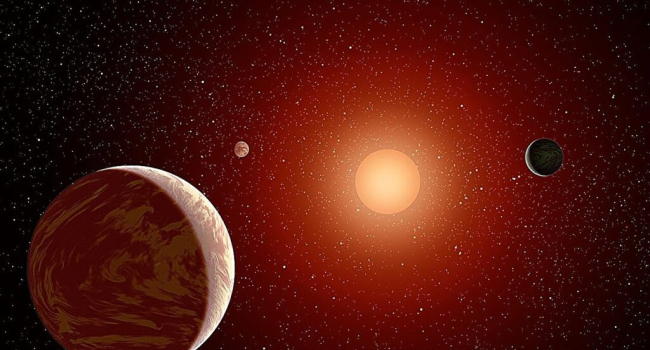
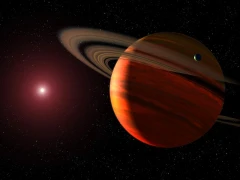
Red dwarfs (M-type stars) make up roughly 75% of all stars in the Milky Way, and Earth-like planets in their habitable zones are found most often around them. For a long time, these stars were considered prime candidates for hosting complex life: they live for trillions of years, and their habitable zones are very close in. New research from San Diego State University, published as a preprint on arXiv, casts serious doubt on this hope.
The main problem — light
A key factor in the evolution of complex life on Earth is photosynthesis, which led to the Great Oxidation Event about 2.3 billion years ago. The accumulation of oxygen in the atmosphere created conditions for multicellular life, including animals and plants. Earth-like photosynthesis requires light in the 400–700 nm range — the visible spectrum.
The Sun emits ample energy in this range. Red dwarfs do not. Most of their radiation is in the infrared, which is almost useless for Earth-type photosynthesis. Scientists modeled how much oxygen photosynthetic microorganisms could produce on planets around red dwarfs.
Using TRAPPIST-1e — one of the most studied Earth-like exoplanets — as an example, they found that, in the worst-case scenario, reaching Earth-level oxygen concentrations would take about 63 billion years — several times longer than the current age of the Universe (13.8 billion years). Even under optimistic assumptions (microbes adapted to infrared light or able to survive in near-darkness), evolving to a Cambrian-level biosphere would require over 10 billion years.
Conclusions and implications
The researchers conclude that planets around red dwarfs would never accumulate enough oxygen in their atmospheres to support complex animals and plants. Microbial life is still possible — it doesn’t require high oxygen levels — but complex multicellular forms, like those on Earth, are extremely unlikely.
Since red dwarfs dominate the galaxy, this finding significantly lowers the probability of widespread complex life in the Universe. It also refines search priorities: if the goal is to find planets capable of supporting complex biology, it makes sense to focus on solar-type stars that provide the necessary light and energy.
In brief
San Diego State University scientists show that Earth-like planets around red dwarfs are unlikely to develop complex life. The dominance of infrared light makes Earth-type photosynthesis almost impossible — oxygen accumulation to required levels would take tens of billions of years. This reduces the chances of widespread multicellular life in the Universe and shifts the search toward Sun-like stars. Microbial life around red dwarfs remains possible, but complex biology is extremely rare.