make preferable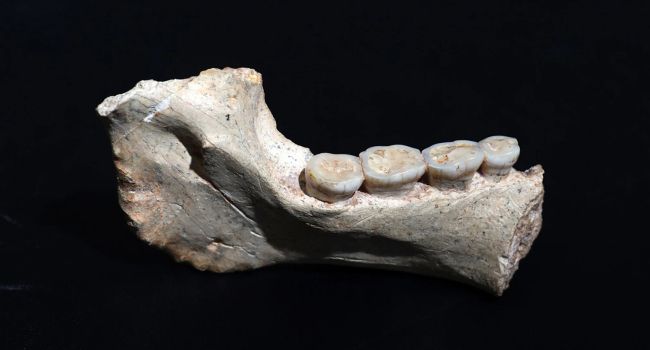
In Morocco, an international archaeological expedition has discovered fossilized skeletal fragments that scientists consider to be the most likely remains of a common ancestor of modern humans (Homo sapiens) and Neanderthals. The find was presented at the Ministry of Youth, Culture and Communication of the Kingdom, according to TASS.
What exactly was found
The remains were discovered in the Thomas I quarry near Casablanca on the Atlantic coast. The collection includes:
a fragment of an adult lower jaw;
a complete lower jaw of a child;
a fragment of a femur;
several teeth and vertebrae.
The estimated age of the fossils is between 700,000 and 773,000 years.
Significance of the discovery
One of the project leaders, Professor Abderrahim Mouhib of Morocco’s National Institute of Archaeology and Heritage, said that analysis using electromagnetic radiation revealed a combination of primitive Homo erectus traits with more advanced features closer to Homo sapiens.
According to Mouhib, the find represents “a crucial link in understanding the evolution of modern humans and the ‘sister line’ that led to the development of other human forms discovered in Europe.”
He emphasized that the remains correspond to the period when two major evolutionary branches diverged: the African line leading to Homo sapiens and the Eurasian line leading to Neanderthals and other human forms. For this reason, the fossils are considered the most likely candidates for the common ancestor of Homo sapiens and Neanderthals.
Context of human evolution
The discovery fits into a broader revision of the classic “Out of Africa” model. Anthropologists have increasingly questioned the idea that early Homo sapiens migrated exclusively via the eastern coast of the continent. Finds in Morocco, including earlier discoveries at Jebel Irhoud, point to North Africa as a possible center of early human evolution.
Why it matters
If the hypothesis is confirmed, it will fill a key gap in the human evolutionary chain and refine the timeline of the split between Homo sapiens and Neanderthals. Further genetic analyses, if any DNA has been preserved, could provide definitive evidence.
In brief
Fossils dated to 700,000–773,000 years ago with traits of Homo erectus and early Homo sapiens have been found in Morocco. Scientists, including Professor Abderrahim Mouhib, consider them remains of a probable common ancestor of modern humans and Neanderthals from the period when the African and Eurasian branches diverged. The discovery strengthens the role of North Africa in human evolution and could reshape part of paleoanthropological history.