make preferable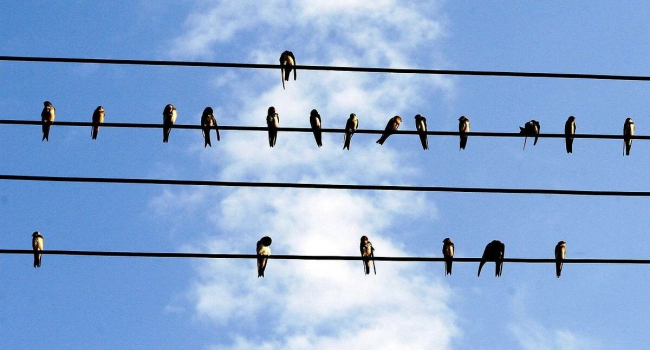
Birds often sit calmly on power lines carrying voltages of up to two hundred kilovolts, yet they tend to avoid lines with even higher voltage. Why does electricity not harm them, and what makes them steer clear of certain wires? This can be explained using basic physics in simple terms.
Why electricity does not shock birds
To understand why birds are not affected by electricity, it helps to recall a few fundamentals. Electric current is the movement of charged particles between points with different electric potential. Voltage is the difference in potential, for example between a live phase wire and the ground. For a bird to be electrocuted, it must become a conductor between two points with different potentials.
When a bird lands on a wire, it touches only a single phase conductor and takes on the same electric potential as that wire, effectively becoming part of it. The potential difference between the bird’s feet is extremely small. Power lines have very low electrical resistance, while a bird’s body has much higher resistance and very small dimensions. As a result, almost no current flows through the bird’s body, and it remains unharmed.
Dangerous situations do exist. Birds can be killed if they simultaneously touch a live wire and a grounded structure, such as a metal crossarm on a power pole. Large birds like storks are at risk if their wings bridge two wires with different potentials. In winter, animals or birds trying to warm themselves on transformers may also receive fatal electric shocks because high voltage and low voltage components are located close to each other.
Why birds avoid lines above two hundred kilovolts
Birds tend not to land on power lines with voltages above two hundred kilovolts, and this behavior is linked to their sensitivity to the environment.
High voltage lines create strong electromagnetic fields that birds can sense. These fields can cause discomfort, encouraging birds to avoid such areas.
Another factor is corona discharge. At very high voltages, the air around the wires becomes ionized, producing weak electrical discharges along the conductors. Birds instinctively detect this activity and choose safer places to perch.
This natural sensitivity helps birds stay away from potentially dangerous high voltage lines and protects them from harm.
In brief
Birds are not electrocuted on power lines up to two hundred kilovolts because they touch only one wire, so no significant current flows through their bodies due to the minimal potential difference. Danger arises when a bird connects a live wire to a grounded structure or to another wire with a different potential. Lines with voltages above two hundred kilovolts are avoided because birds sense strong electromagnetic fields and corona discharges. This phenomenon is fully explained by basic laws of physics combined with the natural instincts of birds.