make preferable
In the late 1970s, the legendary physicist John Wheeler posed a radical question about when the Universe “notices” that a quantum experiment is being performed and whether that moment matters at all. His idea, later implemented in real experiments, challenged familiar notions of time, observation, and the nature of reality itself.
Double slit: wave or particle?
As reported by Space.com, everything begins with the classic double-slit experiment. Light passing through two narrow slits behaves like a wave, interfering with itself and producing alternating bright and dark bands on a screen, similar to ripples on water. If the light is weakened so that photons pass one at a time, each photon hits the screen like a particle. However, after many photons are detected, an interference pattern still emerges.
If a detector is added that records which slit a photon passes through, the wave behavior disappears. The photon then behaves only as a particle, and the interference pattern vanishes. This forces a choice between observing wave-like or particle-like behavior, but not both at once.
Delayed choice: Wheeler’s experiment
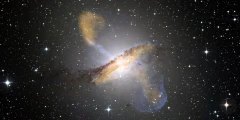
Wheeler proposed going further by considering what would happen if the detector were placed after the photon had already passed through the slits. In his analogy, light from a distant quasar travels for billions of years toward Earth, with part of the light arriving directly and part bending around a massive galaxy cluster acting as a gravitational lens. When the light finally reaches Earth, observers can choose either to let the paths interfere or to measure which path each photon took.
Wheeler predicted that even this delayed choice would matter. Experiments later confirmed that photons behave in accordance with a decision made after they passed the critical point in the setup. In effect, a choice made in the future is correlated with how the system appears to have behaved in the past.
Quantum eraser: even stranger
An even more paradoxical version is the delayed-choice quantum eraser experiment. In this setup, a photon passes through the slits and is detected on a screen, while the decision to preserve or erase information about its path is made afterward. If the path information is preserved, no interference pattern appears. If the information is erased and becomes fundamentally inaccessible, the interference pattern emerges.
The crucial point is that this choice is made after the photon has already been detected on the screen. Nevertheless, that decision determines whether its behavior can be described as wave-like or particle-like.
Rethinking reality
Wheeler argued that it makes no sense to speak of photons “in flight” in the classical sense. According to his view, physics deals only with measurements and final observational outcomes. The order of events in an experiment has no independent physical meaning. Photons do not travel in the way we intuitively imagine, and wave-particle duality is not an intrinsic property. Instead, it reflects how nature responds to the question posed by the act of measurement.
In brief
The delayed-choice quantum eraser experiment shows that a decision to observe or not observe a photon’s path, made after its detection, determines whether wave-like or particle-like behavior is observed. This forces a reassessment of time and causality, creating the impression that the system takes future choices into account. In Wheeler’s interpretation, reality is defined by measurement rather than by the underlying process. Quantum mechanics thus continues to challenge our intuitive understanding of how the world works.