make preferable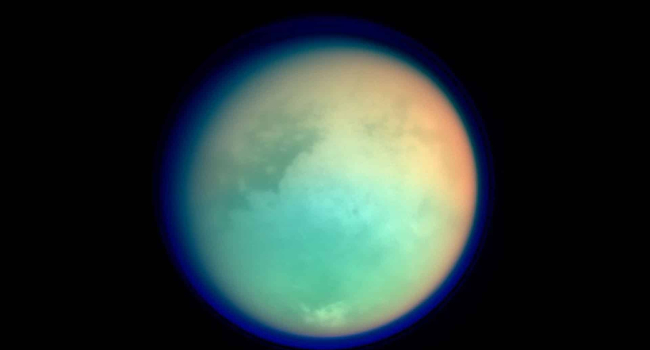
Titan, Saturn’s largest moon and one of the most mysterious worlds in the Solar System, may not be hiding a global ocean beneath its icy crust after all. A new study suggests that instead of a continuous subsurface sea, Titan likely contains a slushy layer of ice near its melting point, with scattered pockets of liquid water. This significantly changes how scientists assess Titan’s potential habitability.
Why Scientists Previously Thought There Was an Ocean
Titan is unique. It is the only moon with a dense atmosphere and the only body besides Earth known to have stable liquid on its surface, in the form of methane and ethane lakes. Data from the Cassini mission from 2004 to 2017 showed that Titan slightly flexes under Saturn’s gravity. This behavior was long interpreted as evidence of a global subsurface ocean beneath an icy shell.
The lead author of the study, Flavio Petracca of NASA’s Jet Propulsion Laboratory, said that Titan is one of the most interesting worlds in the Solar System.
New Analysis Changes the Picture
Petracca and his colleagues reanalyzed Cassini’s radio science data using improved methods that significantly reduced uncertainties. They found that Titan resists tidal deformation from Saturn much more strongly than previously believed. This is inconsistent with the presence of a global ocean. Instead, the data point to a layer of ice close to melting, but prevented from fully liquefying by high pressure. Within this layer are scattered pockets of liquid water.
The researchers noted that a global ocean may have existed earlier in Titan’s history, but later froze as heat from radioactive decay in the core declined. Petracca added that a new heating cycle may now be beginning.
What This Means for Life
A global ocean was considered ideal for potential life because it would provide a stable environment with liquid water. Isolated liquid pockets are less hospitable, but still scientifically intriguing. Petracca said that the team is not sure whether having scattered liquid pockets instead of a global ocean makes Titan more or less habitable, and that answering this question will be important.
NASA’s Dragonfly mission, set to launch in 2028 and arrive in 2034, will use a rotorcraft lander to explore Titan’s surface and subsurface, which should bring clearer answers.
The study was published on December 17, 2025, in Nature.
In Brief
A reanalysis of Cassini data suggests that Titan likely does not have a global subsurface ocean. Instead, it may host a slushy ice layer containing pockets of liquid water under high pressure. This reshapes estimates of Titan’s habitability, as such pockets are less stable than a global ocean. The Dragonfly mission, arriving in 2034, is expected to provide crucial new data. Titan remains one of the most promising places to search for life in the Solar System, but now with new questions to answer.