make preferable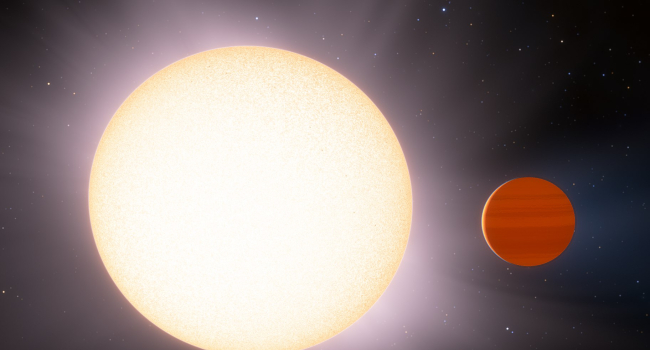
The James Webb Space Telescope enabled researchers from the University of Geneva and the Montreal Institute for Exoplanet Research to continuously track atmospheric escape from the ultra-hot Jupiter WASP-121b over its entire 30-hour orbit. The findings were unexpected: the planet is surrounded not by one, but by two enormous streams of helium stretching across more than half of its orbit. The study was published in Nature Communications.
Two Tails Instead of One
WASP-121b is a typical ultra-hot Jupiter: temperatures on its dayside exceed 3000 K, causing light gases to effectively “boil off” into space. Previously, astronomers detected such outflows only during transits, when the planet passed in front of its star. JWST has now revealed the full picture.
One stream trails behind the planet, pushed away by stellar wind. The second, unexpectedly, bends forward—likely drawn in by the star’s gravity. Together, they form a structure three orbital radii in length, spanning dozens of planetary radii.
Lead author Romain Allart said that the team was struck by how long the signal persisted, explaining indirectly that the data reveal the complexity of the processes shaping exoplanet atmospheres and their interactions with host stars, and that scientists are only beginning to grasp how diverse such worlds can be.
Why It Matters
Observations like this help researchers understand how ultra-hot Jupiters lose their atmospheres and may eventually transform into “chthonian planets”—exposed, super-heated cores. The dual-tail structure also suggests that stellar wind and the star’s gravity both play equally important roles in shaping these atmospheric streams, rather than radiation pressure alone, as was previously assumed.
In Short
JWST has, for the first time, revealed atmospheric escape across the entire orbit of WASP-121b: the planet is surrounded by two giant helium tails—one pushed back by stellar wind, the other drawn forward by the star’s gravity. The discovery reshapes current understanding of how ultra-hot Jupiters lose gas and evolve, marking another surprising breakthrough in exoplanet atmospheric physics in 2025.