make preferable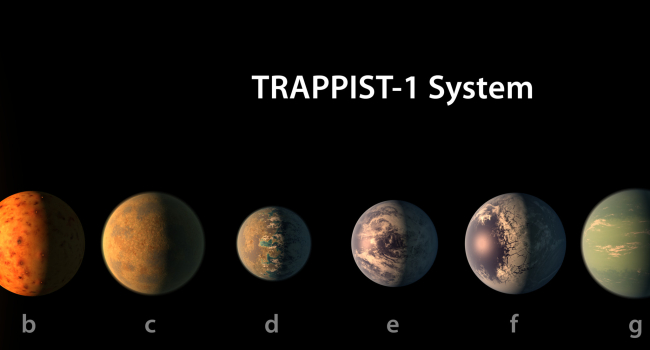
The ultracool red dwarf TRAPPIST-1, located 40 light-years away, is known for its volatility: it produces about six powerful flares per day. At first glance, this seems like a death sentence for the atmospheres of its seven Earth-sized planets. However, new data from the James Webb Space Telescope show that these flares not only destroy but also help reveal which planets may have retained an atmosphere — and possibly the conditions needed for life. The study was published on November 20, 2025, in The Astrophysical Journal Letters.
Why the Flares Became “Messages” from the Star
A team led by Ward Howard at the University of Colorado Boulder examined six TRAPPIST-1 flares recorded by JWST in 2022–2023. The telescope’s infrared sensors detected sharp bursts of heat, and computer models reconstructed the physics of each flare, from the energy of the electron beams to the emission spectrum.
The modeling showed that TRAPPIST-1’s electron beams are roughly ten times weaker than those of similar red dwarfs. This does not make the flares harmless — they still emit intense ultraviolet and X-ray radiation capable of eroding an atmosphere over millions of years. But the reduced beam strength allows more precise estimates of how much atmosphere each planet may have retained.
TRAPPIST-1e as the Leading Habitable Candidate
According to early results, the inner planets (b, c and possibly d) have likely lost most of their atmospheres and turned into bare rocky worlds. TRAPPIST-1e, the fourth planet and the one located in the middle of the habitable zone, may instead have preserved a thin, Earth-like atmosphere. Researchers now consider it the most promising candidate for liquid water and potentially life.
Flares as a Tool, Not Only a Threat
Rather than treating flares solely as destructive, astronomers are turning them into a diagnostic tool. Each flare becomes a kind of message from the star, revealing how much radiation reaches each planet and how long its atmosphere can resist erosion.
Summary
TRAPPIST-1’s flares turned out to be ten times weaker than expected, offering hope that TRAPPIST-1e has preserved its atmosphere and remains the system’s main habitable candidate. New JWST-based models allow the flares themselves to serve as indicators of planetary survival. The search for life around red dwarfs now has a powerful new tool.