make preferable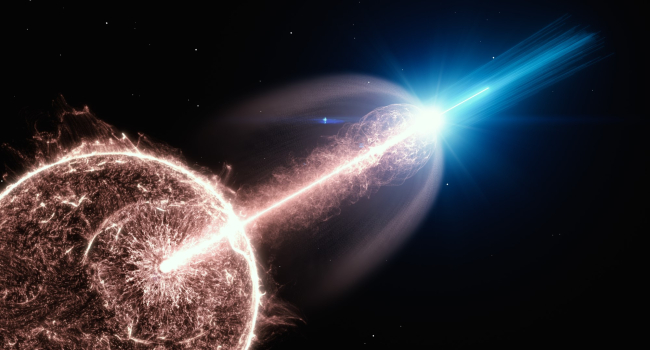
Astronomers from the University of North Carolina at Chapel Hill have announced the discovery of the longest gamma-ray burst ever observed. GRB 250702B lasted nearly seven hours. Since typical gamma-ray bursts last from a few seconds to a few minutes, this event has forced scientists to reconsider existing models of the most powerful cosmic catastrophes. The study was published in The Astrophysical Journal Letters.
Seven Hours of Light from a Dying Galaxy
Gamma-ray bursts are short, intense releases of energy comparable to the explosion of billions of supernovae. They usually originate from the collapse of massive stars or the merger of neutron stars or black holes. GRB 250702B began on July 2, 2025, and instead of ending within seconds or minutes, it continued emitting for almost seven hours.
After the burst was detected by space observatories such as Swift and Fermi, the team used major ground-based telescopes to locate the fading afterglow in a distant, heavily dust-obscured galaxy, which is where the explosion occurred.
Jonathan Carney, the lead author of the study, noted that the burst did not fit into any existing model. The team outlined several hypotheses under consideration:
• the collapse of an unusually massive star
• the merger of exotic compact objects
• the destruction of a star by an intermediate-mass black hole
The available data are still insufficient to determine which explanation is correct.
Why This Matters for Science
Such extremely long bursts offer a rare opportunity to study conditions where densities approach those of atomic nuclei and gravity dramatically distorts spacetime. Gamma-ray bursts also help disperse heavy elements across galaxies; without them, planets — and ultimately life — would not exist.
GRB 250702B has already been declared a new benchmark. All future ultra-long bursts will be compared to it to determine whether it is unique or represents an entirely new class of cosmic explosions.
Summary
On July 2, 2025, astronomers recorded GRB 250702B, a gamma-ray burst that lasted almost seven hours — dozens of times longer than usual. It does not fit current theoretical models and may indicate a new type of cosmic event. The burst provides an exceptionally rare chance to study extreme physics and the distribution of heavy elements in the Universe.