make preferable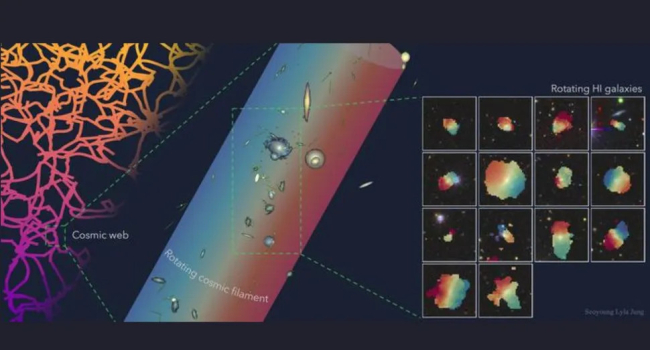
Astronomers Leila Jung and Madalina Tudorache of the University of Oxford, using the MeerKAT radio telescope in South Africa, have identified a gigantic dark-matter filament stretching 50 million light-years, within which galaxies rotate in the same direction as the filament itself. It is one of the largest coherently rotating structures ever observed in the Universe, as well as the first direct evidence that large-scale matter flows can determine the spin of individual galaxies. The study was published on December 4, 2025, in Monthly Notices of the Royal Astronomical Society.
“Teacups on a ride”: dual rotation
At the core of the filament lies a chain of 14 galaxies arranged almost perfectly along a straight line extending 5.5 million light-years. All of them contain abundant neutral hydrogen, the raw material for star formation. This chain is embedded within a larger filament containing roughly 300 galaxies.
What is striking is not only the alignment but also the synchrony of their motion: the galaxies rotate around their own axes while simultaneously orbiting the filament’s long axis at about 110 km/s — all in the same direction.
Jung explained that the structure’s significance lies not only in its size but also in the combination of aligned spins and collective rotation. She noted that it could be compared to a spinning-teacup ride: each galaxy behaves like an individual rotating cup, while the entire platform — the cosmic filament — turns as well. This dual movement, she said, offers a rare opportunity to understand how galaxies acquire their spin from the larger structures that host them.
How it was detected
The team used MeerKAT’s 64 antennas to trace the motion of neutral hydrogen via its 21-cm emission line, supplementing the data with optical measurements from DESI and SDSS to determine velocities. It had already been shown in 2022 that the filaments of the cosmic web can rotate, but this is the first demonstration that such rotation can be transmitted to the galaxies contained within.
Tudorache emphasized that the filament serves as a kind of fossil record of cosmic flows, helping researchers reconstruct how galaxies build up spin and evolve over time.
Why this changes models of galaxy formation
The traditional view holds that a galaxy’s spin is mostly inherited from the rotation of the gas cloud from which it formed 13 billion years ago, with additional influence from random encounters and mergers. The new finding indicates that large-scale flows along dark-matter filaments may be a dominant factor, especially in the early Universe.
The galaxies inside the filament are relatively young and are forming stars actively, which means their spin may still evolve as they age.
Implications for cosmology
The discovery is likely to affect interpretations of weak gravitational lensing in surveys such as the Vera Rubin Observatory’s LSST. Incorporating the synchronized rotation of galaxies along filaments could make dark-matter maps more accurate.
In brief
A dark-matter filament 50 million light-years long has been identified about 140 million light-years from Earth, containing hundreds of galaxies rotating in unison with the filament itself — one of the largest coherent rotating structures known in the Universe. It provides the first direct evidence that large-scale matter flows can dictate galactic spin, prompting a reassessment of galaxy-formation models. The MeerKAT discovery raises new questions about the role of the cosmic web in shaping the evolution of the Universe.