make preferable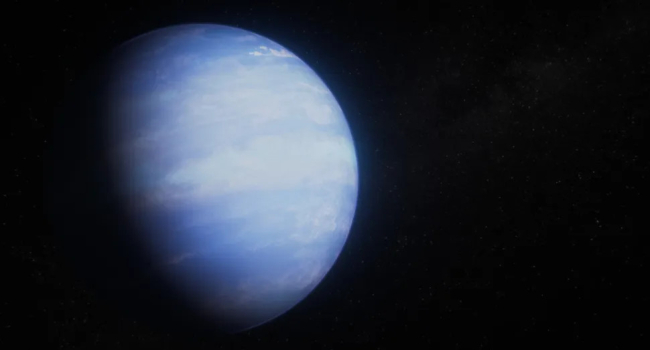
Astronomers using the James Webb Space Telescope (JWST) have captured a unique phenomenon: the giant exoplanet WASP-107b, known as a “super-puff,” is actively evaporating its atmosphere, creating a massive cloud of helium that moves ahead of the planet along its orbit. The results were published on December 1, 2025, in Nature Astronomy.
Helium Escapes One and a Half Hours Before the Planet Arrives
WASP-107b is a “hot Neptune” with a radius nearly as large as Jupiter’s but with only twelve Earth masses. It orbits its star at a distance seven times closer than Mercury is to the Sun, and due to its extremely low density, its atmosphere is essentially boiling away under harsh stellar radiation.
The Webb telescope’s NIRISS spectrometer detected, for the first time, an infrared signal from helium escaping the planet. This helium cloud extends nearly ten planetary radii and passes in front of the star one and a half hours before the actual transit of WASP-107b, a phenomenon now called pre-transit helium absorption.
“The James Webb Telescope has, for the first time, caught helium leaking from this planet, and this is the most confident detection of pre-transit helium absorption for any exoplanet,” said lead author Vigneshwaran Krishnamurthy of the Trottier Space Institute at McGill University.
What This Reveals About the Planet’s Past and Future
Water vapor has been detected in WASP-107b’s atmosphere, but methane is absent. This indicates strong vertical mixing: hot layers from below rise upward and destroy methane molecules. In addition, the oxygen abundance is higher than expected for a planet that formed in its current close-in orbit.
“The amount of oxygen in WASP-107b’s atmosphere is higher than we would expect if it had formed on its present orbit,” noted study co-author Caroline Piole-Gorayeb, who modeled the spectrum. According to her, the planet was likely pushed inward by a distant companion, WASP-107c, a massive planet on a much wider orbit.
In Brief
JWST has observed, in real time for the first time, the super-puff WASP-107b losing its helium atmosphere, producing a huge cloud that crosses the star one and a half hours before the planet itself. The discovery confirms that WASP-107b migrated inward, where it began to evaporate intensely, and provides a rare opportunity to witness the atmospheric evolution of giant exoplanets as it happens.