make preferable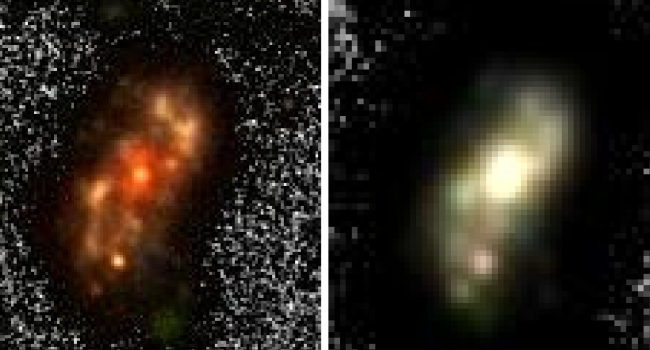
The James Webb Space Telescope continues to overturn long-standing views of the cosmos. Indian astronomers Rashi Jain and Yogesh Wadadekar of the National Centre for Radio Astrophysics (TIFR, Pune) have discovered the spiral galaxy Alaknanda, which formed only one point five billion years after the Big Bang, when the Universe was just ten percent of its current age. According to all canonical models, only chaotic, shapeless clouds of gas and stars could exist during such an early epoch, not a mature spiral with two well-defined arms and a distinct central bulge — almost an exact copy of today’s Milky Way.
The results were published in Astronomy and Astrophysics.
A Galaxy That “Should Not Exist”
Alaknanda lies at a redshift of about z = five point five — its light has traveled twelve point two billion years to reach us. The galaxy is about thirty thousand light-years across and is forming stars at a rate of sixty solar masses per year, twenty times higher than in the modern Milky Way. Half of its stellar population formed in just two hundred million years — a cosmic instant.
Classical theory predicted that spiral arms emerge only after several billion years of calm evolution: gas must settle into a disk, density waves must stabilize, and the galaxy must avoid disruptive mergers. Alaknanda contradicts all these expectations at once.
“Alaknanda shows a level of structural maturity that we usually see in much older systems,” noted Rashi Jain. “It appears that the physical processes shaping spiral galaxies can unfold far faster than we believed. This forces us to rethink our theoretical framework.”
Why This Discovery Is Revolutionary
- Spiral galaxies were considered products of a mature Universe — their numbers increased sharply only after five to six billion years.
- Alaknanda shows that perfect spiral morphology can arise during a phase of intense star formation and active mergers.
- The discovery confirms that JWST is repeatedly finding galaxies in the early Universe that appear “too evolved” for their age — and there are already dozens of them.
This is no longer an isolated case but a systematic problem for the Lambda-CDM model: either we underestimate how fast disks can evolve, or unknown mechanisms of accelerated structure formation were at work in the early Universe.
In Short
Only one point five billion years after the Big Bang, a fully formed spiral galaxy — Alaknanda — already existed, nearly a structural twin of the modern Milky Way but forming stars twenty times faster. The JWST discovery forces a complete revision of galactic evolution timelines: spiral arms and bulges may form dozens of times faster than theory predicted. The early Universe turns out to have been far more “mature” than previously thought.