make preferable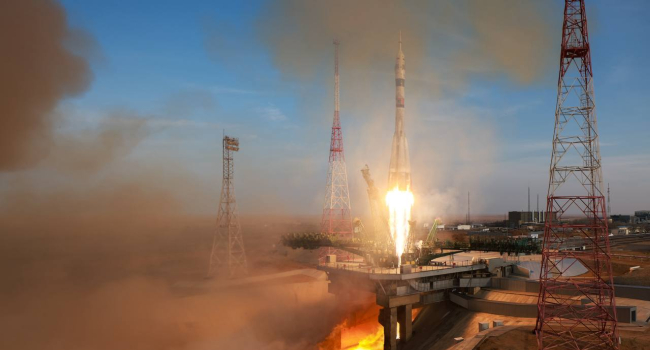
On November 27, 2025, an incident occurred at the Baikonur Cosmodrome that many experts already call the most serious event for the Russian crewed space program in recent decades. After the nominal launch of the Soyuz MS-28 spacecraft from Launch Pad 31, the retractable service cabin, a massive metal structure that provides engineers access to the upper levels of the rocket, collapsed on the pad.
The incident has sparked extensive discussion in the professional community and raised concerns about a possible halt to launches to the International Space Station.
What happened
According to Lenta.ru, the launch of the Soyuz-2.1a rocket with the Soyuz MS-28 spacecraft proceeded normally. The rocket successfully delivered the crew to orbit, the docking with the ISS occurred without deviations, and Roscosmos reported that the crew felt well.
However, viewers noticed twisted metal structures under the launch table in the broadcast following the liftoff. Video recordings showed that a massive piece of infrastructure ended up beneath the rocket’s nozzles, where it should not have been.
According to DW, immediately after the launch a heavy metal structure was discovered under Pad 31. Spaceflight popularizer Vitaly Egorov explained that it was the retractable service cabin, the balcony used by engineers to access the upper levels of the rocket and which is supposed to be pulled behind an armored wall before liftoff.
Launch analyst Georgy Trishkin reported that the structure fell into the flame trench right after launch. The cause remains unknown, but one thing is clear: the mechanism should have been secured, yet the rocket exhaust simply tore it off.
This version is also supported by Vzglyad. According to eyewitness scientist and journalist Mikhail Kotov, who was present at Baikonur, the service cabin was torn from its place and thrown into the exhaust trench by the powerful blast of the rocket’s exhaust. Kotov noted that no one was on the platform at the moment of the incident and there were no injuries.
Hi-News describes the same picture, emphasizing that engineers initially thought a side tower had collapsed, but it soon became clear that the exhaust had torn off the service cabin, which had not fully retracted into its protective niche.
The causes of the incident have not yet been officially announced. According to Lenta.ru and BBC, several technical versions are being considered: failure to secure the cabin in its niche, operational errors, worn mechanisms, human error, or a more systemic problem. The Roscosmos commission is conducting an investigation that may take considerable time.
Russia has temporarily lost the ability to launch crewed spacecraft
Lenta.ru reports that Roscosmos confirmed damage to the launch table but emphasized that all necessary spare elements are available and the damage will be repaired. The agency did not call the event an accident, stating that inspection is carried out after every launch and any identified damage is repaired promptly.
The seriousness of the Baikonur incident lies in the fact that Russia effectively has no backup options for crewed launches. As BBC notes, Launch Pad 31 remains the only site from which it is possible to send spacecraft to the ISS. Other cosmodromes are either unsuitable for orbital trajectories or already decommissioned. After the end of cooperation with the Kourou spaceport, there are no international alternatives. According to DW, this is why Complex 31 has carried the entire crewed program since 2018, and its shutdown automatically puts the program on hold.
The future of missions now depends directly on how quickly the infrastructure can be restored. This concerns not only crew rotation schedules but also Russia’s participation in ISS operations, the stability of scientific programs, and the overall status of Russian spaceflight.
How long will repairs take
Repair timelines remain a topic of debate. According to DW, experts doubt a quick restoration. Trishkin says that even under favorable conditions it will take at least six months. If the service cabin has to be manufactured anew, the process may stretch to one and a half years. According to him, launches of Soyuz and Progress spacecraft to the ISS will now have to be postponed indefinitely. He emphasized that Russia has effectively lost its ability to send humans into space since that day, something that has not happened since 1961.
Vitaly Egorov supports this assessment. In his view, damage to such a critical element makes immediate launches impossible. Hi-News reminds readers that this is a complex structure with a long production cycle, and the speed of repair depends primarily on whether Roscosmos has spare elements already prepared.
Science journalist Mikhail Kotov, according to Vzglyad, believes the panic is exaggerated. He calls claims about the end of the crewed program misinformation and says repairs will take only a few months, with the first launch from the pad potentially occurring in the first quarter of 2026. Kotov notes that the problem is localized: it is the service cabin that was torn off, and spare parts are available.