make preferable
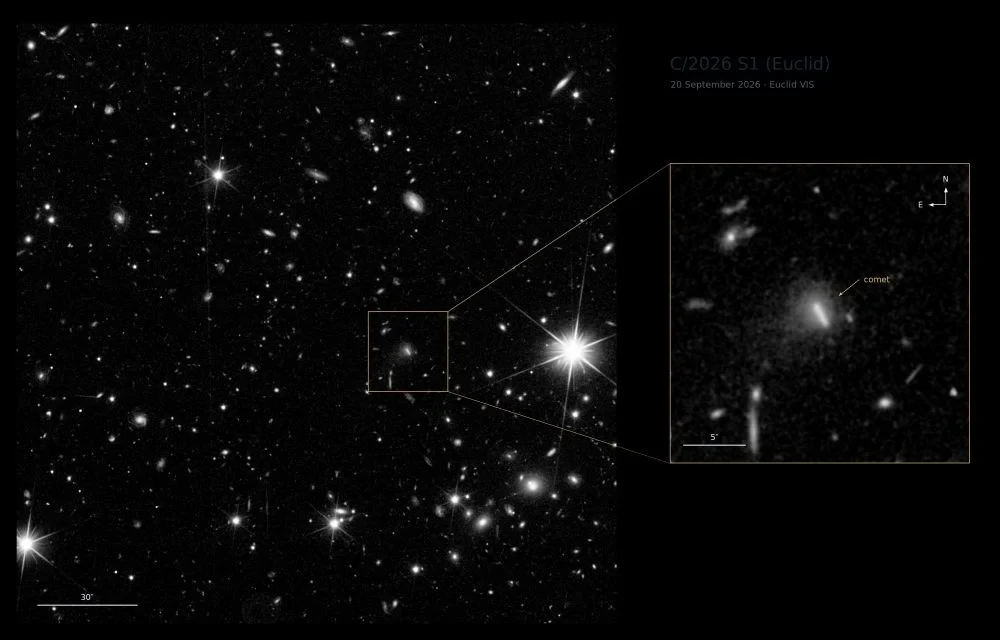
The European space telescope Euclid has discovered a comet previously unknown to astronomers. It appeared in images taken during observations of distant galaxies, even though the spacecraft was not designed to search for comets, the European Space Agency (ESA) reports.
A comet 1.3 billion kilometers from Earth
The object was designated C/2026 S1 (Euclid). It was recorded in images taken from September 16 to 24, and on October 8 the discovery was confirmed by the Minor Planet Center of the International Astronomical Union. The comet was detected thanks to a program developed by Mikko Pöntinen, a doctoral student at the University of Helsinki. The algorithm identified an elongated trail of a moving object in the images. The researcher calculated where it should appear in other images and found it in several more sets of observations.
Further study showed that the object is surrounded by a diffuse envelope of gas and dust — a characteristic sign of a comet. A check of catalogs of known comets and asteroids found no matches, after which the observations were submitted for confirmation of the discovery. According to the European Space Agency (ESA), the comet is located about 1.3 billion kilometers from Earth, in the region of the Solar System between the orbits of Jupiter and Saturn in terms of its distance from the Sun. Its orbit lies far outside the plane in which most planets move. According to preliminary calculations, one full orbit around the Sun takes about 345,000 years.
Why its discovery was accidental
Euclid was built for a different purpose: during its six-year mission, it is supposed to map the Universe by observing billions of galaxies and studying the effects of dark matter and dark energy. To do this, the telescope takes deep images of large areas of the sky. At the same time, the spacecraft tries to avoid the plane of the Solar System, where light from dust can interfere with observations. It also does not return to each section of the sky on request, so tracking the comet’s motion across multiple images was not easy.
In the end, the object was detected in 16 exposures across five fields of view. According to members of the scientific team, such discoveries are not expected to be frequent for Euclid. The comet will not become a target of the upcoming European mission Comet Interceptor. However, as ESA notes, this case made it possible to test the interaction between the teams working on Euclid data processing and on preparations for the future mission. Comet Interceptor is planned to be sent to a suitable comet in order to study it directly in space.
Comets are of particular interest to scientists because they preserve material from the time of the Solar System’s formation about 4.6 billion years ago. Studying their composition helps researchers understand what material the planets formed from and which chemical compounds were present in the early stages of our system’s history.