make preferable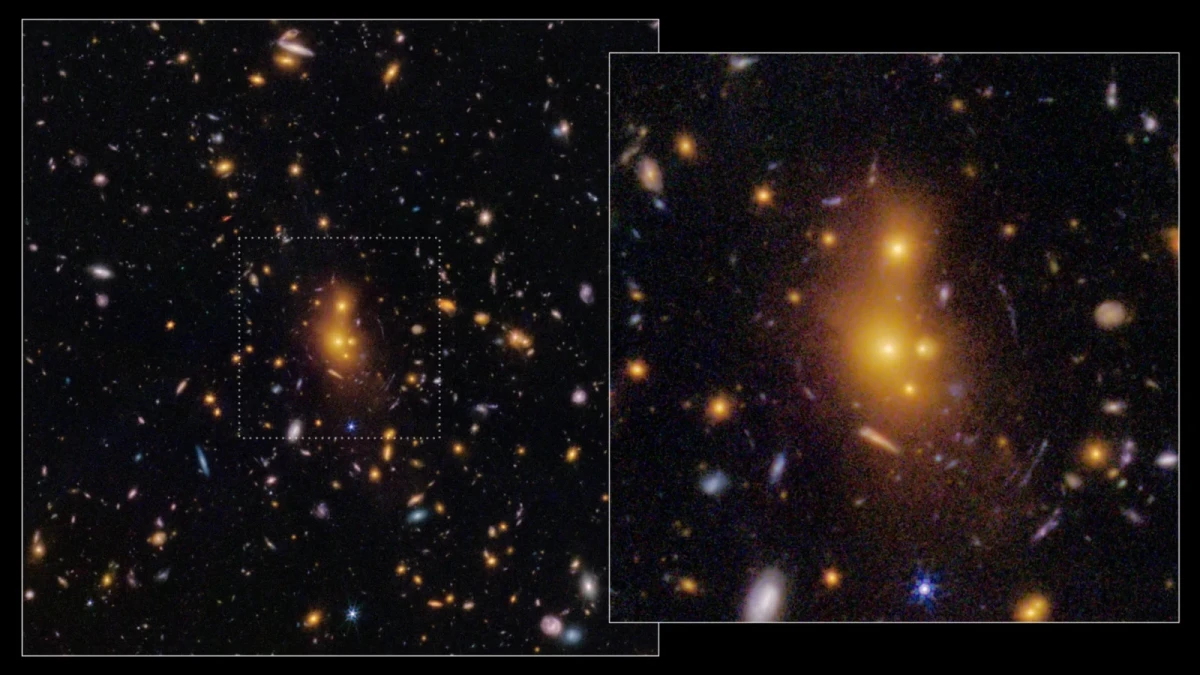
The James Webb Space Telescope helped astronomers study the galaxy cluster XLSSC 122, which formed about 10.4 billion years ago. Despite its young age by cosmic standards, it already has an unusually dense central region where a significant fraction of its mass is concentrated. This may indicate that some large-scale structures in the Universe developed faster than standard cosmological models suggest.
The observations also made it possible to detect the earliest known evidence of intracluster light — the faint glow of stars scattered between galaxies. Its distribution turned out to be closely linked to the location of dark matter, which could help astronomers study the invisible component of the Universe in the future.
The results of three studies led by scientists at IPAC — a scientific center of the California Institute of Technology specializing in astrophysics and planetary science — were presented on June 17, 2026, at a conference of the American Astronomical Society.
Gravitational lensing revealed hidden mass
The XLSSC 122 cluster was first discovered in 2014 using the European Space Agency’s XMM-Newton X-ray telescope. Later, observations by Hubble helped refine its distance from Earth — about 10.4 billion light-years — and showed that the cluster looked surprisingly mature for its era.
However, it was James Webb that detected distinctive arcs of light around the cluster’s center. They arise due to strong gravitational lensing: a massive object bends spacetime and changes the direction of light coming from more distant galaxies located behind it.
As a result, background objects can appear stretched, curved, or even form multiple images. Analysis of these distortions makes it possible to estimate the cluster’s mass, including the portion that cannot be seen directly.
XLSSC 122 became the most distant known galaxy cluster in which strong gravitational lensing has been detected. For astronomers, this is especially valuable: the more precisely the mass distribution can be measured, the better theories of cosmic structure formation can be tested.
There was unexpectedly a lot of dark matter in the center
XLSSC 122 existed during the era astronomers call cosmic noon. About 10 billion years ago, star formation in the Universe reached particularly high intensity: some galaxies were producing stars dozens of times faster than typical galaxies do today. At the same time, small structures were gradually merging into larger clusters.
But XLSSC 122 stands out even against this backdrop. Measurements showed that a significant share of its mass is concentrated in the central region. Such a concentration turned out to be unexpected for a cluster that existed at such an early stage in the Universe’s history.
This creates a problem for standard cosmological models describing the growth of structures under the influence of gravity. If objects like this turn out not to be exceptional, scientists may have to revise some ideas about how quickly massive galaxy clusters formed.
At the same time, one unusual object is not enough to disprove existing models. It is still unknown how typical XLSSC 122 was for its era.
How astronomers mapped invisible matter
Ordinary matter — stars, gas, and other objects that emit or absorb light — makes up only a small fraction of the cluster’s mass. According to scientists’ estimates, dark matter makes the main contribution to the gravitational distortions.
It cannot be observed directly in ordinary light, but its presence is revealed by gravitational effects. On cosmic scales, dark matter helps hold galaxies and clusters together and participates in shaping the large-scale structure of the Universe.
To reconstruct the mass distribution of XLSSC 122, researchers used not only strong but also weak gravitational lensing. Unlike strong lensing, which creates noticeable arcs and other pronounced distortions, weak lensing slightly changes the apparent shape of many background galaxies. These small changes are detected statistically.
The two methods complement each other. Strong lensing is especially useful for studying the dense center of the cluster, while weak lensing makes it possible to estimate the mass distribution at greater distances from it.
Combined with X-ray and radio measurements from other telescopes, these data showed that XLSSC 122 is still undergoing a merger: its components continue to interact and combine. The unusually high concentration of mass in the center nevertheless remained.
Light from stars between galaxies mirrors the distribution of dark matter
Another important finding is linked to intracluster light — the faint glow of stars that no longer belong to individual galaxies and are located in the space between them.
Such stars can be set free when gravitational interactions between galaxies pull them out of their original systems. Therefore, the distribution of intracluster light can reveal information about the collisions and mergers the cluster is going through.
James Webb observations detected this light in XLSSC 122 at a record-early stage of cosmic history. Its distribution also helped confirm that the cluster is in the process of merging.
But the researchers also found a more unexpected pattern: in the cluster’s central region, the shape and distribution of the intracluster light closely match the dark matter map reconstructed from strong gravitational lensing.
This means that the faint glow of intergalactic stars could potentially serve as a visible guide for locating invisible mass. If this connection is confirmed in other clusters, astronomers will gain an additional tool for studying the distribution of dark matter, including in the early Universe.
However, so far this concerns only one system. It is necessary to check whether this pattern holds in other clusters and under different conditions.
Why one cluster is not enough
The next step for the team is to find and study dozens of other clusters that existed at comparably early stages in the Universe’s history. This will make it possible to determine how often objects with such a high concentration of mass occur and whether they really developed faster than models predict.
James Webb itself is best suited primarily for detailed study of individual targets: its field of view is relatively small for large-scale sky surveys. That is why promising objects first have to be found using wide-field X-ray and radio surveys.
One way to detect clusters is connected with the Sunyaev–Zel'dovich effect. Energetic particles of hot gas inside a cluster interact with the cosmic microwave background — residual radiation from the early Universe — changing its spectrum. These changes help identify massive structures even when they are difficult to detect by other methods.
If many clusters similar to XLSSC 122 are found in the early Universe, this will become a serious test of modern ideas about the formation of cosmic structures. For now, however, the discovery points to an unusual object and suggests new ways of studying dark matter, but it does not prove that the standard cosmological model is wrong.
As study leader Kyle Finner notes, the era of James Webb is only just beginning. Data on dozens or hundreds of such objects will make it possible to test far more reliably how accurately modern theories describe the evolution of the Universe.