make preferable
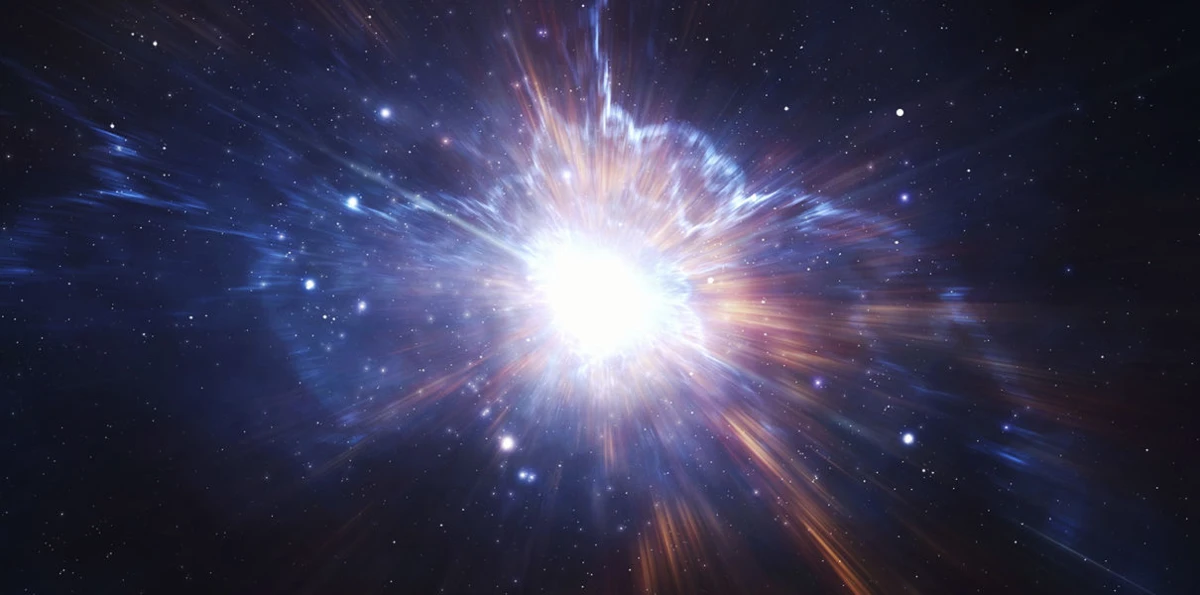
An international team of astronomers has measured with unprecedented precision the abundance of helium formed in the first minutes after the Big Bang. The margin of error was only 0.5% — three times smaller than in previous estimates. The result will help scientists test how well modern physical theories describe the conditions in which the Universe existed at the very beginning of its history.
The study is based on 130 hours of observations using the Large Binocular Telescope. The results are presented in five papers published in The Astrophysical Journal, sciencedaily.com reports.
Why the amount of helium tells us about the early Universe
According to the modern cosmological model, the Universe began expanding about 13.8 billion years ago from an extremely hot and dense state. One of the most important confirmations of this picture is the chemical composition of the early Universe, including the amounts of helium and deuterium formed in the first minutes after the Big Bang.
During this period, the temperature and density of matter allowed nuclear reactions to take place, producing the first light elements. Their initial proportions depended on the physical conditions in the young Universe, so scientists can use these data to test cosmological models.
However, measuring the primordial abundance of helium is not easy. Over billions of years, stars produced new amounts of this element, changing the chemical composition of the surrounding gas. To reconstruct the original values, astronomers need to study objects in which such changes were minimal.
Distant galaxies helped scientists look into the past
Instead of the traditional approach, which involves studying a large number of galaxies and then extrapolating the results, the researchers focused on 15 small galaxies exceptionally poor in heavy elements. Their chemical composition has changed relatively little, so they preserve information about matter close in composition to the primordial one.
The scientists used the MODS spectrographs developed at Ohio State University. These instruments made it possible to simultaneously study more than ten helium spectral lines and fifteen hydrogen lines.
Spectral lines arise when atoms absorb or emit light at specific wavelengths. Based on their characteristics, astronomers determine the chemical composition of distant objects and estimate the abundance of individual elements.
The simultaneous analysis of a large number of lines helped the researchers identify and correct small sources of error that might have gone unnoticed in less precise measurements. This is especially important when it is necessary to achieve an uncertainty of less than one percent.
As a result, the team obtained an estimate with an uncertainty of only 0.5%. According to Evan Skillman, a professor at the University of Minnesota Twin Cities who took part in the work, this is one of the most significant results of his 40-year scientific career.
What the helium measurement says about the laws of physics
The data obtained are important not only for refining the chemical composition of the early Universe. They also make it possible to test the Standard Model of particle physics — the theoretical framework describing the known elementary particles and their interactions.
The amount of primordial helium depends on the conditions under which the first nuclear reactions took place. In particular, it is influenced by the number of particle types involved in the physical processes of that time.
Using the new measurement, the researchers were able to calculate the number of neutrino families in the early Universe. Neutrinos are extremely light elementary particles that play an important role in particle physics and cosmology.
Thus, the helium abundance becomes a kind of cosmic test of the fundamental laws of nature. If calculations based on existing theories do not match sufficiently precise observations, this may indicate the need to revise certain ideas about the early Universe.
At the same time, the high precision of the measurement in itself does not mean that scientists have discovered a violation of the Standard Model. First and foremost, it is about a more rigorous test of existing theories.
Why this result took 12 years to achieve
The precision of the measurements was made possible by specialized instruments. The development of the MODS spectrographs took 12 years — from the initial concept to the first astronomical observations.
Richard Pogge, professor of astronomy at Ohio State University, noted that the instruments were originally designed for this kind of research. They make it possible to obtain detailed spectra of distant objects and measure fundamental parameters with high precision.
The international research group included specialists from universities in the United States, Mexico’s National Autonomous University, and the Canadian research center TRIUMF.
The work shows how important for cosmology are not only new telescopes capable of observing ever more distant objects, but also instruments that make it possible to analyze the received light more precisely. Sometimes progress lies not in discovering an unknown object, but in measuring an already known quantity so precisely that it becomes a more stringent test of our understanding of nature.
Scientists now have a more precise benchmark for studying the first minutes of the Universe’s existence. The next step is to use it together with other cosmological observations to find out how fully modern physical models explain the origin and early evolution of matter.