make preferable
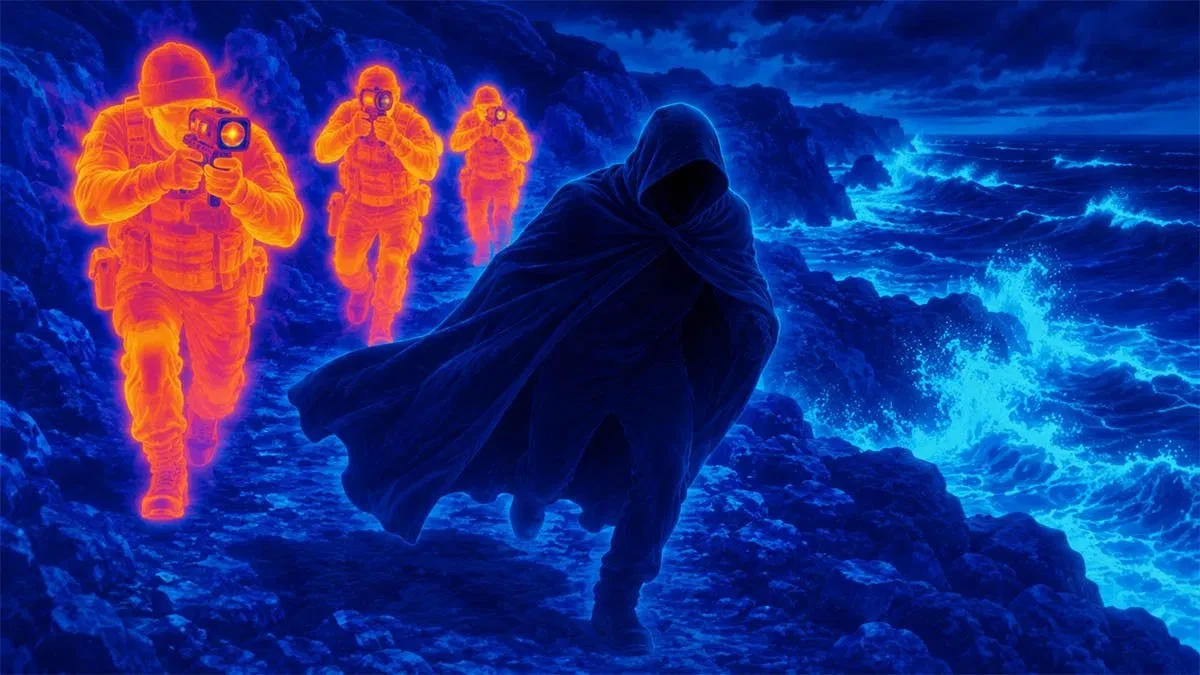
Scientists from the United States and Denmark have developed and tested a three-dimensional device capable of hiding objects from infrared cameras while also protecting them from extreme temperatures. Unlike previous designs, the new thermal invisibility cloak works with complex-shaped objects and allows heat flows to be controlled from virtually any direction. The technology could find applications in cooling microchips, protecting sensitive electronics, and thermal camouflage systems against heat-based detection.
The study was conducted by specialists from the University of Illinois Urbana-Champaign together with a colleague from the Technical University of Denmark. The results were published in the scientific journal Nature Communications.
How thermal invisibility works
Conventional cameras detect infrared radiation associated with the temperature of objects. Because of this, they can identify people, machinery, and other items even in the dark, when a regular optical camera is almost useless.
The new development makes it possible to circumvent this detection principle. The device does not block heat but redirects its flows around the concealed object. As a result, the temperature distribution behind the cloak remains as it would be if there were no obstacle. For an infrared camera, the object becomes almost indistinguishable from the surrounding environment. At the same time, the cloak performs another function: it protects the space inside from external temperature effects. Thus, the technology provides both thermal camouflage and temperature insulation.
“A true thermal cloak must work regardless of where the heat is coming from,” said the study’s lead researcher, Shelley Zhang, a professor in the Department of Civil and Environmental Engineering at the University of Illinois. According to her, the development makes it possible to conceal complex three-dimensional objects from virtually any direction while maintaining a stable temperature inside the structure.
Aluminum and a rubber-like material control heat flows
Creating a full-fledged three-dimensional thermal cloak had long remained a difficult scientific challenge. Previously, experimental devices could redirect heat mainly along a flat surface or function only under a specific heat-flow direction. This limited their capabilities and made it impossible to provide полноценную маскировку объектов в трехмерном пространстве. To solve this problem, the researchers turned to the principles of transformation thermotics, a scientific field that studies ways to control heat propagation using specially engineered materials.
The key element of the development was a lattice structure whose properties can be independently adjusted along three spatial directions. This makes it possible to control how effectively heat passes through different parts of the structure and to create a wider range of thermal conductivity than previous solutions allowed. The device itself was made using two materials with opposite properties. First, using three-dimensional metal printing, the researchers created a complex aluminum lattice that provides efficient heat conduction. They then filled the remaining cavities with a rubber-like material that conducts heat poorly.
The combination of these components makes it possible to guide thermal energy along predetermined paths, bypassing the area that needs to be concealed. At the same time, the structure does not merely hinder the spread of heat but controls its distribution in three dimensions.
From cooling microchips to military technologies
One possible area of application for the development is electronics. Modern microchips and other high-performance components generate significant amounts of heat, and overheating can limit their performance and lifespan.
The technology for controlling heat flows in three dimensions could potentially make it possible to draw heat away from sensitive components, improve the cooling of electronic devices, and protect equipment operating under significant temperature fluctuations.
Another possible direction is protecting equipment from extreme temperatures. Since the device allows external heat flows to be directed around the protected area, this principle could prove useful in creating thermal protection systems for various technical devices.
Of particular interest is the use of the technology for camouflage against infrared detection. In the future, such structures may help conceal the thermal signatures of equipment and other objects, making them harder to detect using thermal imaging systems.
However, the study’s results do not mean that a universal cloak has already been created that can make a person or any piece of equipment invisible under real-world conditions. So far, only the operation of a specific structure that redirects external heat flows has been demonstrated. The possibilities for its practical application, including for concealing objects under changing conditions, still need to be studied.
As Zhang emphasized, the technology could be useful in any field where precise heat control or the prevention of object detection through thermal radiation is required. The broader idea behind the development lies in the ability to control the information carried by heat.
The next step is to hide objects that generate heat themselves
Despite the successful tests, the researchers still have one more important task to solve: learning how to conceal objects that produce heat themselves. The current design redirects thermal energy coming from outside and protects the internal area from temperature effects. But if the concealed object emits heat on its own, its thermal signature may disrupt the temperature pattern and reveal its presence.
Solving this problem will require more advanced materials and structures capable of actively managing thermal energy within the concealed area. This involves the ability to concentrate, distribute, and direct heat depending on changing conditions. Such improvements could expand the technology’s applications—from more effective temperature management of electronic components to the creation of systems capable of adapting to external conditions and hindering infrared detection.
“We have shown that a true omnidirectional three-dimensional thermal invisibility cloak is possible. The next step is to create cloaks that not only conceal and protect, but also actively manage heat in useful ways,” Zhang concluded.