make preferable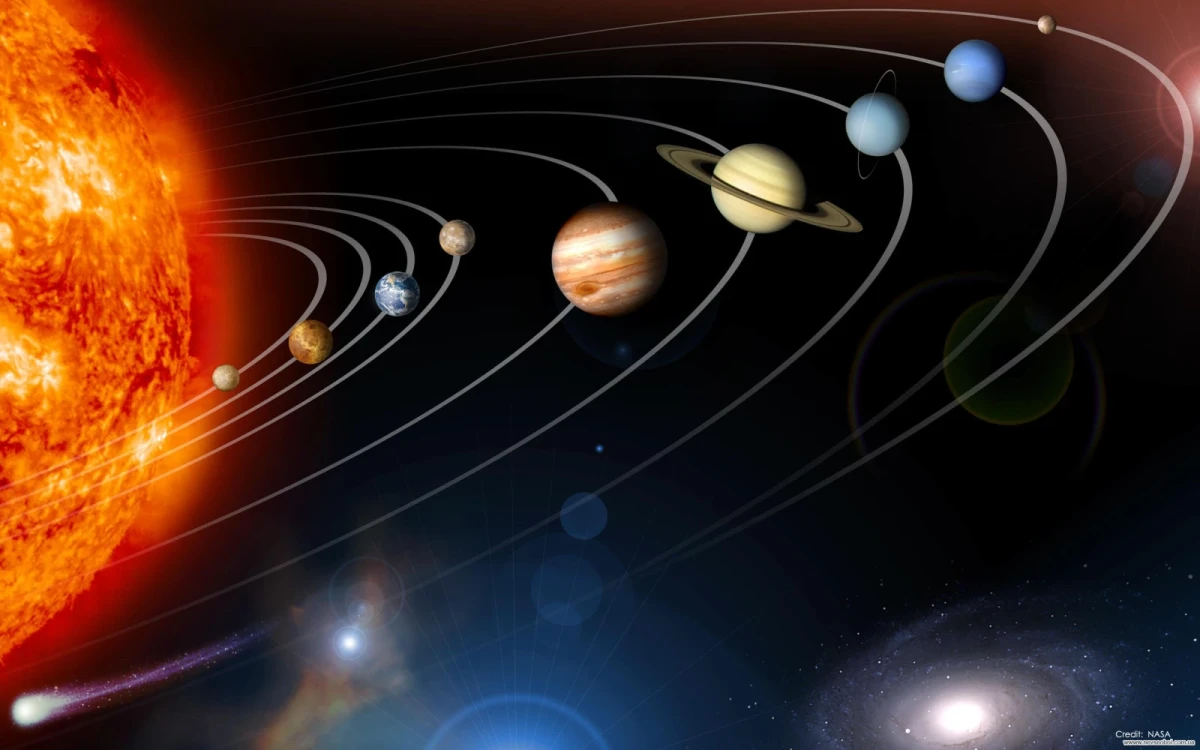
For more than a century, scientists have been searching for a planet that may be hiding on the farthest fringes of the Solar System. Today it is called Planet Nine. No one has seen it directly yet, but the strange behavior of small objects beyond Neptune’s orbit leads astronomers to suspect that an unknown large body may be there.
At the same time, this is not about restoring Pluto’s status as the ninth planet. The modern hypothesis arose from observations of much more distant objects and their unusual orbits.
From Planet X to Planet Nine
The idea of an unknown planet appeared long before the modern hypothesis. After the discovery of Neptune in 1846, astronomers understood that the existence of an unseen body could be inferred from its gravitational effect on other planets.
At the beginning of the 20th century, American astronomer Percival Lowell suggested that irregularities in the motion of Uranus and Neptune might be caused by another distant planet. He called it Planet X.
The search eventually led to Clyde Tombaugh’s discovery of Pluto in 1930. However, in 2006 Pluto was officially reclassified as a dwarf planet.
In addition, later observations, including data obtained by Voyager 2 during its studies of Uranus and Neptune, showed that the peculiarities of these planets’ orbits can be explained without the existence of an unknown ninth planet.
The modern Planet Nine hypothesis emerged for a different reason.
Why astronomers suspect it exists at all
In 2016, California Institute of Technology astronomers Konstantin Batygin and Michael Brown drew attention to the unusual orbits of several extreme trans-Neptunian objects.
These bodies are extremely far from the Sun, and their orbits display certain patterns. According to the researchers, one possible explanation could be the gravitational influence of a still unknown planet.
This is the key difference between Planet Nine and the old Planet X hypothesis: scientists are no longer trying to explain oddities in the motion of Uranus and Neptune. They are looking for traces of an unknown object in the behavior of small bodies at the very edge of the Solar System.
What oddities Planet Nine could explain
Supporters of the hypothesis believe that the same gravitational source could explain several features of the distant part of the Solar System at once.
These include the clustering of the orbits of some trans-Neptunian objects, unusually large distances from the Sun at the closest point of their orbits, the retrograde motion of certain bodies, and the strong tilt of their orbits relative to the plane of the Solar System.
In 2024, Batygin’s team presented an additional analysis of objects with long orbital periods and low inclinations that cross Neptune’s orbit.
According to Batygin, such objects are dynamically unstable and must be constantly replenished. Models with Planet Nine, the scientist argues, naturally reproduce the observed population, whereas calculations without it fit the data poorly after accounting for observational biases.
But there is one fundamental problem: no one has detected the planet itself so far.
The main piece of evidence is still missing
According to Batygin, the direct detection of Planet Nine remains the only major missing element of the hypothesis.
This matters because unusual orbits by themselves do not yet prove the existence of a specific planet. They can be explained by other processes, and the statistics of observed objects depend on which ones astronomers are actually capable of detecting.
Batygin believes that if the observed structure of the outer Solar System really exists, then at present there is no equally convincing alternative theoretical explanation for it.
At the same time, the researcher urges greater caution in interpreting individual new findings. According to him, the picture is becoming more complex rather than simply “stronger” or “weaker.” For example, one should not expect absolutely all distant objects to show the same orbital clustering.
The next chance: the Vera Rubin Observatory
One of the main instruments that could bring us closer to an answer will be the Vera Rubin Observatory in Chile. Its large-scale sky surveys will make it possible to discover far more faint and distant objects in the Solar System.
It is precisely the increase in sample size that could prove decisive. If new observations show that different orbital characteristics of independent groups of objects converge on the same parameters for the proposed Planet Nine, the hypothesis will gain much stronger support.
Batygin considers especially convincing a possible scenario in which a large and well-studied sample simultaneously demonstrates patterns in orbital orientation, the distribution of distances from the Sun, orbital inclination, and the population of objects crossing Neptune’s orbit.
In that case, explaining all these features without a common gravitational perturbing body would become significantly more difficult.
The planet may either be found or definitively ruled out
For now, Planet Nine remains just a hypothesis. Astronomers have indirect signs of its possible existence, but no photograph and no direct measurement of its gravitational influence.
Future surveys could lead to one of two outcomes. New objects and their orbits may strengthen the statistical evidence for the existence of an unknown planet, after which a targeted search for the body itself will begin. Or the accumulated data may make it possible to build another model that explains the observed patterns without Planet Nine.
In this sense, today’s situation resembles the story of Planet X a century ago. Only now astronomers have far more powerful tools and the ability to study huge numbers of faint objects on the outskirts of the Solar System.
Perhaps the answer to whether the Sun has another planet is already hidden among them.