make preferable
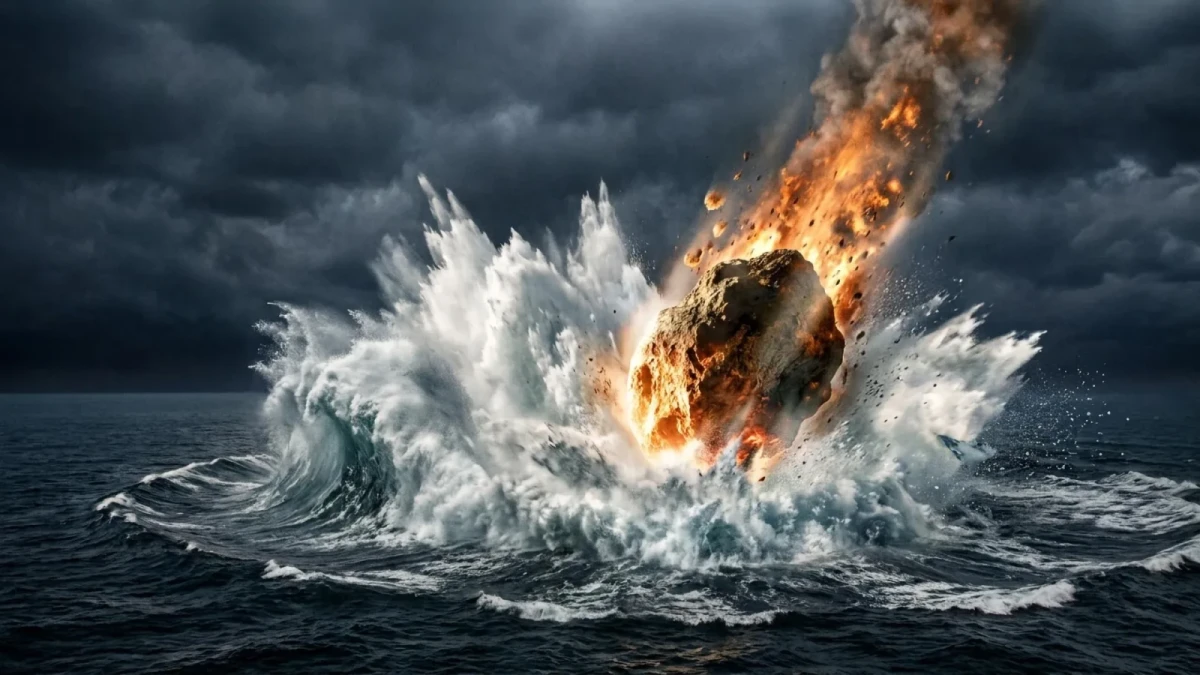
About 43–46 million years ago, an asteroid or comet slammed into the floor of the North Sea, raising a giant wave and leaving behind a crater about three kilometers across. For a long time, scientists debated the origin of this structure, discovered in 2002. Now researchers have found compelling evidence of a cosmic impact: minerals altered by extreme pressure were discovered in the rocks. The study results were published in the journal Nature Communications, reports sciencedaily.com.
The crater that baffled scientists for decades
The Silverpit crater is located about 130 kilometers off the coast of Yorkshire in eastern England, at a depth of roughly 700 meters beneath the seabed. It is approximately three kilometers in diameter, while the surrounding area of ring faults stretches nearly 20 kilometers.
When the structure was first discovered in 2002, scientists immediately noted its resemblance to known impact craters. Its nearly circular shape and central uplift could point to a powerful collision: during an impact, rocks are intensely compressed, and the central part of the surface can then rise as the compressed material begins to rebound.
However, the outward resemblance was not enough proof. Some geologists suggested that the crater formed because of movement in underground salt deposits deforming the overlying rocks. Others linked its origin to volcanic activity and the collapse of a section of the seafloor.
The debate became so serious that in 2009 specialists even voted on different explanations for Silverpit’s origin. At the time, most participants rejected the asteroid impact hypothesis.
Now a team led by Weisdin Nicholson of Heriot-Watt University in Edinburgh has presented evidence that has helped settle this long-running debate.
Microscopic traces of extreme pressure
The key to solving the mystery came from new seismic images and rock samples obtained while drilling an oil well near the crater.
Seismic surveying makes it possible to study subsurface structures by analyzing how sound waves pass through different layers of rock. Thanks to improved data, scientists were able to examine Silverpit’s internal structure and the deformation features of the surrounding rocks in greater detail.
But the decisive factor was a discovery that could not have been made from images alone: microscopic crystals of quartz and feldspar bearing signs of shock deformation were found in the samples.
When a cosmic body collides with a surface, shock waves are generated that create enormous pressure. This pressure changes the internal structure of minerals, leaving distinctive microscopic signatures. Ordinary geological processes are generally incapable of producing such features.
The crystals were found at a depth corresponding to the crater floor. This became strong physical evidence that the rocks had indeed been subjected to an extraordinarily powerful impact.
Nicholson compared the search for these minerals to trying to find a needle in a haystack: such samples are extremely difficult to detect, especially in rocks hidden beneath the seabed. According to the researcher, they were what made it possible to confirm Silverpit’s impact origin.
How the collision generated a wave as tall as a 30-story building
After confirming the crater’s origin, the researchers used computer modeling to reconstruct the circumstances of the ancient collision.
According to the calculations, an asteroid about 160 meters in diameter was traveling from the west and struck the seabed at a shallow angle. On impact, it hurled enormous masses of water and shattered rock into the air.
The model shows that in just a few minutes, a column of water and rocky debris about 1.5 kilometers high formed. When this mass collapsed back into the sea, it generated a tsunami more than 100 meters high.
For comparison, such a wave would be comparable in height to a 30-story building. At the same time, this is not an observed event but a reconstruction produced using computer calculations. The exact height of the ancient wave cannot be measured directly, so the estimate depends on the model used and the parameters built into it.
Nevertheless, the calculations show how destructive the impact of even a relatively small object by cosmic standards can be when it strikes the ocean. An asteroid 160 meters across is far smaller than the body associated with the extinction of non-avian dinosaurs, but at enormous speed it can still release colossal energy upon impact.
In such a case, the danger is linked not only to the impact itself. The rapid displacement of large volumes of water can trigger powerful waves, while the ejected rock and subsequent changes to the seafloor amplify the destructive effects.
Why the crater has survived to this day
Confirming Silverpit’s origin is important not only for reconstructing one ancient cataclysm. This site gives scientists a rare opportunity to study how high-speed impacts alter the structure of a planetary surface and the rocks beneath it.
On Earth, traces of such events often disappear long before they can be studied. Erosion destroys craters, sediments bury them under new layers, and the movement of tectonic plates gradually reshapes the planet’s surface.
According to Nicholson, about 200 impact craters have been confirmed on land, while only around 33 have been found beneath the oceans. That is why well-preserved structures like Silverpit are especially valuable.
Because a significant part of the crater is hidden beneath the seabed, researchers can study not only its shape but also the consequences of the collision at depth: fractures, rock displacement, and changes in geological layers. This helps scientists understand processes that also occur on other planets, where studying the internal structure of impact craters is much more difficult.
Professor Gareth Collins of Imperial College London, who took part in the earlier debate over Silverpit’s origin and in preparing the numerical models for the new study, noted that scientists can now move from arguing about the crater’s nature to investigating the collision itself.
Silverpit also adds to the picture provided by other confirmed impact structures, including the Chicxulub crater in Mexico, associated with the mass extinction of non-avian dinosaurs, and the Nadir crater off the west coast of Africa.
Each such site helps reconstruct individual episodes in Earth’s cosmic history. In Silverpit’s case, what is especially important is that the collision occurred at sea: studying it helps assess how asteroid impacts interact with the ocean and what consequences they may have for the planet.
Although the modeling results do not allow the ancient event’s scenario to be directly applied to the present day, they show that catastrophic consequences do not require a collision with an asteroid large enough to cause a global mass extinction. Even a much smaller body can lead to large-scale regional destruction — especially if its trajectory ends in the ocean.