make preferable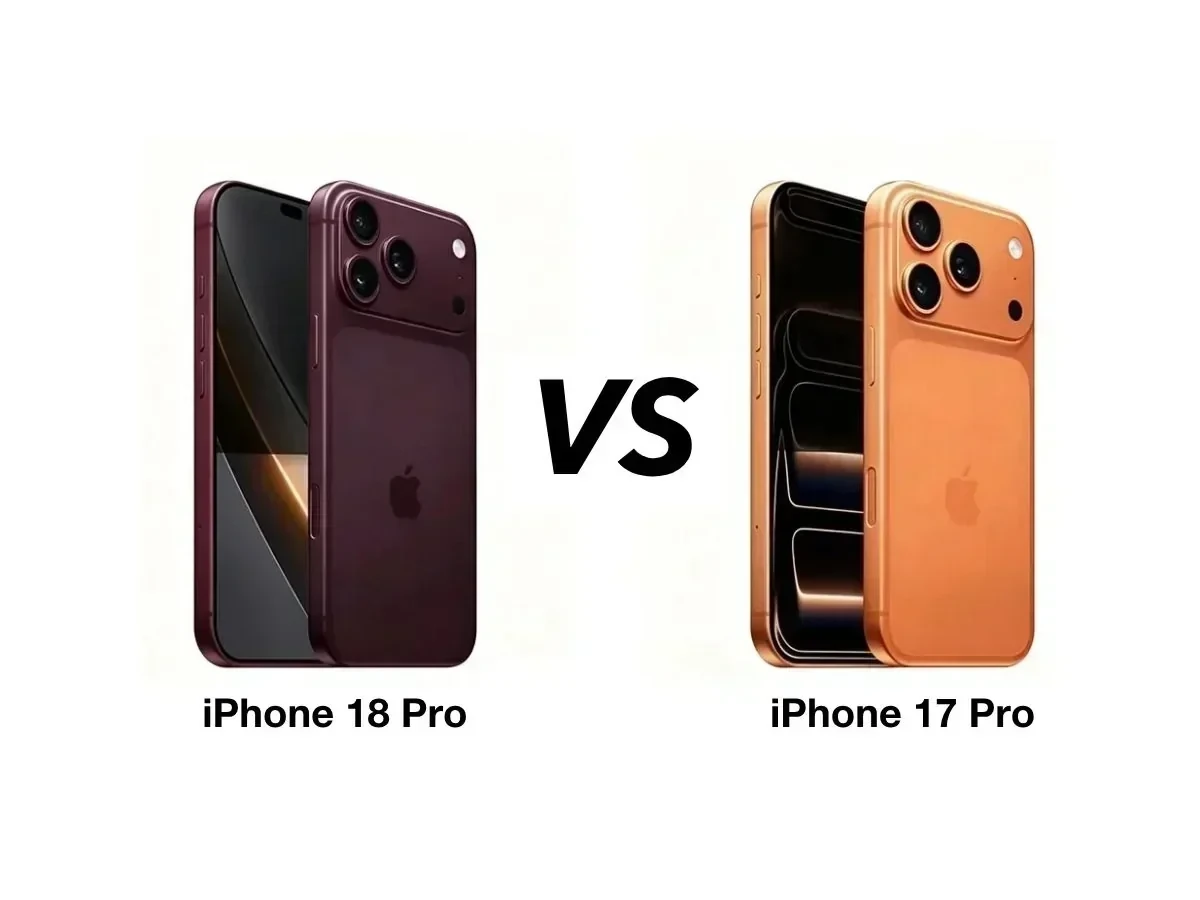
On the outside, the iPhone 18 Pro has barely changed compared to last year’s flagship, but inside Apple has upgraded several key components at once. A variable aperture, a more powerful 2nm chip, a new cooling system, longer battery life, and faster charging — that’s where the main line is drawn between the two generations.
At the same time, not all of these changes will be noticeable in everyday use. The displays, body materials, and a significant part of the camera system have remained the same, so for iPhone 17 Pro owners it won’t make sense to replace the smartphone in every case.
Let’s break down what exactly has changed in the iPhone 18 Pro and which of these differences really matter.
1. The camera got a true variable aperture
The most noticeable upgrade went to the main 48MP Fusion camera. The iPhone 17 Pro used a lens with a fixed f/1.78 aperture, while the iPhone 18 Pro is the first to feature a four-step mechanical aperture.
It can switch between f/1.48, f/1.8, f/2.8, and f/4.0. At its widest setting, the camera captures more light, which is especially useful for night photography. According to Apple, the f/1.48 setting allows it to capture 50% more light compared to last year’s model.
At f/2.8 and f/4.0, the lens closes down more, making it possible to control depth of field at the optical level. This is especially interesting for portrait and group photography.
Apple has also expanded the capabilities of the Camera app: direct shutter speed control, a real-time histogram, and additional grain settings for Photographic Styles have been added.
For an iPhone 17 Pro owner, this is one of the few new features that cannot be obtained with a simple software update.
2. The A20 Pro moved to a 2nm process
Instead of the A19 Pro, the iPhone 18 Pro is equipped with the A20 Pro, manufactured on TSMC’s 2nm process.
The new chip boosts CPU performance by up to 20%, while the seven-core GPU is around 40% faster than the A19 Pro. This should be especially noticeable under sustained heavy loads — in games, photo and video processing, and other resource-intensive tasks.
At the same time, the move to a finer process node brings more than just extra computing power. Higher power efficiency makes it possible to handle everyday tasks with less energy, which ultimately also affects battery life.
3. The cooling system became three times larger
Another change that isn’t visible from the outside but may prove important under prolonged load is the new vapor chamber.
Its area in the iPhone 18 Pro has tripled compared to the iPhone 17 Pro. Because of this, the smartphone should dissipate heat more effectively and maintain high performance longer without throttling.
Apple claims up to a 40% increase in sustained performance. This primarily matters to those who spend long periods gaming, recording, and editing video directly on the smartphone.
For the average user, the difference will be harder to notice: when checking email, watching videos, or using messengers, the iPhone 17 Pro already has no shortage of performance.
4. Battery life improved, especially on the Pro Max
Apple has increased the claimed video playback time.
The iPhone 18 Pro delivers up to 36 hours versus 33 hours on the iPhone 17 Pro. On the iPhone 18 Pro Max, the difference is even more noticeable: up to 45 hours versus 39 hours on the 17 Pro Max.
There’s an important caveat: the maximum figures apply to versions without a physical SIM card tray, where the freed-up space inside the body is used for the battery.
So these numbers shouldn’t be taken as a direct indicator of real-world battery life. However, the very increase in claimed battery life shows that the combination of the new chip and a higher-capacity battery really produced results.
5. Charging became noticeably faster
The changes also affected wired charging. The iPhone 17 Pro, when used with a 40W adapter, reached about 50% charge in 20 minutes.
The iPhone 18 Pro supports up to 60W and can restore the first 50% in about 15 minutes.
It’s a small change on paper, but in real life it may prove more useful than many other upgrades. A five-minute difference is especially noticeable when the smartphone is almost dead and there’s no time for a full charge.
At the same time, MagSafe and Qi2.2 wireless charging remain at the same level — up to 25W when using compatible devices.
6. Dynamic Island got smaller
Apple continues to gradually reduce the area occupied by Face ID. In the iPhone 18 Pro, the system’s components have become more compact, allowing the physical Dynamic Island to take up less space on the display.
This doesn’t change how the smartphone works, but it reduces the portion of the screen covered by the cutout, which is especially noticeable when viewing full-screen content.
The software side has changed too. While the iPhone 17 Pro could display two background activities at the same time, the iPhone 18 Pro can show up to three.
Of all seven differences, this is perhaps one of the least noticeable, but it gradually makes using Dynamic Island more convenient.
7. New colors, more storage, and slightly more weight
Externally, the iPhone 18 Pro retains the familiar design, but Apple has slightly changed the body finish. The transition between the rear glass and the metal frame is now done in a unified color scheme.
New color options have appeared: Ice, Burgundy, and Black.
Because of the larger battery, the smartphones have also become heavier. The iPhone 18 Pro weighs 211 g — 5 g more than its predecessor. The iPhone 18 Pro Max gained 16 g and weighs 249 g.
Another important change concerns storage: for the 6.3-inch iPhone 18 Pro, a 2TB option is available for the first time.
The base 256GB versions start at $1,199 for the iPhone 18 Pro and $1,299 for the iPhone 18 Pro Max — $100 more than the starting prices of the iPhone 17 Pro.
What stayed the same
Despite the list of upgrades, the iPhone 18 Pro can’t be called a completely new device. The display sizes remain the same — 6.3 and 6.9 inches — as does the claimed peak brightness of 3000 nits.
The body materials have also remained virtually unchanged. The ultra-wide and telephoto cameras did not receive as significant an upgrade as the main module.
So an iPhone 17 Pro owner won’t get a fundamentally different smartphone by moving to the new generation. Most of the changes are concentrated inside the body and show up in specific usage scenarios.
Should you switch from the iPhone 17 Pro to the iPhone 18 Pro?
For most iPhone 17 Pro owners, probably not. Last year’s flagship remains a very powerful smartphone, and the display, body, and much of the camera system have hardly changed.
The upgrade looks justified primarily for those who truly care about the capabilities of the main camera with its mechanical aperture, professional shooting tools, or maximum performance under prolonged heavy loads. Extra battery life and faster charging can also become compelling arguments.
If the iPhone 17 Pro already satisfies you in terms of battery life, speed, and photo quality, the difference between the generations in everyday tasks is unlikely to be significant enough to justify replacing the smartphone after just one year.