make preferable
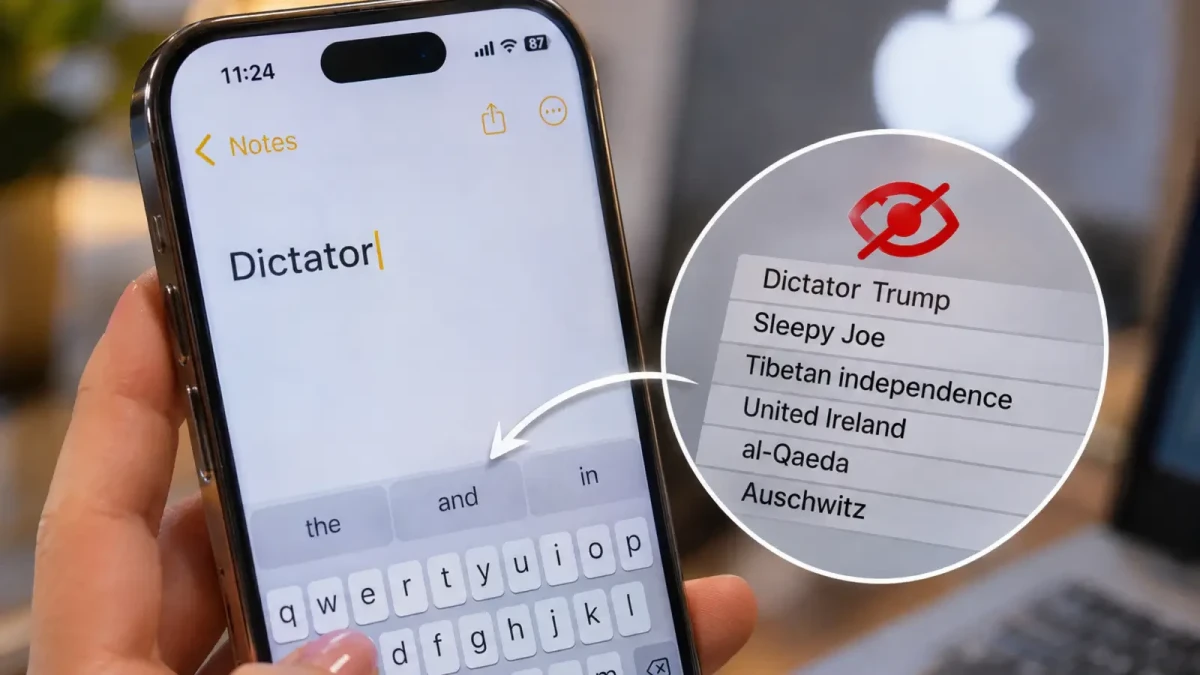
A so-called “gray list” of words and phrases has been found in the iPhone keyboard, for which iOS offers no autocomplete suggestions and does not support swipe typing. It is believed to contain at least 100,000 entries, ranging from political slogans and insults to references to drugs. Users can still type these words manually and send them in messages: the restrictions apply only to keyboard features.
Researcher Derek Kaufman drew attention to the hidden list. Reuters reported the discovery, and an independent cybersecurity expert verified the mechanism’s existence.
Which words are restricted
According to TechRadar, researchers found politically charged phrases such as “sleepy Joe,” “dictator Trump,” and “Tibetan independence” among the expressions for which the iPhone offers no suggestions. The Guardian reports that the list also includes “NSA spies,” “question your sexuality,” and even the phrase “Australia is a very bad place.”
Some restrictions concern references to drug use. Based on the researchers’ observations, the keyboard does not suggest these expressions during regular typing and does not allow them to be entered using swipe typing.
This does not mean the words are blocked at the operating system level. Users can type any of these phrases manually, copy them from another source, and send them to someone. The keyboard simply will not suggest the corresponding options or automatically recognize them when users slide their finger across the letters.
Apple says the aim is to prevent unwanted suggestions
Apple did not directly comment on the existence of a separate “gray list” in response to an inquiry from Reuters. However, the company confirmed that the iPhone keyboard is configured to avoid suggestions that could be inappropriate or offensive.
This is not the first time the iPhone’s automated input features have raised questions. A year earlier, users found that the smartphone replaced Donald Trump’s name with the word “racist” during voice dictation. Apple said at the time that it was working to fix the problem. Such situations show how contentious the results of automated speech and text processing can be.
Researchers call for greater transparency
Electronic Frontier Foundation representative David Greene acknowledged that Apple may have reasons to restrict unwanted keyboard suggestions. In his view, however, users should clearly understand how such a mechanism works and be able to configure it themselves.
Kaufman himself described the mechanism he discovered as “a very mild form of censorship.” At first glance, the restrictions are barely noticeable: they do not prohibit users from writing certain words or prevent them from sending messages. But, as the researcher notes, given the size of Apple’s user base, even a small intervention in how the keyboard works can have a significant impact.
The issue here is not so much the existence of the filter itself as the lack of transparency about how it works. Users do not know exactly which expressions are restricted, what criteria were used to select them, or whether this filtering can be disabled. Until Apple discloses more details, it also remains unclear how consistently the company applies these rules across different categories of words.