make preferable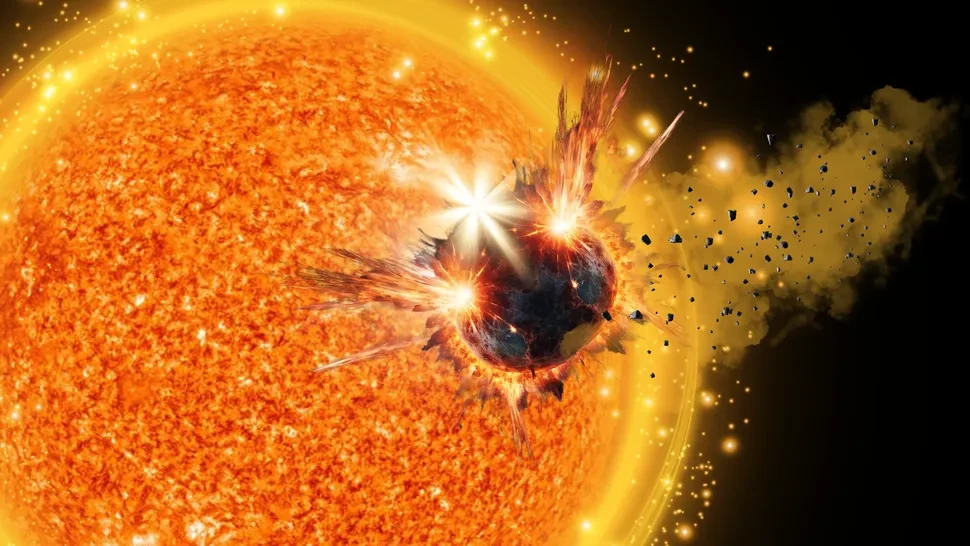
Scientists have proposed an explanation for several features of the Sun that do not fit well with standard models of its evolution. According to the new hypothesis, at an early stage of its existence the star may have swallowed a planet with a mass of five to ten Earths. If this really happened, the chemical and structural trace of such a collision may still be preserved deep inside the Sun.
The study was published on September 10 in the journal Monthly Notices of the Royal Astronomical Society.
A planet may have fallen into the young Sun
As Space.com reports, super-Earths — planets more massive than Earth — are quite common in other planetary systems. At the same time, there is no such world in the Solar System: between Earth and the larger planets there is no object of this type.
Researchers from Ege University in Turkey suggested that the explanation may lie in the Sun’s early history.
When stars like our Sun are just forming, they are surrounded by a protoplanetary disk — a flat cloud of gas and dust from which planets later emerge. Material can move between the disk and the young star, and forming planets can change their orbits.
According to one earlier hypothesis, one or more super-Earths may have formed in the immediate vicinity of the young Sun. Later, such a planet could have gradually moved closer to the star and eventually collided with it.
The new study focuses on a different question: if such a planet really fell into the Sun, can its traces be found billions of years later?
Traces may have remained in the star’s interior
To test this idea, scientists used computer models of stellar evolution and simulated various scenarios in which the Sun absorbs a planet.
The model that best matched the star’s present-day characteristics was the one in which the Sun absorbed a planet with a mass of about five to ten Earth masses — that is, a super-Earth.
Such an event, according to the authors of the study, could have left a chemical imprint inside the star. Planets form from material that is chemically different from the substance that makes up the gas around a young star. Therefore, after the absorption, some of this material could have altered the composition of the Sun’s interior and influenced the Sun’s further evolution.
The researchers link the hypothesis to several features of the star that remain not fully explained by standard models. Among them are the depth of the Sun’s convective zone and the structure of the speed of sound distribution directly beneath it.
Another mystery is connected with lithium. There is less of this element on the Sun’s surface than some models of its evolution predict. The absorption of a planet, scientists believe, could also help explain this feature.
The Sun may have preserved the “imprint” of an absorbed planet
The authors of the study note that they themselves did not expect to obtain such a specific range for the planet’s mass. However, the calculations showed that it is precisely a super-Earth five to ten times more massive than Earth that best matches the Sun’s current characteristics.
At the same time, the scientists do not claim that they have found proof of the existence of such a planet. Their conclusion is based on computer modeling and an attempt to explain features of the Sun that still cannot be fully reconciled with standard calculations.
Moreover, the model does not require that the planet must necessarily have been completely absorbed by the star. Therefore, there are other possible explanations for the observed characteristics of the Sun.
Nevertheless, the researchers believe that if a planet really was absorbed, its consequences may still be detectable today. This is not about a preserved “fragment” of an alien world inside the Sun, but rather a subtler chemical and structural trace that could have affected the star’s internal structure.
The answer may be hidden in the Sun itself
In the next stage, scientists want to test whether the signs of planet absorption predicted by the model can be detected independently.
This makes the hypothesis testable: if the necessary chemical and structural features are indeed present in the Sun’s interior, they could support the scenario of an ancient collision. If observations do not confirm the model’s predictions, then the explanation for the Sun’s features will have to be sought in other processes.
For now, the story of the absorbed super-Earth remains a hypothesis. But it offers an interesting answer to a question that arises when comparing the Solar System with other planetary systems: why do we not have a super-Earth, even though such planets are often found around other stars.
Perhaps one of them once existed and was located roughly where the planet closest to the Sun is found today. And then its orbit changed so much that the planet itself became part of the star. If future observations detect the predicted “imprints,” this will be evidence that the Sun really may have swallowed an entire world even before the Solar System we know had fully formed.