make preferable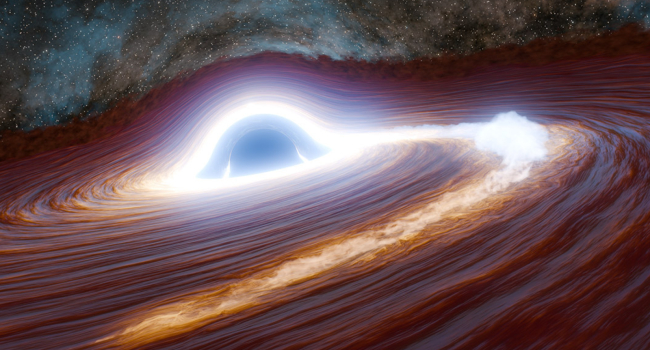
Black holes are among the most mysterious and fascinating objects in the Universe. They are regions of spacetime where gravity is so strong that not even light can escape beyond the event horizon. It is therefore unsurprising that they attract the attention of both scientists and the general public. The year 2025 was no exception: over the past 12 months, astronomers announced several impressive discoveries related to these cosmic giants.
As we move into 2026, it is worth recalling the most significant achievements in black hole research from the past year.
James Webb Detects a Rapidly Growing Supermassive Black Hole in the Young Universe
According to Space.com, in November astronomers using the James Webb Space Telescope confirmed the existence of an actively growing supermassive black hole in a galaxy that formed just 570 million years after the Big Bang. The object lies at the center of the galaxy CANUCS-LRD-z8.6, one of the so-called little red dots, a class of compact, bright, and extremely distant galaxies that JWST has been regularly discovering since 2022.
The lead author of the study, Roberta Tripodi of the University of Ljubljana, explained that the discovery was remarkable because the galaxy formed less than 600 million years after the Big Bang and not only hosts a supermassive black hole, but one that is growing far faster than expected for a galaxy at such an early epoch.
This finding challenges existing models of black hole and galaxy formation in the early Universe.
A Runaway Supermassive Black Hole
In December, JWST confirmed the first observation of a runaway supermassive black hole with a mass of 10 million Suns. It is racing through space at a speed of 2.2 million miles per hour, or 3.5 million kilometers per hour, which is about 3,000 times faster than the speed of sound on Earth.
The black hole generates a galaxy-scale shock wave ahead of it and leaves behind a 200,000 light-year-long tail in which new stars are actively forming.
Peter van Dokkum of Yale University commented that the observation was astonishing, noting that the forces required to eject such a massive black hole from its host galaxy are enormous, even though theory had predicted that such events could occur.
Cosmic Tornadoes at the Center of the Milky Way
Not all supermassive black holes are active. Sagittarius A star at the center of the Milky Way accretes matter extremely inefficiently, roughly equivalent to consuming a single grain of rice every million years. However, in March 2025 astronomers using the ALMA array discovered swirling streams of gas around Sagittarius A star, described as cosmic tornadoes, fundamentally changing the view of so-called quiet black holes.
Xin Lu of the Shanghai Astronomical Observatory explained that the research revealed these fine filaments as an important part of material circulation. He said they could be thought of as cosmic tornadoes, violent gas flows that dissipate quickly and efficiently redistribute material in the surrounding environment.
Mid-Infrared Flares from Sagittarius A Star
In January 2025, JWST recorded high-energy flares from Sagittarius A star for the first time in the mid-infrared range. These data, published in November, helped improve models of outflows from supermassive black holes.
Sebastiano von Fellenberg of the Max Planck Institute for Radio Astronomy noted that mid-infrared data are particularly valuable because JWST allows researchers to close the gap between radio and near-infrared wavelengths, which had previously been a major missing region in the spectrum of Sagittarius A star.
A Supermassive Black Hole Burp at 134 Million Miles per Hour
In December, scientists observed a plasma outflow from a black hole in the spiral galaxy NGC 3783 traveling at 134 million miles per hour, or 216 million kilometers per hour, roughly 20 percent of the speed of light. The event followed an X-ray flare detected by the XRISM and XMM-Newton telescopes.
Camille Diez, a researcher at the European Space Agency, explained that winds from active galactic nuclei play a major role in the evolution of their host galaxies and in star formation. She emphasized that understanding the magnetism of such nuclei and how they generate winds is key to reconstructing the history of galaxies in the Universe.
The Most Powerful Flare: Energy Equivalent to 10 Trillion Suns
A record-breaking flare known as J2245+3743, produced by a supermassive black hole in a galaxy 10 billion light-years from Earth, released energy equivalent to 10 trillion Suns, about 30 times more than the previous record holder from 2018, known as Scary Barbie. The event resulted from a star being torn apart by a black hole with a mass of 500 million Suns.
The flare is still ongoing, indicating that the black hole continues to consume the star. Matthew Graham of Caltech compared the process to a fish that has been swallowed halfway by a whale.
The Oldest and Most Distant Black Hole
In August, astronomers announced the discovery of the most distant known supermassive black hole, located in the galaxy CAPERS-LRD-z9, another little red dot identified by JWST. The black hole has a mass of 300 million Suns and dates to just 500 million years after the Big Bang.
Anthony Taylor of the University of Texas at Austin explained that, in the search for black holes, this discovery represents approximately the furthest distance researchers can currently probe.
Possibly the Most Massive Black Hole
Also in August, another team reported a candidate for the most massive black hole ever detected, with an estimated mass of 36 billion Suns. It resides in one of the most massive known galaxies, located about 5 billion light-years away. This object rivals the black hole in the Phoenix A cluster, which is estimated at around 100 billion solar masses.
Thomas Collett of the University of Portsmouth stated that this object ranks among the ten most massive black holes known and could plausibly be the most massive of all.
In Brief
The year 2025 brought numerous breakthroughs in black hole research thanks to JWST, ALMA, and other observatories. From rapidly growing black holes in the early Universe and runaway supermassive black holes to record-setting flares and tornado-like gas flows around Sagittarius A star, these discoveries deepen our understanding of galaxy evolution, magnetic fields, and extreme cosmic processes. They confirm that black holes have actively shaped the Universe since its earliest epochs and promise even more discoveries in the future.