make preferable

Future power systems may be able to generate electricity without heating up to temperatures at which conventional materials wear out quickly and the overall design becomes more complex and expensive. This could open the way to more compact and potentially longer-lasting energy systems — from hydrogen-powered installations to devices that today require high-temperature operating conditions. Researchers from Japan and other countries have found a material that conducts oxygen ions well already at 233°C, Nature Communications reports.
Why temperature matters
One way to generate electricity is to use fuel cells. Unlike a conventional engine, they do not burn fuel to rotate mechanical parts, but convert chemical energy directly into electricity. In solid oxide fuel cells, the electrolyte plays a key role — a special material through which oxygen ions move. For this process to proceed fast enough, such devices usually operate at high temperatures. For example, traditional systems with an electrolyte made of stabilized zirconium dioxide are designed to operate at around 700–1000°C.
Heating requires time and energy, and constant thermal stress places additional demands on materials and design. Lowering the operating temperature could potentially reduce these difficulties, decrease wear, and expand the possible applications of fuel cells. However, it is not enough to find a material that can simply withstand heat. It must conduct the required ions quickly, remain chemically stable, and not allow electric current to pass in a way that disrupts the device’s operation.
A material that conducts oxygen at 233°C
At the center of the study is a compound of bismuth, tellurium, lanthanum, oxygen, and bromine with the formula Bi₁.₉Te₀.₁LaO₄.₀₅Br. It belongs to the class of layered oxyhalides — materials whose crystal structure consists of alternating layers of different composition. At a temperature of 233°C, the material demonstrated a bulk ionic conductivity of 0.01 siemens per centimeter. This is an important показатель: it reflects how easily ions pass through the internal structure of the substance.
For comparison, a traditional electrolyte based on stabilized zirconium dioxide reaches a comparable conductivity level at about 644°C, while the LSGM material does so at 534°C. In other words, the new compound makes it possible to achieve this performance at a significantly lower temperature. This does not yet mean that a ready-made fuel cell based on it will be able to replace existing systems with the same characteristics. But the result shows that a promising electrolyte can be sought among materials that efficiently conduct oxygen ions without extreme heating.
An unexpected answer: ions move through vacant sites
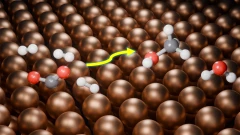
Of particular interest is not only the result itself, but also exactly how oxygen moves inside the new material. In crystals, ions occupy specific positions that form an ordered structure. For an ion to move, there must be a free space in a neighboring position. These unoccupied positions are called oxygen vacancies.
You can imagine a row of seats in a hall: a person cannot move to the neighboring seat if it is occupied. But if one seat is empty, they can move there, and their previous seat becomes vacant. A similar sequence of transitions allows ions to move through the crystal.
In materials with excess oxygen, the researchers might have expected another mechanism to play an important role — the movement of additional oxygen ions between the usual positions in the crystal lattice. However, measurements and computer modeling showed that long-range oxygen transport in the studied compound occurs predominantly through vacancies.
Calculations showed that the energy barrier for this mechanism is 0.43 electronvolts, whereas for the alternative mechanism involving additional oxygen ions it is 0.74 electronvolts. The lower this barrier, the more easily particles can move at a given temperature.
According to the authors, the layered structure of the material itself plays an important role. It creates conditions in which oxygen ions can move relatively easily within certain layers of the crystal.
Why this matters for practical applications
High conductivity alone does not yet make a material suitable for energy equipment. The electrolyte must retain its properties in different gas environments and must not break down when operating conditions change.
The researchers tested the new material in oxidizing and reducing atmospheres, in humid and dry environments, and also in the presence of carbon dioxide. Under the studied conditions, the compound retained its chemical stability; no noticeable change in its volume under chemical воздействие was observed either.
This is important for fuel cells, where different parts of the device come into contact with different gases. The electrolyte must enable the transport of oxygen ions without losing its properties upon contact with the operating environment.
The authors also found that charge transport is mainly associated specifically with oxygen ions, rather than electrons or protons. For a fuel cell electrolyte, this is fundamental: the material must conduct the required ions, but must not create an unwanted path for electronic current through the electrolyte itself.
At the same time, the development has an important limitation. In practice, resistance is created not only by the crystal itself, but also by the boundaries between individual grains of the material. Therefore, the measured conductivity of the whole sample may be lower than the conductivity of its internal structure. To use the compound in a real device, scientists will have to optimize the ceramic structure, grain size, and material density.
From a laboratory result to the energy sector of the future
The study is not limited to a single compound: the scientists also investigated other related oxybromides and oxyiodides, some of which also showed noticeable oxygen-ion conductivity. This makes it possible to view the work not only as a search for one successful substance, but also as a way to design an entire family of potential electrolytes.
If further tests confirm the efficiency and durability of such materials as part of full-fledged devices, lowering the operating temperature could make it easier to create fuel cells for stationary power supply and other applications where stable operation and reduced heating requirements are important.
But before practical implementation, there is still a long path from laboratory measurements to engineering optimization and testing of finished systems. For now, the researchers’ main achievement is demonstrating that high oxygen-ion conductivity is possible at much lower temperatures, as well as identifying the mechanism that helps achieve this result.