make preferable
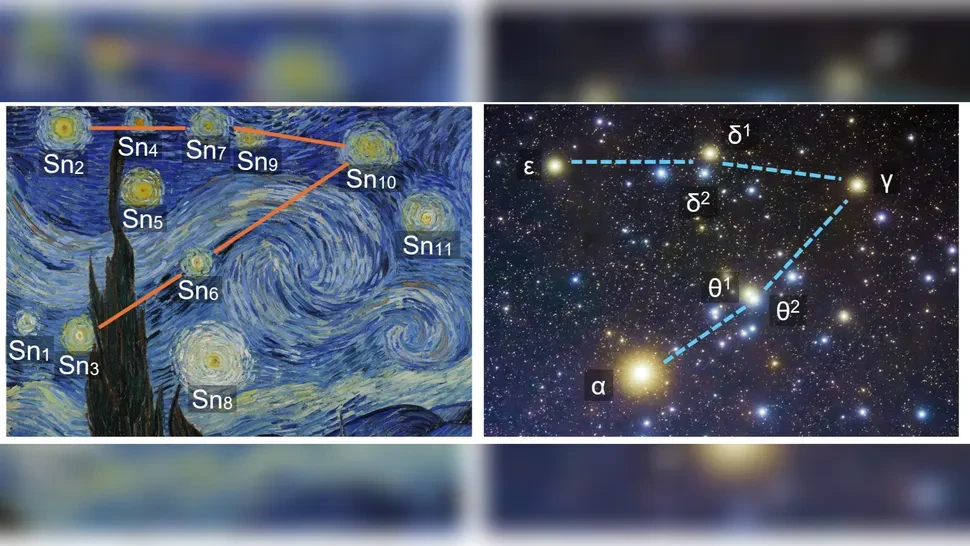
Vincent van Gogh’s famous painting The Starry Night may depict not just a fantastic whirl of light and color, but a very specific sky above the French town of Saint-Rémy-de-Provence. Researchers compared the positions of celestial objects in the painting with 19th-century astronomical data and concluded that the closest match falls in the pre-dawn hours of July 22, 1889. This calls into question the painting’s usual dating: art historians long believed that the artist painted it in June.
The stars on the canvas as an astronomical puzzle
The Starry Night has long attracted the attention not only of art historians, but also of astronomers. The swirling sky, bright stars, and glowing crescent Moon look so unusual that a natural question arises: how accurately did Van Gogh depict what he actually saw?
Attempts to find the real celestial prototype for the painting were made several decades ago. In 1984, art historian Albert Boime and astronomer George Abell of the University of California, Los Angeles began investigating possible correspondences between the image and the real sky. Later, astronomer Charles Whitney of Harvard University joined the search. However, their analyses led to different results, and it was not possible to establish a single convincing date.
A new attempt was made by a team led by Elijah Jonghyeon Kim, head of the South Korean company SLLAB, which develops robotic telescopes, and a graduate student at Kyung Hee University’s School of Space Research.
The researchers decided not to limit themselves to visual resemblance. They combined astronomical calculations with a study of Van Gogh’s letters and the circumstances of his life in the summer of 1889, and also drew on ecological and meteorological data.
How they found the right sky
First, the team reconstructed the positions of celestial objects above Saint-Rémy-de-Provence, taking into account the place from which the artist could have observed the sky. The researchers then compared the configuration of the stars in the painting with the arrangement of objects on historical astronomical charts.
To do this, they used a method known as Procrustes analysis. It makes it possible to compare two groups of points while accounting for differences in position, scale, and rotation. This approach is especially useful for analyzing paintings: the artist may have depicted a constellation larger than it appears in reality, or slightly changed its tilt.
After aligning the images, the method evaluates the remaining discrepancies. In this way, the researchers were able to quantitatively test the similarity of the celestial configurations, which in previous studies had been described mainly visually.
But a match in the star points alone was not enough: different constellations could produce a similar result. So the team checked whether the corresponding objects were actually located in the right part of the pre-dawn sky on the proposed date, whether they could have fallen within the artist’s field of view, and whether the depicted positions of the Moon and Venus matched the calculated ones.
According to the researchers, the object that best satisfied all these conditions was the Hyades star cluster. Together with the positions of Venus and the waning crescent Moon, it points to the sky above Saint-Rémy-de-Provence around July 22, 1889.
Why July does not match the usual dating
The main difficulty is that art historians have traditionally dated The Starry Night to June 1889. The new study does not prove that the painting was completed precisely in July, but it offers a possible explanation for the discrepancy.
Van Gogh’s letters contain evidence of his long-standing interest in the starry sky. As early as April 12, 1888, the artist wrote that he would like to try to depict the starry sky in the same way that, during the day, he might paint a green meadow dotted with dandelions.
There is also a piece of evidence closer in time. In a letter dated to the period between late May and early June 1889, Van Gogh described how he had long observed the countryside from his window before sunrise. In his field of view was the “morning star,” which seemed very large to him. By this name, the artist was probably referring to Venus, one of the brightest objects in the pre-dawn sky.
These notes suggest that Van Gogh regularly observed the sky before dawn. However, they do not confirm that he saw the exact configuration corresponding to July 22. The link between the letters and the specific date remains the researchers’ interpretation, not an established historical fact.
There is another argument in favor of revising the chronology: some leading art historians have noted that stylistically, The Starry Night differs from Van Gogh’s other works created in June. This alone does not establish the date of its creation, but it does raise further questions about the generally accepted version.
The painting may have been conceived in June and finished in July
The study’s authors propose a cautious hypothesis: Van Gogh may have conceived the painting in June and completed it after July 22, 1889. In that case, the artist’s letters, his observations of the pre-dawn sky, and the astronomical match would not contradict one another.
At the same time, the researchers do not claim that Van Gogh literally transferred what he saw onto the canvas. Even if the celestial objects have a real prototype, their placement, size, and movement in the painting may have been altered for artistic purposes. The Starry Night remains a work of art, not a precise sketch of an astronomical observation.
To finally resolve the dating, further research in art history and materials science will be needed, including analysis of the painting itself and a more detailed study of the artist’s documents.
The study was published on October 22, 2026, in the journal Scientific Reports. Its main conclusion is not that the mystery of The Starry Night has been definitively solved, but that one of the most recognizable depictions of the night sky in the history of art may have a specific astronomical moment behind it—one that can be tested through calculations.