make preferable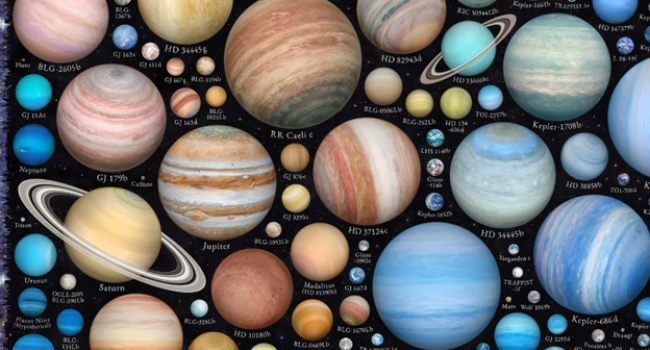
Astronomers from the University of Tokyo have developed a method that, for the first time, makes it possible to confidently divide hot Jupiters into two types based on how they migrated toward their host stars: those that moved smoothly within the protoplanetary disk, and those that experienced chaotic gravitational scattering. The study was published in The Astronomical Journal.
The Mystery of Hot Jupiter Migration
Hot Jupiters are massive gas giants that orbit their stars in just a few days. Since the discovery of the first such planet in 1995, one thing has been clear: they form far from their stars and later migrate inward. The key question has been how this migration happens.
There are two main hypotheses:
- Chaotic migration: gravitational interactions with other bodies stretch the planet’s orbit into an ellipse; the planet plunges toward the star, and tidal forces later circularize the orbit.
- Calm migration: the planet slowly loses energy within the gas-and-dust disk, maintaining an almost circular orbit throughout the process.
The problem is that even a perfectly circular and well-aligned orbit today does not prove a calm past. Over time, tidal forces erase the traces of earlier chaos.
A New Method: Timing the “Circularization”
Yugo Kawai and Akihiko Fukui proposed a simple yet elegant criterion: calculate how long it would take for tidal forces to circularize a planet’s orbit after a chaotic migration. This timescale depends on the planet’s mass, its distance from the star, and other physical parameters.
If the calculated circularization time exceeds the age of the planetary system, then the planet could not have undergone a highly elongated orbit in the past. In that case, it must have migrated inward smoothly.
By analyzing more than 500 known hot Jupiters, the researchers identified about 30 whose orbits are too “perfect” for their ages. These planets most likely migrated inward calmly within the protoplanetary disk.
Why This Matters
Such “calm” hot Jupiters preserve a kind of memory of their birthplace. The composition of their atmospheres reflects the chemistry of the region of the protoplanetary disk where they formed. Studying their chemical makeup, including elemental ratios and isotopes, can reveal how planetary systems form in general, including our own Solar System.
In Brief
A new method based on the timescale of tidal orbital circularization has identified about 30 hot Jupiters that migrated smoothly through the gas disk rather than through gravitational chaos. This opens a window into the early chemistry of protoplanetary disks and brings us closer to understanding how planetary systems like the Solar System were formed. Another step toward unraveling the origins of planets.