make preferable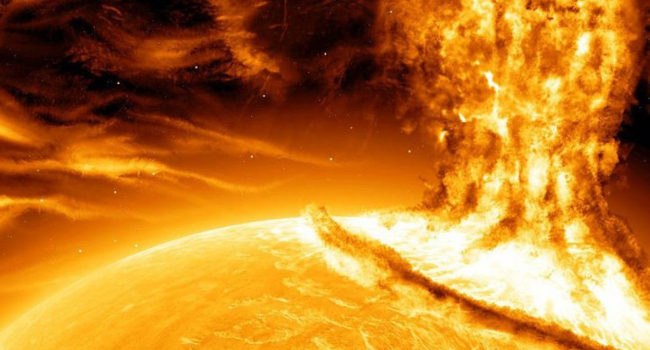
In the southern hemisphere of the Sun, the largest sunspot complex of 2025 has formed, with its area reaching record values. According to the Solar Astronomy Laboratory of the Space Research Institute (IKI) of the Russian Academy of Sciences, this structure, which rotated toward Earth only two days ago, may be accumulating energy for an exceptionally powerful flare — a so-called superflare. The unusual silence in such a massive region raises questions comparable in mystery to the “silence of the Universe.”
Record Size and Unusual Quiet
The total area of the complex, measured on the morning of December 1, reached 1600 millionths of a solar hemisphere, which is one third larger than the previous 2025 record (1200 in May) and about 60 percent of the largest sunspot groups of the twenty-first century (up to 2800). NOAA astronomers divided the formation into three groups: 4296 (left), 4294 (central), and 4298 (right).
Despite its enormous size, the region remains unusually calm: no flares, no eruptions, no visible activity. “Either there is a serious intention here to go down in history by accumulating energy for a superflare, or sometimes there are big and kind people — so let us assume a big and kind sunspot has formed on the Sun. Let us believe in the second option and send rays of kindness back,” the laboratory notes with irony.
Why This Could Lead to a Superflare
Sunspots are regions of strong magnetic fields, where energy is stored in twisted loops. Usually, such giant structures quickly release this energy through M- or X-class flares, causing radio interference and geomagnetic storms on Earth. But if the release is delayed, the pressure grows, raising the possibility of a superflare at the level of X20+ or even higher, comparable to the Carrington Event of 1859, which burned telegraph lines around the world.
Recall that on December 1, the Sun already produced an X1.95 flare — the fifth strongest this year — but it occurred in another region. Now that the giant complex has turned toward Earth, the risk increases: the Sun–Earth line may fall directly in its path.
Consequences for Earth
If a superflare occurs, the consequences would be serious: global radio interference, satellite failures, GPS disruptions, and powerful geomagnetic storms (G5 level). In 1989, a similar event left Quebec without power for nine hours. However, precise forecasting is impossible — the region could erupt in the coming days or remain quiet.
In Brief
The largest sunspot complex of 2025, with an area of 1600 millionths of a solar hemisphere, has formed on the Sun — one third larger than the May record. Its unusual calm leads IKI RAS scientists to suspect that energy is accumulating for a potential superflare that could affect Earth. The risk is high, but predictability is low. Observations in the coming days will be crucial.