make preferable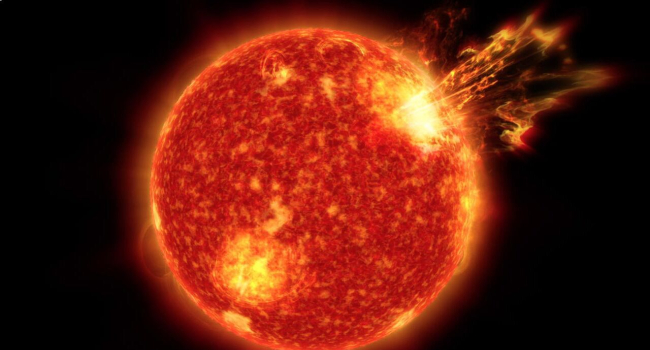
On the morning of December 1, 2025, the Sun released its first X-class flare in two weeks — an X1.95 event. This became the fifth strongest flare of the year and once again confirmed that the single active region No. 4274 on the northeastern limb continues to keep the star in a state of complete chaos. The Solar Astronomy Laboratory of the Space Research Institute of the Russian Academy of Sciences and the Phobos center recorded the peak at 05:49 Moscow time (06:49 Yerevan time).
What happened and why it matters
At 05:49 MSK (06:49 AMT), a powerful explosion took place in region 4274, releasing energy stored in twisted magnetic loops. On the GOES scale, the X-ray flux reached X1.95 — only about 5 percent weaker than the record-setting X2.2 flare observed in February 2025.
Since October 2025, region 4274 has been almost solely responsible for all extreme solar activity. It has produced a series of strong flares and several coronal mass ejections that have already triggered G3–G4 geomagnetic storms on Earth.
Good news: Earth is almost unaffected
The key point is that the flare occurred on the northeastern limb, far from the direct Sun–Earth line (about 70–80 degrees in heliographic longitude). This means:
- The main flow of charged particles will move away from our planet.
- Only a weak sideways impact from plasma is possible in 4–5 days, if the ejection is wide enough.
- If a geomagnetic storm occurs at all, it will not exceed G1–G2 (minor to moderate).
According to current estimates from SDO, SOHO, and the Space Research Institute, the probability of a significant Earth-directed CME is below 10 percent.
Why region 4274 is so active
This is the remnant of a giant sunspot group that crossed the visible disk in November and produced several powerful M-class and X-class flares. It is now returning to the limb, but its magnetic configuration remains extremely unstable — a typical beta-gamma-delta structure, with opposite polarities tightly intertwined and constantly generating new outbursts.
What to expect next
- Over the next two to three days, region 4274 will continue rotating toward the edge of the disk and may produce more M-class and X-class flares.
- It is expected to fully rotate off the limb by December 5–6.
- Its next “dangerous” return to the visible side will be in January 2026.
In short
On December 1 at 05:49 MSK (06:49 AMT), the Sun produced an X1.95 flare — the fifth strongest event of 2025 and the first X-class flare in two weeks. The same region 4274 is responsible, keeping the star in an extreme state since October. Earth is lucky: the flare occurred far from the Sun–Earth line, so no strong geomagnetic storms are expected. But the Sun clearly is not calming down yet — several more days of potentially hazardous activity lie ahead.