make preferable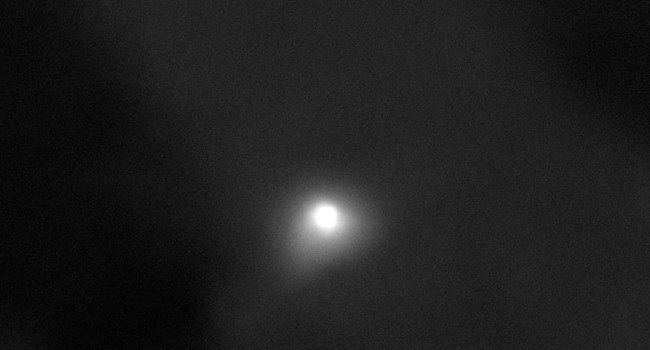
The American space agency has released the first detailed images of the interstellar comet 3I/Atlas — only the third confirmed object to enter the Solar System from another stellar system. The comet, discovered in the summer of 2024, passed just 29 million kilometers from Mars in October, giving scientists a rare opportunity to study it simultaneously with several orbiting spacecraft.
What the Visitor from Interstellar Space Looks Like
In images captured by the HiRISE camera aboard the Mars Reconnaissance Orbiter, 3I/Atlas appears as a pale, blurry spot with a bright semicircular core and a long, translucent tail extending downward and to the side. The comet is estimated to measure between 440 meters and 5.6 kilometers across. Its hyperbolic trajectory and speed of about 60 km per second leave no doubt that it formed outside the Solar System, in a much older stellar environment.
In addition to American spacecraft, the comet was photographed by two Mars orbiters operated by the European Space Agency (ESA). NASA and ESA missions, along with dozens of ground-based observatories, are expected to continue observing it in the coming weeks.
Where and When It Can Be Seen from Earth
3I/Atlas is already visible to amateur observers: in the pre-dawn hours, it can be seen in the eastern sky with binoculars or a small telescope. Its closest approach to Earth will occur in mid-December 2024, after which it will leave the Solar System forever.
Sean Domagal-Goldman, the acting director of NASA’s Astrophysics Division, commented that anyone with a telescope would likely want to observe it and that such an opportunity is both extremely rare and remarkably exciting.
Observations from Deep Space
The ESA spacecraft Juice, now en route to Jupiter, is of particular interest. Throughout October and November, its cameras and instruments were directed at 3I/Atlas, especially after the comet passed perihelion. Data from Juice will not reach Earth until February 2025, as the spacecraft’s main antenna is currently being used as a thermal shield.
“This Is Definitely a Comet, Not an Alien Ship”
Amid inevitable speculation about whether the object could be artificial, NASA issued a prompt clarification. Amit Kshatriya, NASA’s deputy administrator, emphasized that 3I/Atlas is a comet. He noted that the agency actively searches for signs of extraterrestrial life, but this object does not fall into that category.
In Brief
NASA and ESA have released the first detailed images of 3I/Atlas, the third interstellar comet in history. The object, up to 5.6 km in size, passed 29 million km from Mars, was photographed from Martian orbit, and is now visible in amateur telescopes. Its closest approach to Earth will occur in mid-December 2024, after which it will permanently leave the Solar System. Scientists underline that it is a natural object, not an alien probe.