make preferable
The powerful geomagnetic superstorm of May 2024, known as the “Gannon Storm” or the “Mother’s Day Storm,” became the most intense event of the past two decades. For the first time, scientists in Japan directly recorded how such an event can compress the plasmasphere — the protective layer of charged particles surrounding Earth — to one fifth of its usual size. The findings were published in the journal Earth, Planets and Space.
What the Plasmasphere Is and Why Its Compression Is Dangerous
The plasmasphere is a “doughnut” of cold plasma that surrounds Earth at altitudes ranging from a few thousand to tens of thousands of kilometers. It acts as a buffer, shielding satellites, astronauts, and ground systems from excessive radiation. Normally, the outer boundary of the plasmasphere (the plasmapause) lies at a distance of about 4 to 6 Earth radii (roughly 25,000–38,000 kilometers from Earth’s center, or about 44,000 kilometers above the surface when calculated at the equator).
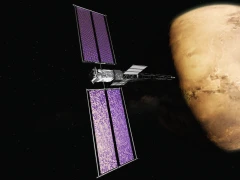
During the superstorm on May 10–11, 2024, Japan’s scientific satellite Arase (launched by JAXA in 2016) was inside the plasmasphere and recorded a new extreme: the plasmapause collapsed to only 2.5 Earth radii — about 9,600 kilometers above the surface. This is the lowest value ever measured directly.
How the Storm Compressed the Plasmasphere
A series of powerful coronal mass ejections from the Sun struck Earth’s magnetosphere. Within hours, the plasmasphere lost up to 80 percent of its usual volume. This was caused by two simultaneous processes:
- Strong heating of the polar atmosphere, which led to the expansion of upper layers and the “blowout” of plasma outward.
- A “negative storm” event — a sharp drop in oxygen ion concentration in the ionosphere, cutting off the normal supply of hydrogen plasma that replenishes the plasmasphere.
Recovery took more than four days, the longest period observed in seven years of Arase operations.
Consequences: Auroras Over Japan and Mexico
Because Earth’s magnetic field was heavily compressed, energetic particles penetrated much closer to the equator than usual. As a result, bright auroras were observed at unusually low latitudes: in Japan, China, Mexico, the southern United States, and even southern Europe. This became one of the most widespread auroral displays in recent decades.
Why the Discovery Matters
The study, led by Atsuki Shinbori of Nagoya University, is the first to clearly link negative ionospheric storms with delayed plasmasphere recovery. This will help improve predictions of near-Earth space behavior during extreme solar events, which is especially important as activity in Solar Cycle 25 continues to rise, with its peak expected in 2025–2026.
In Short
The May 2024 superstorm compressed Earth’s plasmasphere fivefold — from about 44,000 kilometers to 9,600 kilometers above the surface. Japan’s Arase satellite recorded the event directly and showed that recovery took more than four days due to a negative ionospheric storm. The discovery will aid in better protecting satellites and power systems during future solar storms.