make preferable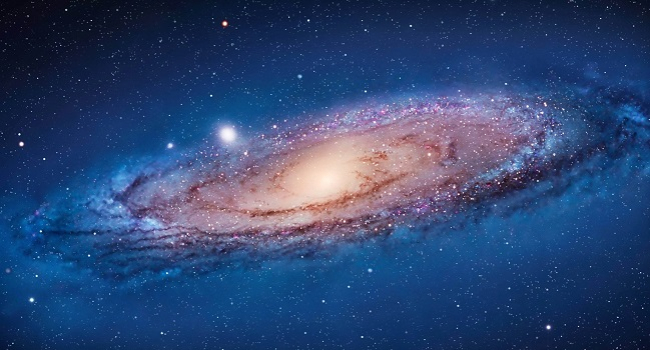
At the SC25 conference in Atlanta, an international team led by Keiya Hirasima from Japan’s RIKEN iTHEMS center presented a breakthrough simulation of our galaxy — the most detailed and the fastest ever created. For the first time, the Milky Way has been modeled “star by star”: the simulation includes the trajectories and evolution of more than 100 billion individual stars, almost all that actually exist.
The Key: A Hybrid of Neural Networks and Classical Physics
For decades, traditional galaxy simulations hit a fundamental barrier: to fit an entire galaxy into a supercomputer, researchers had to “merge” thousands or millions of stars into a single particle with a mass of billions of Suns. Meanwhile, fast astrophysical processes such as supernova explosions and shock waves required extremely small time steps. As a result, simulating one million years of galactic evolution took hundreds of hours, and one billion years stretched into decades of real time.
The RIKEN team solved the problem in a radical way:
- They first ran ultra-detailed simulations of individual supernova explosions on the Fugaku supercomputer, with a spatial resolution of tens of parsecs and time steps measured in years.
- They then trained a deep neural network to predict how the shock wave and gas cloud would evolve over the next 100,000 years — with the accuracy of the physical model but almost instantaneously.
- This “surrogate” AI module was integrated into the global galactic simulation.
The Results Are Astonishing
- Resolution increased 100-fold (each particle now represents one star)
- Simulation speed increased by more than 100 times
- One million years of Milky Way evolution now takes 2 hours 47 minutes to compute
- One billion years takes less than four months (previously it required 36 years)
What This Means for Science
- Precise element formation: For the first time, researchers can trace how supernovae and neutron stars “forge” carbon, oxygen, iron, and heavy elements that eventually form planets and living organisms.
- Dark matter dynamics: The model shows how the invisible dark-matter framework of the galaxy influences the orbits of billions of stars.
- The Milky Way’s history: It becomes possible to reconstruct the galaxy’s evolution from its first stars to its mergers with dwarf galaxies, including the recent absorption of Gaia-Enceladus.
Beyond Space: A Revolution for Computational Science
The same approach is already being tested in climatology, oceanography, and meteorology. In all fields that require modeling both global processes and microscopic phenomena (turbulence, chemical reactions, cloud formation), the “physics + AI” hybrid delivers speedups by factors of tens or hundreds.
Keiya Hirasima stated that humanity stands at the threshold of a fundamental shift: artificial intelligence is no longer merely a tool for image recognition but is becoming a full-fledged partner to physics in discovering new laws of nature.
In Short
In 2025, scientists simulated the Milky Way with 100 billion individual stars for the first time. A hybrid method combining classical physics and neural networks boosted the speed and resolution of calculations by more than 100 times. A billion years of galactic evolution can now be computed in months rather than decades. This is not only the most accurate model of our galaxy — it marks the beginning of a new era in computational science, where AI helps uncover the universe’s mysteries at the level of fundamental physics.