make preferable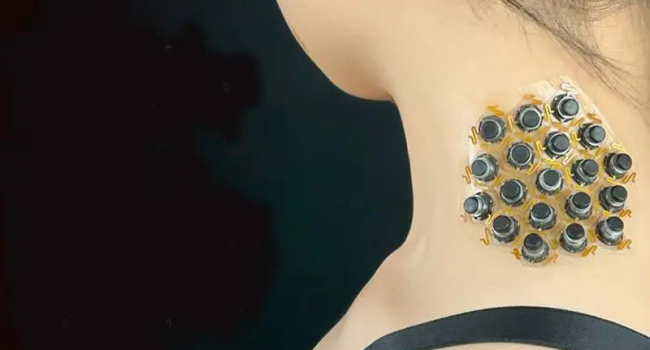
Researchers at Northwestern University (USA) have developed a high-tech patch that allows users to experience a wide range of tactile sensations, from gentle touches and strokes to firm pressure and stretching. This invention has applications in both entertainment, such as providing feedback in virtual reality, and in healthcare, by helping visually impaired people better navigate their surroundings.
The patch prototype consists of a hexagonal silicone base with 19 actuators, which can vibrate or press on the skin at the point of contact. The main innovation lies in the actuators, which are noted for their record-breaking energy efficiency.
The actuators receive signals from a smartphone via Bluetooth, with each containing a miniature battery. Software controls the sequence and mode of actuator activation to transmit specific tactile sensations to the skin. The researchers have designed a solution that allows the actuators to maintain two stable states without consuming energy. This feature is especially valuable for long-term wear.

According to the researchers, they harnessed the natural elasticity of human skin. When the actuator applies pressure, the skin compresses and remains in a tense state until a release command is given, at which point the actuator switches to the opposite state using only the stored compression force and without additional energy.
In addition to delivering tactile sensations for games and virtual experiences, the proposed tactile patch offers visually impaired individuals a form of "basic vision." It acts as a substitute for the cane they use to sense their surroundings. Now, a smartphone's LiDAR sensor can perform this task, transmitting coded information to the patch’s sensors. Experiments on volunteers have shown that the system works effectively and can replace a cane, making life more convenient for people with poor or no vision.