make preferable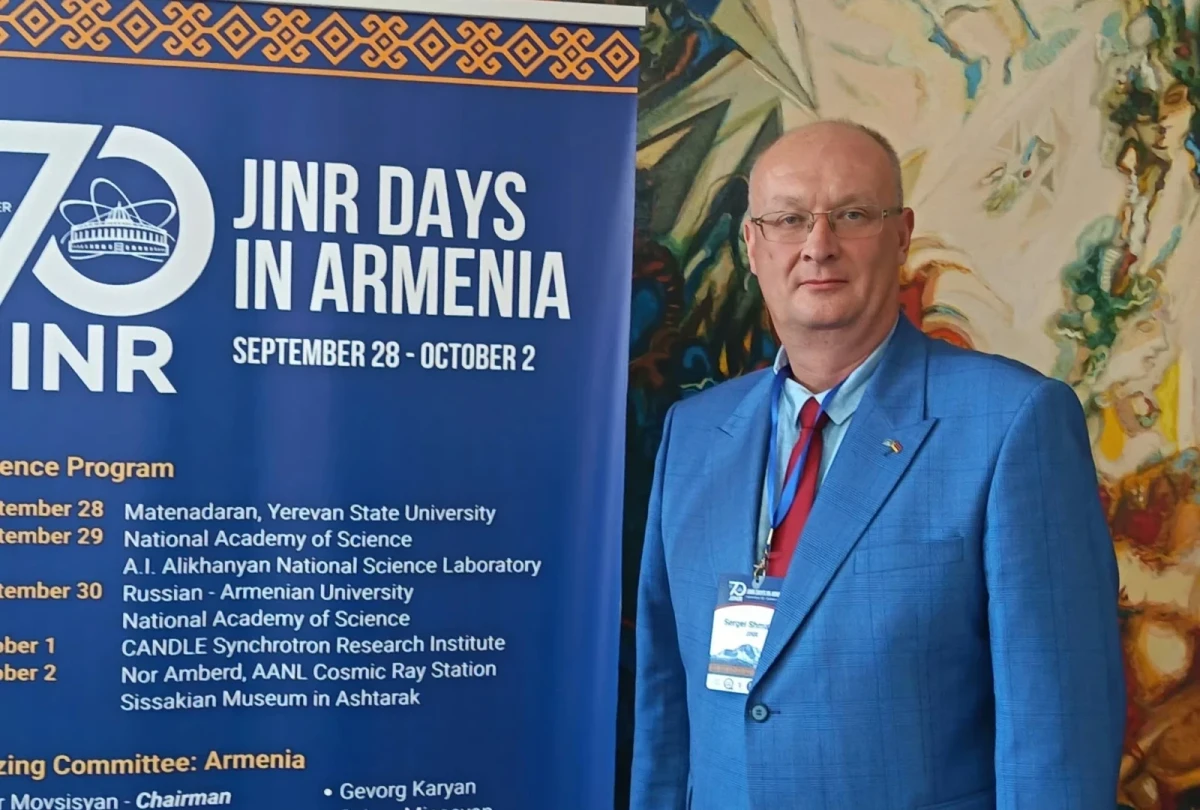
Scientific organizations in Armenia and the Joint Institute for Nuclear Research (JINR) in Dubna are discussing the possibility of creating a unified computing infrastructure that would allow them to jointly use supercomputing power and work with data from major scientific experiments. This is not only about giving Armenian researchers access to Dubna’s computing resources, but also about combining computers located in different countries into a single distributed system.
This was stated in an interview with NEWS.am Tech by Sergey Shmatov, Director of the JINR Laboratory of Information Technologies. According to him, the technical foundation for such cooperation already exists: Yerevan has its own computing facilities, while Dubna hosts one of the region’s largest scientific computing infrastructures.
From remote access to a unified system
Today, Armenian researchers can already use JINR’s computing resources remotely for individual tasks. The next step should be the integration of the capacities of Dubna and Armenian research centers, the specialist noted.
In particular, this concerns the supercomputer of Yerevan State University and the computing resources of the Russian-Armenian University. In the future, they could become part of a shared distributed infrastructure together with JINR’s computing centers. The idea is for the computers not simply to provide each other with access, but to operate as a single system. If the capacity of one center is not being used at a given moment, it can be directed to the tasks of researchers from another center.
“We would like to apply our experience in this area to solving this task. In that case, we will increase the performance of computer resources and ensure their efficiency,” Shmatov explained.
Similar systems are already used in international scientific projects. One of the best-known examples is the processing of data from Large Hadron Collider experiments. For this purpose, a global computing infrastructure has been created, bringing together hundreds of scientific centers.
JINR plans to use a similar approach in cooperation with Armenian organizations as well.
Data from Dubna could be processed in Yerevan
Combining computing capacities is important not only for additional performance. The second key element is access to scientific data. Modern accelerator experiments generate enormous volumes of information. Some of the data obtained in Dubna could be transferred to Armenia, where local research groups would be able to work with it.
This is especially relevant for projects at the NICA accelerator complex at JINR. In this case, Armenian specialists would be able not only to send computational tasks to Dubna’s facilities, but also to gain direct access to experimental data. According to Shmatov, this would make it possible to expand the circle of researchers working with such data: the information would not remain exclusively in a single computing center.
At the same time, this is not about a classic cloud service that would unite the above-mentioned centers. The system should be based on so-called grid computing — a distributed computing technology that has been used in the scientific community for more than two decades. In such an architecture, many independent computing centers are combined into a single infrastructure and jointly process tasks and data.
What about security?
Scientific data do not automatically become publicly accessible in this process, the specialist noted in response to a question about how secure such a merger of computing capacities would be.
In a grid infrastructure, researchers are organized into so-called virtual organizations — communities linked to specific scientific experiments or projects. Only members of the relevant group are granted access to the data. Authentication and security systems are used for this purpose, including special certificates and tokens. Administrators control who uses the computing resources and in what way.
At the same time, experiment data may remain closed until the publication of the results. Sometimes thousands of researchers who are part of the relevant international collaboration have simultaneous access to them, while the information remains inaccessible to all other users.
After publication, some of the data can, if desired, be moved into Open Data mode.
An additional layer of protection is provided by the very nature of scientific data itself. To interpret them, it is not enough simply to obtain a set of files: specialized software created by the scientific collaborations themselves is used for processing.
Yerevan could be connected within one to two months
From a technical point of view, creating such a connection does not require a multi-year project. According to Shmatov’s estimate, if the necessary agreements and specialists are in place, connecting a new center to such an infrastructure could take approximately one to two months.
At the same time, JINR is ready to help Armenian specialists prepare to work with the system. Staff from Yerevan would be able to come to Dubna, undergo the necessary training, and then return to support the infrastructure in Armenia.
Thus, the main limitation now is not so much the cost of equipment as the availability of specialists, time, and organizational agreements.
“The advantages here are obvious, and there is only one drawback. It requires investing one’s own intellectual effort and time,” Shmatov noted.
Additional financial investments would be required only if the existing computing capacities prove insufficient and the centers have to be expanded. The integration of already available resources itself, according to him, could become a kind of additional bonus for scientific research.
As a result, Armenian researchers would have the opportunity to use not separate computers in Yerevan or Dubna, but a distributed international infrastructure in which computing resources and scientific data work together.
It is precisely this approach that is becoming one of the key elements of modern science today: a major experiment may be located thousands of kilometers away from the researcher, while the data and computing power needed for the work are effectively just a few clicks away.