make preferable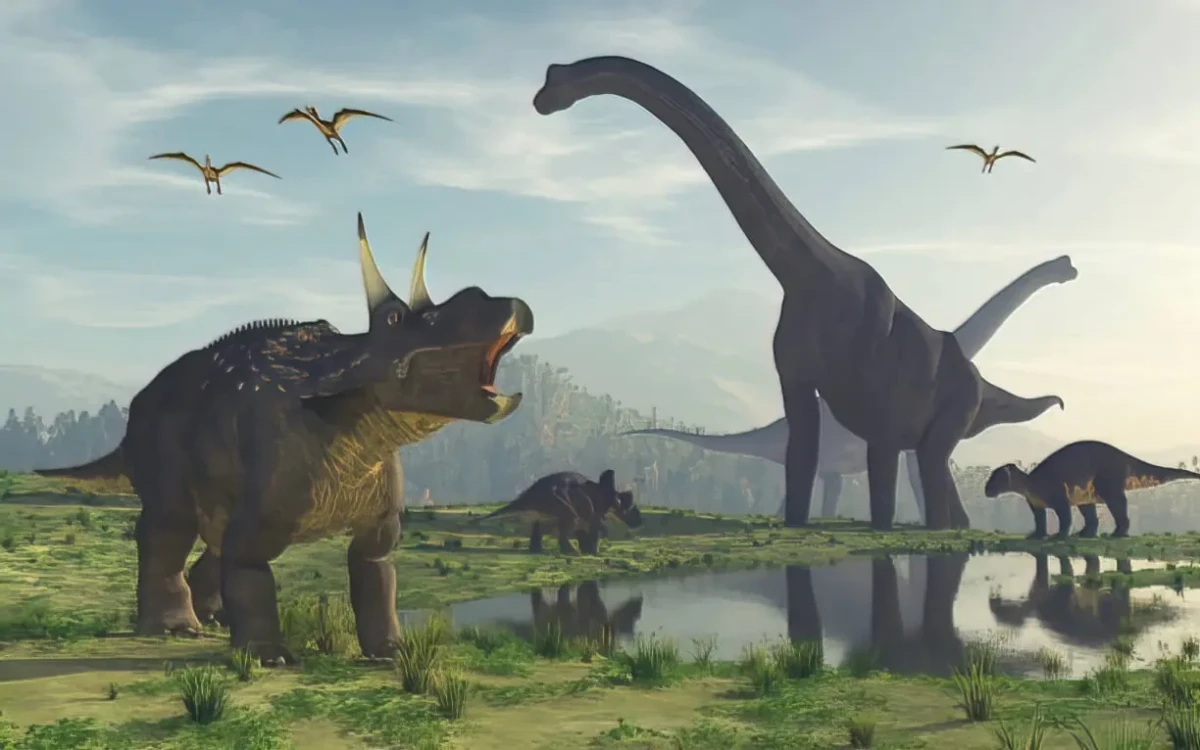
Over hundreds of millions of years, Earth has begun rotating more slowly, so the length of a day has noticeably increased. In the time of the dinosaurs, a day lasted about 22 hours — roughly two hours less than it does now. At the same time, the process of the planet’s rotational slowdown is not uniform: Earth’s rotation speed constantly fluctuates under the influence of various factors.
Why Earth is gradually slowing down
The length of a day is directly linked to the speed of Earth’s rotation around its axis. In the long term, this speed decreases, and days become longer.
According to Sergey Pasynok, head of the Department for Determining Earth Rotation Parameters at the All-Russian Scientific Research Institute of Physicotechnical and Radio Engineering Measurements of Rosstandart, when averaged over hundreds of millions of years, the length of a day increases unevenly. In the age of the dinosaurs, it was about 22 hours.
However, it would be incorrect to speak of a constant and smooth slowdown in rotation. Earth’s rotation is a complex process influenced by many factors, so the length of a day changes both regularly and irregularly.
In recent decades, the opposite process has been taking place
The long-term trend does not mean that every few million years a day necessarily becomes longer by the same amount. Over relatively short periods of time, the direction of change can shift.
Thus, according to Pasynok, over the past 70 years Earth’s rotation speed has, on the contrary, increased. As a result, the length of a day has shortened slightly over this period.
Such fluctuations matter not only for astronomy. Modern timekeeping systems must take into account the planet’s actual rotation speed, since astronomical time and extremely precise atomic clocks can gradually drift apart.
Why scientists need a leap second
It is precisely because of changes in Earth’s rotation speed that UTC must be periodically adjusted using leap seconds. Scientists are now discussing the possible introduction of a negative leap second — that is, the removal of one second from the time scale.
Such a need may arise before 2035 amid the acceleration of Earth’s rotation. The issue is expected to be discussed at the 28th General Conference on Weights and Measures.
The problem is that digital infrastructure is accustomed to operating with a fairly predictable flow of time. An unusual UTC adjustment could create difficulties for telecommunications systems, power grids, satellite navigation, and other systems where synchronization is critically important.
This creates a paradox: on the scale of hundreds of millions of years, Earth is gradually slowing its rotation and increasing the length of a day, but over certain intervals, including recent decades, the planet may rotate faster. That is why measuring time on Earth remains not just a matter of clocks, but a complex challenge at the intersection of geophysics, astronomy, and modern digital infrastructure.