make preferable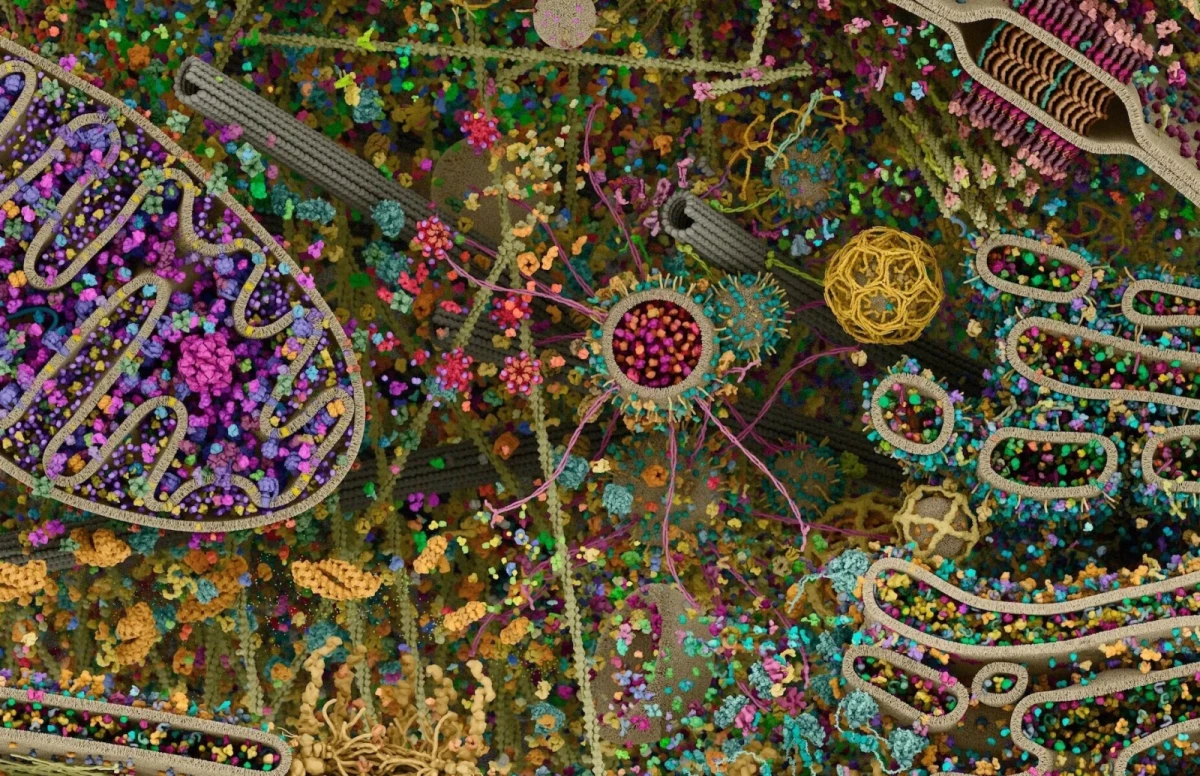
The human body is made up of trillions of cells, and each of them is a complex biological system capable of perceiving information, exchanging resources with neighboring cells, adapting to changes in the environment, and retaining molecular memory of its own origin. New research is prompting scientists to take a fresh look at the capabilities of these microscopic structures, including the ability of adult cells to preserve and, under certain conditions, restore information about their embryonic past.
The smallest yet most fundamental unit
The cell is the smallest yet most fundamental unit of life upon which all processes in the human body are built. A typical human cell is surrounded by a membrane and filled with cytoplasm, within which are organelles—structures that perform specialized functions. For example, mitochondria are responsible for energy production, while the nucleus contains genetic material in the form of DNA.
At the same time, the scale of the cellular world is difficult to imagine. About 10,000 average-sized cells could fit on the head of a pin. But microscopic size does not mean simplicity of structure: a single human cell contains about 37 organelles, approximately 12,000 different proteins, and around 42 million protein molecules.
Cells can “communicate”
Cells do not exist in isolation. A significant part of their work is connected not only with their own survival but also with maintaining the condition of the surrounding tissue. Cellular communication is necessary to preserve balance in tissues, coordinate various processes, and respond to changes in the external environment. Cells are capable not only of exchanging chemical signals but also of directly passing necessary substances to one another.
One mechanism for such exchange is the recently discovered tunneling nanotubes—tiny tube networks, or TNTs. If a cell experiences stress or becomes diseased and sends out a chemical distress signal, neighboring cells can extend hollow tubes toward it. Through them, essential resources are transferred—RNA, proteins, and even whole organelles. Cells also have other ways of exchanging substances, including intercellular contacts known as gap junctions, as well as exosomes.
Thus, tissue turns out to be not just a collection of individual cells, but a system in which its elements constantly interact and help one another maintain stability.
Cells retain memory of their past
Even more unexpected was the discovery related to cellular memory. Researchers at the Dana-Farber Cancer Institute found that adult tissues preserve, in DNA, information about the embryonic cells from which they formed. Moreover, this memory, as it turned out, does not necessarily remain inaccessible forever: under certain conditions, it can be restored.
The discovery may change our understanding of what cells are capable of and may matter for future studies of degenerative and other diseases. In particular, it may help explain how healthy cells can “pick up” cancer-related changes.
Other studies show how complex the mechanisms of tissue self-regulation can be. Scientists at the Pasteur Institute discovered a process in which dying cells temporarily protect neighboring cells from death. Thanks to this, tissue is able to maintain stability and continue renewing itself.
What cells “know” about the surrounding world
Cells constantly have to adapt to the conditions in which they exist. At the same time, humans create additional burdens for them that they were not originally designed to handle.
Long-term smoking, alcohol consumption, and exposure to solar radiation can lead to irreversible damage. Noise, environmental pollution, radiation, and microplastics also pose dangers. Especially vulnerable are the cells of the skin, the oral mucosa, the lungs, and the intestines—that is, those that come into direct contact with the external environment.
At the same time, a cell does not need to possess consciousness or reason in the human sense in order to display complex adaptive behavior. It has the information necessary to perform its functions, beginning with the fundamental task of self-preservation. Using available energy, a cell is able to adapt to local conditions in ways that improve its chances of survival.
And when individual cells unite into larger and more complex systems, a collective level of organization emerges. The more complex such networks become, the greater their combined ability to process information and adapt.
DNA that remains in the environment
Another feature of living organisms is related to so-called environmental DNA, or eDNA. All living organisms release small amounts of genetic material into the external environment. These fragments can be found in the air, water, snow, milk, on grass, and on the surfaces of houses and furniture.
The development of technology allows scientists to extract more and more information even from extremely small samples of such DNA.
Researchers at the Marine Biological Laboratory and the Whitney Laboratory for Marine Bioscience and Sea Turtle Hospital at the University of Florida in St. Augustine were able to obtain medical and hereditary information from trace fragments of human DNA found in the environment.
This means that human genetic material does not necessarily remain inside the body. In a certain sense, the environment may preserve molecular traces of people who were once present in it.
Can environmental DNA preserve an emotional imprint?
The ability of living organisms to leave genetic traces in the environment raises another question: could such information have anything to do with phenomena that people sometimes perceive as unexplained?
Psychology Today recounts a case that occurred in Ontario: a married couple, together with a realtor, entered an old building they were planning to buy. Inside the house, the man suddenly heard children crying and screaming and, frightened, went out to the other side of the street. Later, the realtor explained that about a hundred years earlier the house had been an orphanage. Neither the man nor his wife had known the history of the building.
Stories like this often become part of accounts about the “memory” of places, ghosts, séances, and other unexplained phenomena. But can they be connected to what modern science knows about environmental DNA?
It is known that microscopic fragments of genetic material constantly enter the external environment and can persist in the air, water, and on various surfaces. Moreover, modern technologies make it possible to extract increasingly detailed information from such traces, including medical and hereditary data.
From this arises a much bolder hypothesis: could it be that in some cases a person is somehow capable of perceiving information connected with the genetic traces of people who were once in a particular place? And could genetic material accumulated over millennia have any connection at all to what Carl Jung called the collective unconscious?
At present, this remains a hypothesis rather than an established scientific fact. Research on environmental DNA shows that the environment really does contain a huge amount of biological information, but there is still no scientific evidence confirming that a person can “read” through it the experiences or emotions of people from the past.
Nevertheless, the very possibility of extracting ever more information from the tiniest traces of DNA shows just how much data about living organisms can be preserved outside their own bodies. And this is only one of the reasons why the world of cells turns out to be far more complex than one might suppose when looking at them only through a microscope. The material was prepared based on publications by Psychology Today.