make preferable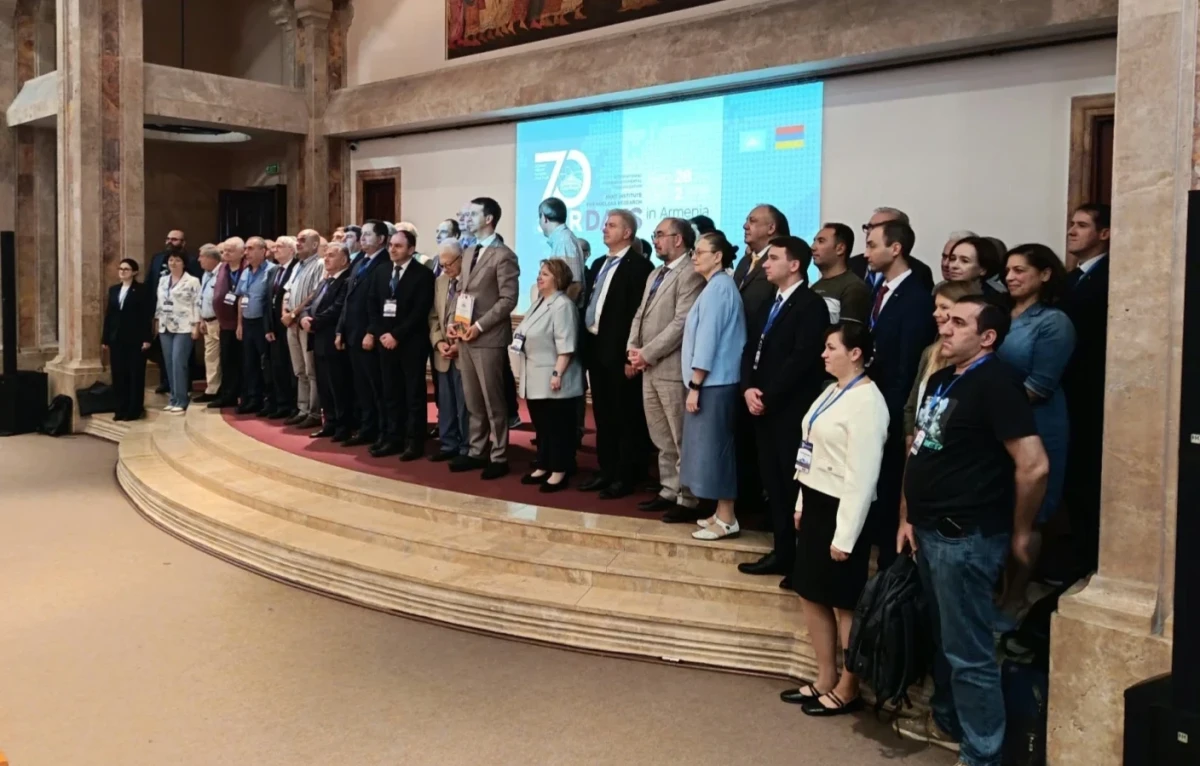
The Joint Institute for Nuclear Research (JINR) in Dubna and Armenia’s scientific organizations intend to expand their cooperation beyond the traditional fields of elementary particle physics and information technology. During the JINR Days being held in Armenia to mark the institute’s 70th anniversary, scientists discussed new areas for joint research, the training of young specialists, and the development of international scientific ties.
From particle physics to a broader range of sciences
JINR is an international intergovernmental scientific organization founded in 1956 and located in Dubna. Armenia is one of the institute’s member states, and cooperation between Armenian scientists and Dubna has continued for decades.
Armen Nersesyan, moderator of the JINR Days in Armenia, told NEWS.am Tech that in the past, contacts between Armenian scientific organizations and the institute were focused primarily on information technology and elementary particle physics. Now the range of shared interests has expanded significantly and already includes biology, chemical physics, materials science, and other fields.
That is why the organizers sought to make the JINR Days program broader than the traditional meetings of physicists. It includes not only Yerevan State University and the A. Alikhanyan National Science Laboratory, which have long cooperated with Dubna, but also specialists from the Institute of Molecular Biology, the Institute of Chemical Physics, the Institute of Physical Research, and the Institute of Physics and Electronics.
Special attention was given to the CANDLE Synchrotron Radiation Center. The idea was to bring together researchers who had previously had little contact with one another and to find points of intersection between their fields for joint projects.
“In this sense, the JINR Days in Armenia became not only an anniversary event, but also an attempt to broaden the circle of participants in the cooperation—from already established ties to new scientific fields,” Nersesyan said.
Armenian scientists have been participating in JINR projects for many years
JINR Director Grigory Trubnikov noted that the institute and Armenian scientific organizations have implemented several joint projects in recent years. In particular, a coordination committee for joint research is operating, and cooperation is developing both with Yerevan State University and with institutes of the National Academy of Sciences of Armenia.
As part of previous JINR events in Armenia in 2022 and 2023, the institute’s information center was opened. After that, several dozen students and postgraduates from Yerevan University and other Armenian organizations visited Dubna and JINR member states.
President of the National Academy of Sciences of Armenia Ashot Saghyan also stressed that ties with Dubna have a long history for Armenian science. According to him, since 1992 the National Academy of Sciences and JINR have regularly held international conferences and working meetings. Around 20 Armenian researchers defended their dissertations at the institute.
He called this contribution particularly important for Armenian science in the 1990s. During a difficult period for the country, JINR, according to Saghyan, helped preserve the professional environment and supported dozens of Armenian physicists.
The historical connection also continues through individual scientists. Among the best-known examples is Academician Yuri Oganessian, who has worked in Dubna for many years and made a significant contribution to the development of nuclear physics. He is also a foreign member of the National Academy of Sciences of Armenia.
Dubna is expanding its international scientific network
For JINR itself, the anniversary year has become an occasion not only to recall the institute’s history, but also to talk about its current scale.
According to Grigory Trubnikov, after the decline associated with the pandemic and subsequent geopolitical events, the number of JINR employees is growing again. The institute now employs about 5,350 people, including roughly 1,200 researchers, around a thousand of whom hold Candidate of Sciences or Doctor of Sciences degrees.
Over the past two to three years, the number of researchers and engineers has been increasing by about 100–150 people annually. At the same time, specialists from different regions of the world come to Dubna for internships, advanced training, and permanent work.
Trubnikov cited Vietnam as a separate example: over three years, the number of its representatives at the institute grew from 11 to 53. Participation is also increasing among specialists from China, India, and Latin American countries, including Brazil and Mexico. At the same time, European researchers continue to come to the institute as well.
For JINR member states, this international network provides an additional benefit: through the institute, they gain the opportunity to interact with researchers from other countries and participate in broader international projects.
JINR is also gradually expanding its own scientific specialization. Alongside high-energy physics, the institute is engaged in data science, information technology, and life sciences. According to the data cited by Trubnikov, the institute publishes about 1,500–1,600 scientific papers per year—comparable to CERN, despite a substantially smaller budget.
The next step: new projects and young researchers
The Armenian side expects that expanded cooperation will make it possible not only to launch new research, but also to increase the mobility of scientists and students.
Gevorg Karyan, Director of the A. Alikhanyan National Science Laboratory, noted that joint work already includes the participation of Armenian researchers in JINR projects, the exchange of scientific expertise, and the training of a new generation of specialists. According to him, further development of the partnership could give more opportunities to young scientists and students to take part in major international projects.
In this context, the link between the already existing competencies of the two sides is especially important. New areas—from biology and chemical physics to materials science and artificial intelligence—make it possible to unite research teams that previously had almost no cooperation with one another.
The topic of artificial intelligence became a separate part of the JINR Days program. At the round table, scientists and science organizers are also discussing the opportunities and challenges of AI in modern society.
For Armenian science, this is taking place against the backdrop of its own renewal of the scientific system. As Ashot Saghyan noted, after a long break, elections of associate and foreign members were held at the National Academy of Sciences, and 31 new associate members joined the academy. Among them are young researchers. According to the academy’s president, this renewal should contribute to the continuity of scientific traditions and the development of international cooperation.
Thus, the anniversary JINR Days in Armenia are devoted not only to the institute’s seventy-year history. Their task is to determine what the next part of that history may become. For Armenia, this means above all expanding the range of joint research and opportunities for young scientists, and for JINR, strengthening ties with the country’s scientific organizations and taking cooperation beyond its traditional areas.