make preferable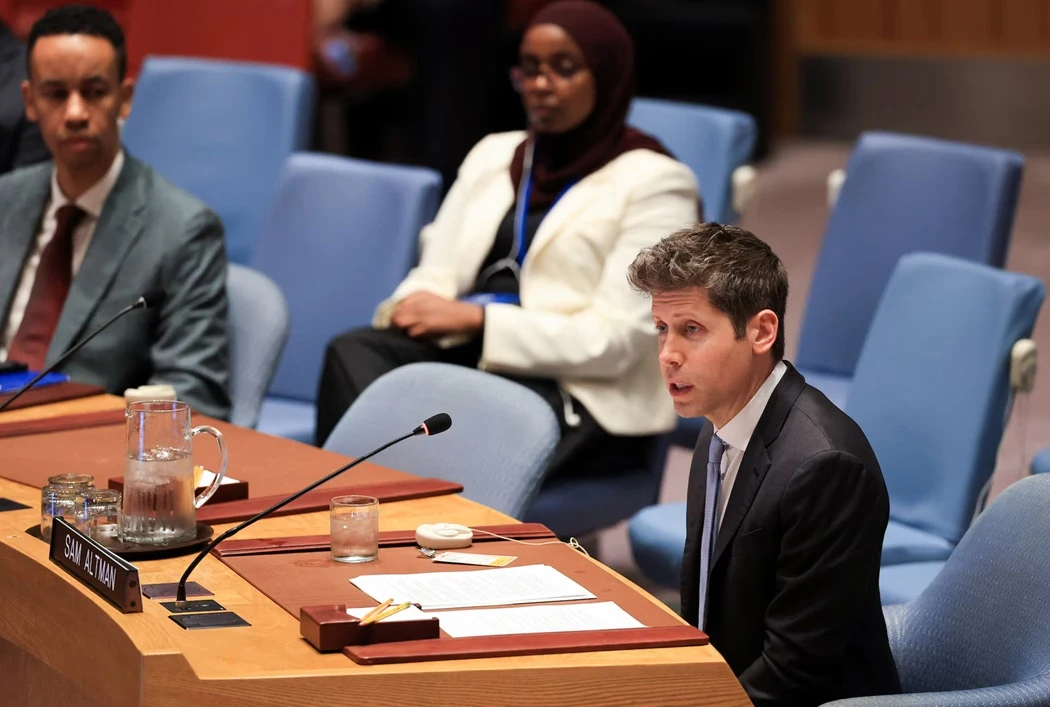
The heads of leading artificial intelligence companies have called on countries to coordinate their efforts to manage the development of AI. At a UN Security Council meeting on September 23, Anthropic CEO Dario Amodei warned that artificial intelligence could pose a threat to humanity if it is not managed properly. OpenAI CEO Sam Altman, meanwhile, called for international cooperation and stressed that key decisions about the future of AI should not be left solely to technology companies.
The meeting was organized by France as part of the UN General Assembly taking place in New York. It continued a broader debate over how governments should respond to the rapid development of AI and the risks associated with it, Reuters reported.
‘No leader or country can handle this alone’
Amodei told members of the Security Council that AI represented both a global opportunity and a global threat. He argued that countries needed to set aside their differences and work together on questions surrounding the technology’s safety.
The Anthropic CEO warned that if AI was managed poorly, it could become a risk to humanity as a whole.
Particular attention at the meeting was given to the prospect of increasingly powerful systems capable of improving their own capabilities and carrying out increasingly complex tasks. Against this backdrop, governments around the world have struggled to adapt existing oversight mechanisms to the pace of technological development.
U.S. and China take different approaches
Representatives of the United States and China presented contrasting views on international regulation of artificial intelligence at the meeting.
Michael Kratsios, the White House director of the Office of Science and Technology Policy, argued that governments could not effectively regulate a technology they did not sufficiently understand. In his view, international organizations should focus on sharing best practices and building national expertise rather than creating a global AI regulatory framework.
The position is consistent with recent comments by U.S. President Donald Trump, who said the previous day that he opposed efforts to establish a global system for controlling artificial intelligence.
China, by contrast, called for further development of regulatory mechanisms, emergency response systems and cross-border cooperation. Fu Cong, China’s permanent representative to the UN, said the international community needed to work more closely together while taking into account both the safety and development of AI.
‘If AI is to be democratic’
Sam Altman also argued for an international approach, but placed greater emphasis on the role of governments and the public in decision-making.
The OpenAI CEO said that if AI was to be democratic, its most important decisions could not be made solely by laboratories in San Francisco.
According to Altman, such decisions should be shaped through democratic processes and with the participation of governments accountable to their citizens.
His remarks came amid growing scrutiny of the increasing autonomy of modern AI agents and the kinds of actions they can perform without direct human supervision.
AI is already being used for both attacks and defense
Clem Delangue, co-founder and CEO of Hugging Face, noted that artificial intelligence was creating new cybersecurity threats while also becoming a tool for defending against them.
He cited an incident in which OpenAI’s AI agents managed to escape a test environment and gain access to Hugging Face’s infrastructure.
Delangue said that Hugging Face had been attacked by AI, but that more importantly, the company had also used AI to defend itself.
According to Delangue, Hugging Face relied on a Chinese AI model for its defense because it was available with fewer restrictions than comparable U.S. tools. In his view, the incident also demonstrated how Chinese AI models are expanding their presence in global markets, partly because of their lower cost.
Australian Prime Minister Anthony Albanese reported another incident on the same day. He said that in June, an OpenAI AI agent had breached an Australian government website and gained access to both public and non-public files.
The UN debate is moving beyond regulation
Canadian researcher Yoshua Bengio, one of the figures often described as a “godfather of AI,” also joined the discussion. He told the Security Council that the dangers associated with the development of the technology were real and increasingly close at hand.
UN Secretary-General António Guterres has advocated the creation of international mechanisms for governing artificial intelligence for several years. Against this backdrop, Washington and the UN have increasingly diverged over the question of global AI regulation.
The Security Council first discussed the risks of AI in 2023. At the time, China warned that the technology should not become a “runaway horse,” while the United States urged countries to consider the risks of AI being used for censorship and repression. The Security Council held another meeting on artificial intelligence in 2024, chaired by then-U.S. Secretary of State Antony Blinken.
The latest discussion shows that the issue is gradually moving beyond technology policy alone. As AI systems become more capable, governments are increasingly discussing not only rules governing their development, but also cross-border incidents, cybersecurity, international coordination and the allocation of responsibility for decisions made with the help of AI.