make preferable
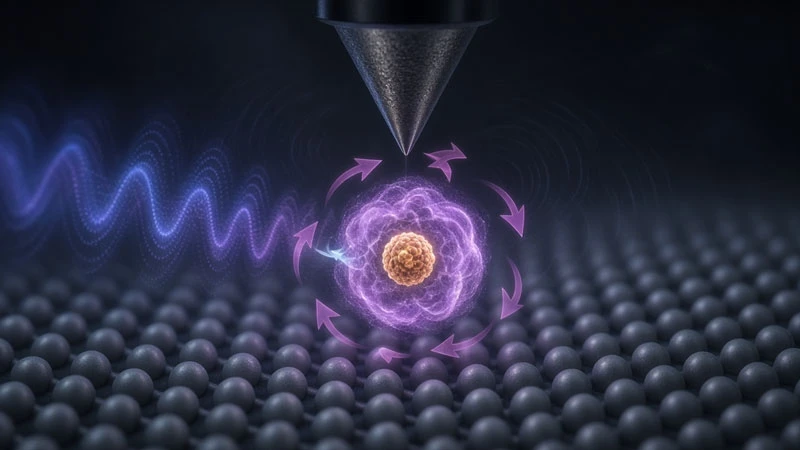
Researchers at Delft University of Technology in the Netherlands have demonstrated a way to directly change the magnetic state of the nucleus within a single atom. They used radio-frequency signals and a modified scanning tunneling microscope to do so. The result surprised even the scientists themselves: according to existing understanding, the electrical signals they applied should not have affected the nuclear spin. The discovery could help in the development of quantum memory, although the mechanism behind the observed effect remains a mystery.
The magnetic field inside an atom
The magnetic properties of atoms arise from a quantum property of particles known as spin. It is often compared to a tiny compass needle pointing in a particular direction.
Both electrons and atomic nuclei have spin. However, electrons make a much greater contribution to an atom's magnetic properties. Nuclear spin has a much weaker magnetic effect, but is better protected from external influences.
This very feature makes it interesting to quantum technology developers. Quantum information is sensitive to interactions with the environment: random disturbances can disrupt a system's state and cause data loss. Because nuclear spin is less susceptible to such influences, it could potentially serve as a more stable carrier of quantum information.
The team led by researcher Sander Otte at Delft University of Technology studies these properties using a specially modified scanning tunneling microscope. This instrument can deliver electrical signals to individual atoms with extremely high precision.
Previously, scientists mainly worked with electron spins, which are easier to detect and measure. Nuclear spin could be observed primarily indirectly, through the so-called hyperfine interaction, which links the magnetic states of the electron and the nucleus. Through this interaction, the two spins can become quantum-mechanically coupled, meaning their states become interdependent.
An unexpected response from the atomic nucleus
In the new study, lead author Hester Vennema and her colleagues took a different approach. They simultaneously applied two independent signals to a single atom: one acted on the electron spin, while the other was tuned to the nuclear spin.
This allowed them to investigate the behavior of the two parts of the system separately. Here, the scientists encountered something unexpected: even when the electron and nuclear spins were largely decoupled, the researchers could still change the orientation of the nuclear spin.
According to previous understanding, this result should not have been possible. The nucleus should not have responded to electrical signals from the scanning tunneling microscope.
“According to our simple understanding, this should not happen. The nuclear spin should not be sensitive to the electrical signals from the scanning tunneling microscope at all,” Otte noted.
The experiment thus revealed an unknown mechanism through which electrical signals interact with the magnetic state of an atomic nucleus. The scientists cannot yet fully explain how it works.
Controlling spins like tuning a musical instrument
To achieve this level of control, the researchers adapted the double magnetic resonance method, applying it to a single atom.
The method involves exposing a magnetic spin to a wave of a specific frequency. If the signal's frequency matches that of an allowed quantum transition, the spin's orientation can change. Different types of spin require different driving frequencies.
Vennema compares this process to playing a guitar: each string has its own note, and making a particular string vibrate requires the right frequency. Similarly, the scientists must tune the signal precisely to act on a specific spin.
In an atom, the frequencies associated with nuclear spin are approximately 100–1,000 times lower than those for electron spin. This allowed the researchers to tune two signals to control the magnetic states of the electron and the nucleus separately.
The experiment showed that this approach makes it possible to manipulate nuclear spin at the single-atom level—far more selectively than traditional measurements of the collective properties of matter.
A potential route to quantum memory
The discovery could prove important for the development of quantum computing and information storage systems. In conventional computers, data is represented by bits with values of either 0 or 1. Quantum systems use states governed by the laws of quantum mechanics, allowing information to be encoded in fundamentally different ways.
One of the main technical challenges facing these systems is preserving a quantum state long enough for information to be reliably written, stored, and read. External influences can destroy fragile quantum states, so researchers are looking for physical systems that are better isolated from their surroundings.
Nuclear spins are of interest precisely because of their relative resistance to external disturbances. Learning to control them directly and reliably could open up new ways to write and read quantum information.
However, practical quantum memory based on this technology is still a long way off. So far, the scientists have experimentally demonstrated the ability to control the nuclear spin of a single atom, but have not created a fully functional data storage system.
Moreover, the study's main finding has also become a new scientific puzzle: the physicists observed an effect they cannot explain within the previous model. As Otte noted, the researchers will now have to return to the theory and work out the underlying mechanism. Such unexpected results, he said, are exactly what drive science forward.
The findings were published in the journal Nature Communications.