make preferable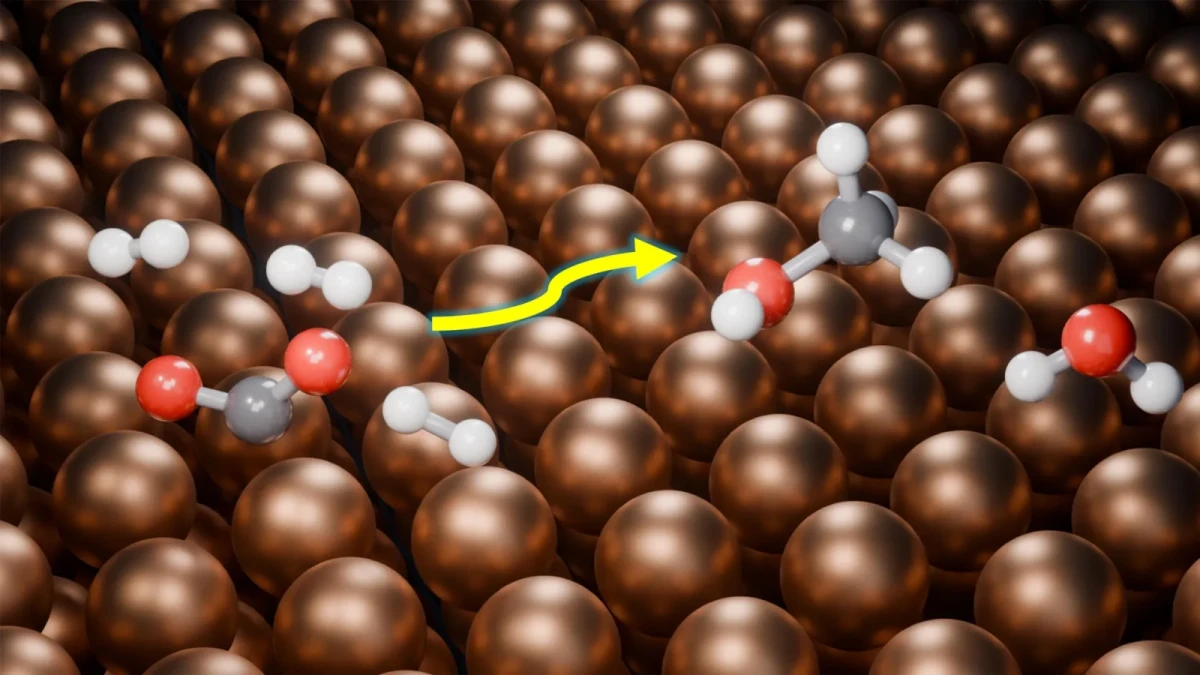
Researchers from the Indian Institute of Science (IISc) used machine learning to identify 9,389 chemical reactions that may occur on the surface of a copper catalyst during carbon dioxide conversion. Many of them were absent from earlier models, causing those models to incorrectly predict the reaction products and underestimate how much CO₂ could be converted.
The new model predicted about 40 times higher carbon dioxide conversion compared with the original one. In addition, the scientists uncovered an unusual mechanism of hydrogen participation that could help in the development of more efficient catalysts for producing methanol and other useful chemicals. The study results were published in Nature Communications.
Why chemical models miss important reactions
One promising way to process carbon dioxide is hydrogenation, in which CO₂ reacts with hydrogen in the presence of a catalyst. This can produce, for example, methanol, which is used as a chemical feedstock and a potential fuel.
However, numerous chemical transformations can occur simultaneously on the catalyst surface. Intermediate compounds form, change, and interact with one another, creating a complex reaction network.
Modeling every possible step using quantum mechanics requires enormous computational resources. As a result, scientists usually select a limited set of reactions they consider the most important. This approach simplifies the calculations but creates a risk of missing a reaction that determines the final outcome.
“How can we know that the very step decisive for the whole process has not been overlooked in the reaction network?” This is how the paper’s first author, Anand Mohan Verma, describes the problem researchers face. At the time of the work, he was a postdoctoral researcher at the Indian Institute of Science, and he now teaches at Motilal Nehru National Institute of Technology in Allahabad.
How AI expanded the network from 152 to 9,389 reactions
First, the scientists used quantum mechanical calculations to build a base set of 152 chemical reactions. They then trained machine learning models to quickly estimate energy barriers — the amount of energy required for a given transformation to proceed.
After that, the researchers applied automated computational tools to study possible reactions involving 105 chemical species on the catalyst surface. The algorithms helped determine which transformations could occur in a single step and expanded the original network to 9,389 reactions.
The difference proved fundamental. The model that included only the initial 152 reactions incorrectly predicted that formic acid, rather than methanol, would be the main product. It also significantly underestimated the extent of carbon dioxide conversion.
When the scientists included thousands of additional reactions, the calculations became much more consistent with experimental observations. The model began correctly identifying methanol and carbon monoxide as the main products of the process.
CO₂ conversion increased 40-fold in the calculations
After expanding the reaction network, the researchers built a model that accounts for the rates of individual chemical processes. It predicted roughly 40 times higher CO₂ conversion than the original model with a limited number of reactions.
This does not mean the scientists increased fuel yield by 40 times in a real reactor. The point is the difference between two computational models, one of which considered far more possible chemical pathways. The new calculations were closer to the experimental results, but they do not by themselves demonstrate a comparable improvement in an industrial setup.
The experimental validation was carried out by specialists from the Green Research and Development Centre of the Indian company Hindustan Petroleum, as well as scientists from Singapore’s Agency for Science, Technology and Research (A*STAR).
The work shows how strongly modeling accuracy depends on the completeness of the description of chemical processes. Even if individual reactions are calculated correctly, excluding many less obvious steps can lead to an incorrect prediction of the behavior of the entire system.
Hydrogen may participate in the reaction in an unexpected way
The expanded network revealed another feature: in some important reactions, hydrogen may be transferred to intermediate compounds as an intact H₂ molecule, without first splitting into separate atoms.
Additional quantum mechanical calculations confirmed that such a pathway may be energetically favorable, especially when hydrogen is transferred to oxygen-containing intermediate compounds.
This calls into question the common view of how hydrogen participates in similar catalytic processes. As the authors note, this unusual mechanism was identified precisely because the new model covered far more possible transformations.
The discovery may suggest how to create catalysts that interact more efficiently with molecular hydrogen. In theory, this could strengthen the chemical pathways that lead to methanol formation. However, it is first necessary to determine how strongly this mechanism affects the actual reaction rate and product yield in specific materials.
Where else this approach could be useful
The method combines several tools: quantum mechanical calculations, machine learning, automated search for possible reactions, and modeling of their rates. Thanks to this, scientists can investigate complex chemical systems without calculating every possible step using prohibitively expensive methods alone.
Besides converting CO₂ into useful substances, the approach could potentially be applied to other industrially important processes — for example, nitrogen reduction and water splitting.
For carbon conversion, this is especially interesting because catalyst efficiency depends not only on its composition but also on the many sequential reactions on the material’s surface. If a model misses some of these steps, it may lead to the wrong choice of promising materials or production conditions.
At the same time, converting carbon dioxide into fuel does not by itself guarantee lower emissions. To assess the environmental benefit, it is necessary to consider the source of hydrogen, the energy required for the process, and how much CO₂ is released during the subsequent use of the resulting fuel.
The main result of the study so far is not the creation of a new industrial catalyst, but the demonstration that AI helps uncover chemical pathways that traditional simplified models overlook. A more complete description of reactions may become an important tool for developing efficient technologies for producing fuel and chemical feedstocks from carbon dioxide.