make preferable
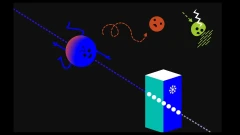
Physicists have discovered that light can spontaneously form regions with left- and right-handed rotation as it propagates through free space. This does not require special lenses, mirrors, or artificially created materials: it is enough to give the light beam a certain internal structure in advance. The discovery could help in developing more sensitive medical tests, optical communication systems, and quantum technologies.
The study was carried out by an international team led by scientists from the University of East Anglia in the United Kingdom together with colleagues from South Africa. The results were published in the journal Light: Science & Applications in the article Topological Control of Chirality and Spin with Structured Light.
How light can rotate without changing its direction of travel
Light has several properties related to rotation. One of them is an optical vortex: in such a light beam, the wave pattern twists around the direction of propagation, resembling a corkscrew. Another is spin, associated with polarization, that is, the nature of the oscillations of the electric field of the light wave.
The direction of rotation can be left- or right-handed. This property is called chirality. It is found not only in optics: for example, many molecules exist in two mirror-image forms that can interact differently with living organisms. That is why the ability to distinguish left- and right-handed chirality is important for chemistry, pharmacology, and biomedicine.
Previously, obtaining and controlling unusual rotational characteristics of light often required special optical components or carefully designed surfaces. The new work shows that under certain conditions, the desired behavior can arise directly during the propagation of a properly prepared beam.
“It initially has no spin at all,” explained master’s student Light Mhumbuza, who conducted the key experiments. According to him, as the beam moves forward, regions with rotation appear and separate—as if the spin was initially hidden and then revealed itself.
In other words, the researchers are not forcing light to rotate with the help of an external device. They define the initial structure of the beam, which determines where and how the rotational behavior will appear.
The mathematical structure that controls light
To explain the effect, the scientists turned to topology—a branch of mathematics that studies the properties of objects that remain unchanged under continuous stretching and deformation.
Researcher Isaac Nape from the University of the Witwatersrand in South Africa offered a vivid analogy: a mug and a doughnut can be represented as shapes with one hole. Their geometry can be continuously transformed into one another without tearing the surface. The presence of a hole in this case is a topological property.
Structured light also has topological characteristics embedded in the polarization distribution. This structure affects how different parts of the beam change during propagation, including the appearance of regions with left- and right-handed rotation.
According to Nape, topology gives scientists a new way to control light: by changing its initial structure, it is possible to tune exactly where chirality appears.
This does not mean that light begins to rotate completely arbitrarily or that scientists have discovered a new type of energy. Rather, it is about a previously underestimated connection between the internal geometry of a light beam and its behavior in space.
Why medicine and communication systems need this
One possible application of the discovery is more sensitive analysis of chemical and biological substances. Many molecules have left- and right-handed forms that can differ in their effects on the body. Controlled light could potentially make it possible to detect such differences more accurately, including in drug research and the search for biological markers of disease.
If the principle can be used in practical devices, it could help create compact optical sensors that would not require complex laboratory equipment.
Another area is data transmission. Light beams with different spatial and rotational characteristics can serve as additional ways of encoding information. This could potentially make it possible to increase the amount of data transmitted by a single beam and find new solutions for optical communication and quantum networks.
The researchers are also considering the possibility of using structured light to manipulate microscopic particles, cells, and molecules. Topological properties may also prove useful in quantum systems, where it is important to protect information from certain types of interference.
However, these are still possible directions for further research, not ready-made technologies. The discovery itself demonstrates a new way to control light, but its practical value will depend on whether the laboratory effect can be turned into reliable and economically viable devices.
Why this discovery matters
Light has been studied for centuries, and modern optical systems make it possible to create complex wave structures with high precision. Nevertheless, the study shows that some unusual effects can be achieved not through additional equipment, but through the proper organization of the light beam itself.
To do this, its internal structure must be configured in advance, after which rotational features arise as it propagates through free space. This approach adds another tool to the methods of controlling light and may simplify the creation of some optical devices.
As noted by the study’s lead researcher, Kane Forbes of the University of East Anglia, light turned out to be far more complex and richer in its properties than it seems at first glance. The unusual behavior demonstrated by the team did not emerge recently—scientists have only now learned how to detect and control it.