make preferable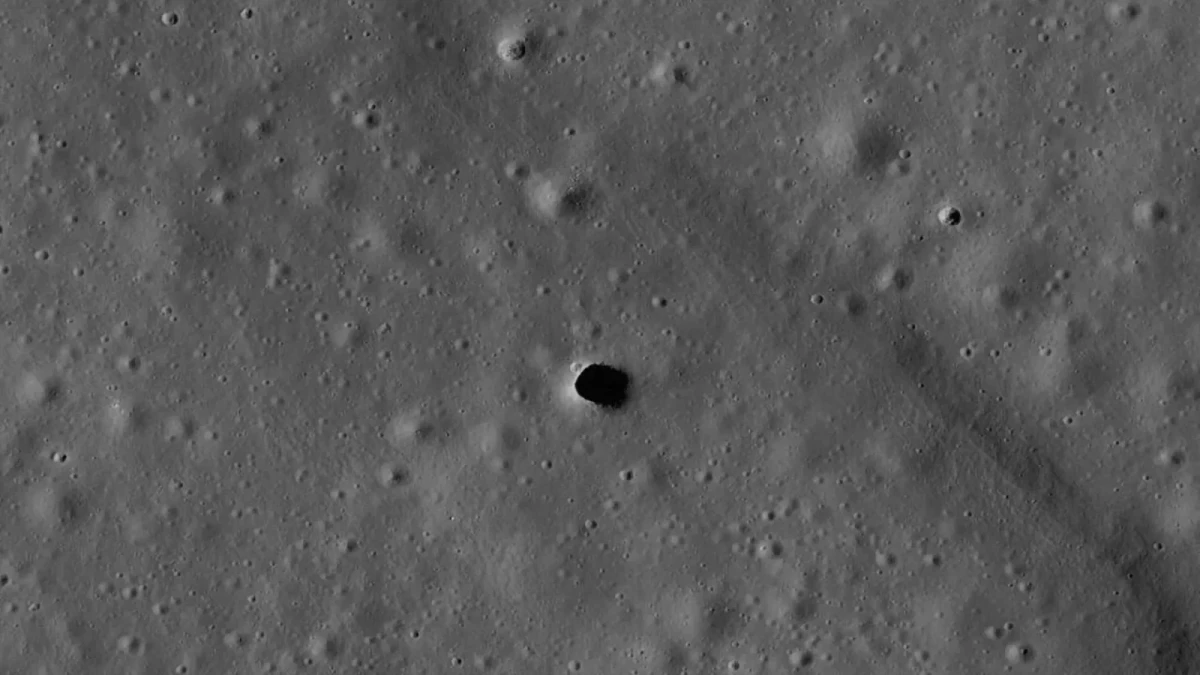
NASA has selected the GIMLI project, which is intended to determine whether a mysterious depression on the Moon leads to a huge underground cave or a lava tube. Scientists will study the Marius Hills area using ground-penetrating radar, seismic sensors, a gravimeter, and cameras. If an extensive cavity is indeed found beneath the surface, it will help reconstruct the history of the Moon’s volcanism and may one day serve as a natural shelter for astronauts.
The project is led by the Planetary Science Institute (PSI). It received support under NASA’s PRISM program, which sends scientific instruments to the Moon aboard landers provided by the agency’s commercial partners, according to Sciencedaily.com.
What lies beneath the Marius Hills pit
The Marius Hills Pit is located in one of the most volcanically diverse regions of the Moon. Similar collapses have already been found in different parts of the satellite. They may be entrances to underground structures formed by ancient volcanic activity.
On Earth, lava tubes form when flows of molten rock cool and harden on the outside while continuing to move inside. After the lava drains away, a hollow tunnel remains. Scientists believe similar structures could also have formed on the Moon.
Observations from orbit point to the possible existence of such cavities, but remote data do not allow scientists to determine with confidence how far they extend beneath the surface. GIMLI is expected to become the first mission to investigate a suspected lava tube directly on site.
Ground-penetrating radar and seismology will peer beneath the lunar soil
The scientific payload will include ground-penetrating radar, seismic sensors, and a gravimeter. Cameras will photograph the surface and the exposed walls of the pit.
Each instrument will provide its own type of data. Ground-penetrating radar will help identify structures beneath the soil, seismic measurements will be used to study rock properties and possible boundaries between them, and the gravimeter will detect mass distribution features that may indicate an underground cavity. Together, these methods will make it possible to assess whether a lava tube exists and how large it is.
Project leader Dan Putzig notes that active seismic investigations on other celestial bodies have scarcely been conducted since the first experiments by Apollo astronauts. In GIMLI, this method will be combined with ground-penetrating radar and gravity measurements.
Honeybee Robotics, a company owned by Blue Origin, will manufacture the instruments and part of the equipment. It will also handle integration of the scientific payload onto the lander and rover and will participate in managing the experiments after landing on the Moon. The ground-penetrating radar will be provided by the Norwegian Space Agency.
Even the absence of a cave would be a discovery
If researchers do not find an underground cavity, the mission will still help explain the origin of the pit and the geological history of the region.
The walls of Marius Hills expose layers of regolith and ancient lava flows that are usually hidden beneath the surface. Studying them will help scientists understand how lava moved across and beneath the Moon’s surface, as well as whether long periods of time separated individual eruptions.
According to the scientists, combining data on rocks and underground structures will help reconstruct the sequence of volcanic processes that shaped this part of the Moon.
Caves may prove useful for future astronauts
A possible lava tube is of interest not only as evidence of ancient volcanism. Underground spaces could protect against some of the hazards of the lunar environment — in particular, radiation and extreme temperature swings.
Conditions on the Moon’s surface are extremely harsh: temperatures vary dramatically, and there is no protection from cosmic radiation like that provided by Earth’s atmosphere. A natural cave could become a shelter for future expeditions and a potential site for placing infrastructure elements.
However, for now this is only a possible application. First, GIMLI must determine whether a sufficiently large and accessible cavity exists beneath the Marius Hills pit. Even if one is found, its suitability for human habitation will require separate study.
The mission’s main task is to understand what lies beneath the lunar surface. But the answer could prove important for two areas at once: reconstructing the Moon’s geological past and planning future crewed expeditions.