make preferable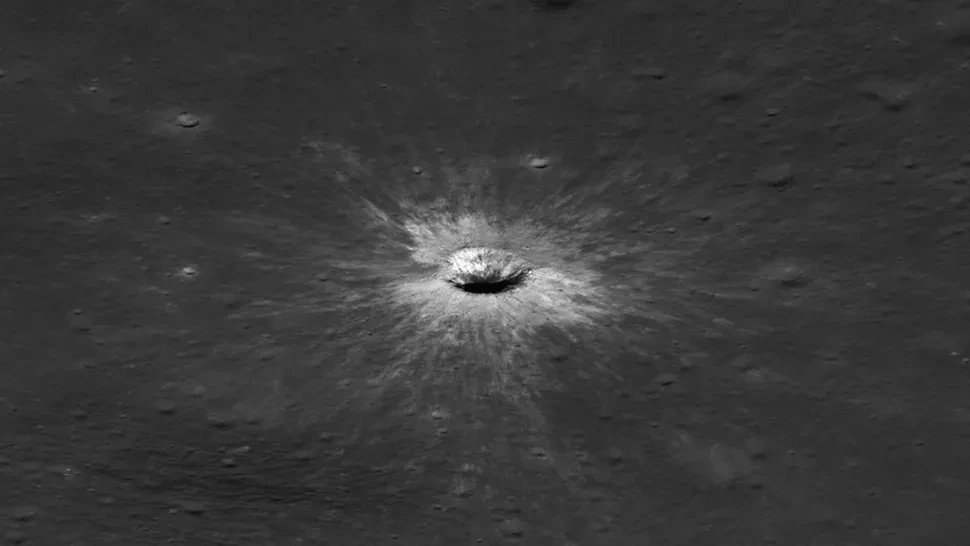
Scientists have discovered on the Moon the largest known crater to have formed very recently. The McGetchin crater appeared between April 11 and May 22, 2024, after an asteroid or a fragment of a comet struck the surface. It is about 222 meters in diameter and approximately 43 meters deep.
Such collisions on the Moon happen roughly once a century, which made the discovery especially valuable: NASA’s Lunar Reconnaissance Orbiter (LRO) managed to photograph this area before the impact and continued observing it afterward. Thanks to this, scientists had a rare opportunity to literally compare the Moon’s surface “before” and “after” the collision.
The results of two studies were published on September 16 in Science Advances.
Scientists saw a new crater appear on the Moon
The lunar surface is covered with a huge number of impact traces. But almost all of them formed millions or billions of years ago and have since been altered by new impacts and space weathering.
With McGetchin, the situation is completely different.
LRO has been observing the Moon for more than 17 years, so researchers have an archive of images of the same area of the surface. In 2025, while comparing images, scientists detected changes indicating a recent impact.
Follow-up images from the Lunar Reconnaissance Orbiter Camera (LROC) made it possible to examine the new crater itself and the material that was thrown out around it.
The size of the object that collided with the Moon is estimated to have been comparable to a three- or six-story building. On impact, it ejected a huge amount of lunar soil, forming a wide layer of debris around the crater.
But the consequences of the collision turned out to be far larger than the crater itself.
The impact scar stretched for several kilometers
Researchers found an extensive blanket of ejected material around McGetchin. An even broader area of changes was detected using another LRO instrument — the Diviner radiometer.
It recorded an area about 7 kilometers in diameter around the crater that becomes roughly 8–9 degrees colder than the surrounding surface during the lunar night.
The reason is related to the properties of lunar soil.
The powerful impact disturbed the upper layers of the regolith and made them less compact — looser and more “fluffy.” Such soil retains heat less effectively, so after lunar night falls, it cools more than the surrounding surface.
This means the collision changed not only the Moon’s relief, but also the physical properties of the soil over an area far exceeding the size of the crater itself.
Why the fresh crater is so important for science
Usually, scientists have to reconstruct the history of lunar crater formation from a surface that has already been heavily altered. McGetchin provides a much rarer opportunity: to observe the process practically from the very beginning.
Researchers can compare the state of the same area before the collision and shortly afterward, studying how much material is ejected on impact, how far it travels, and how the structure of the regolith changes.
This helps to better understand one of the fundamental processes that shaped the surface of the Moon and other airless bodies in the Solar System.
“McGetchin is unique because it is the largest recently formed impact crater discovered to date,” said Tyler Powell, the lead author of one of the studies.
According to him, a collision of this scale occurs on the Moon about once every hundred years, so scientists were exceptionally lucky that it happened while LRO was operating and that the spacecraft managed to observe this area both before and after the impact.
The crater could become a target for future expeditions
McGetchin is of interest not only to scientists working with satellite images. It is located on the boundary between two noticeably different types of lunar surface — dark basaltic maria and lighter highlands.
This makes it possible to study how the same impact affects different geological environments.
Observations directly from the surface would be especially valuable. A rover or astronauts could study the structure of the soil, the distribution of ejected material, and small changes in the surface that cannot be fully examined from orbit.
Such data would also be useful for the future exploration of the Moon. The more spacecraft, rovers, and landers are sent to the surface, the more important it becomes to understand how regolith is structured and how its properties change after impacts.
That is why the new crater is interesting not only as another trace of a cosmic collision. For scientists, it has effectively become a natural laboratory created on the Moon just a few years ago, where the consequences of an impact can be studied using unique images of the surface from before and after the event.