make preferable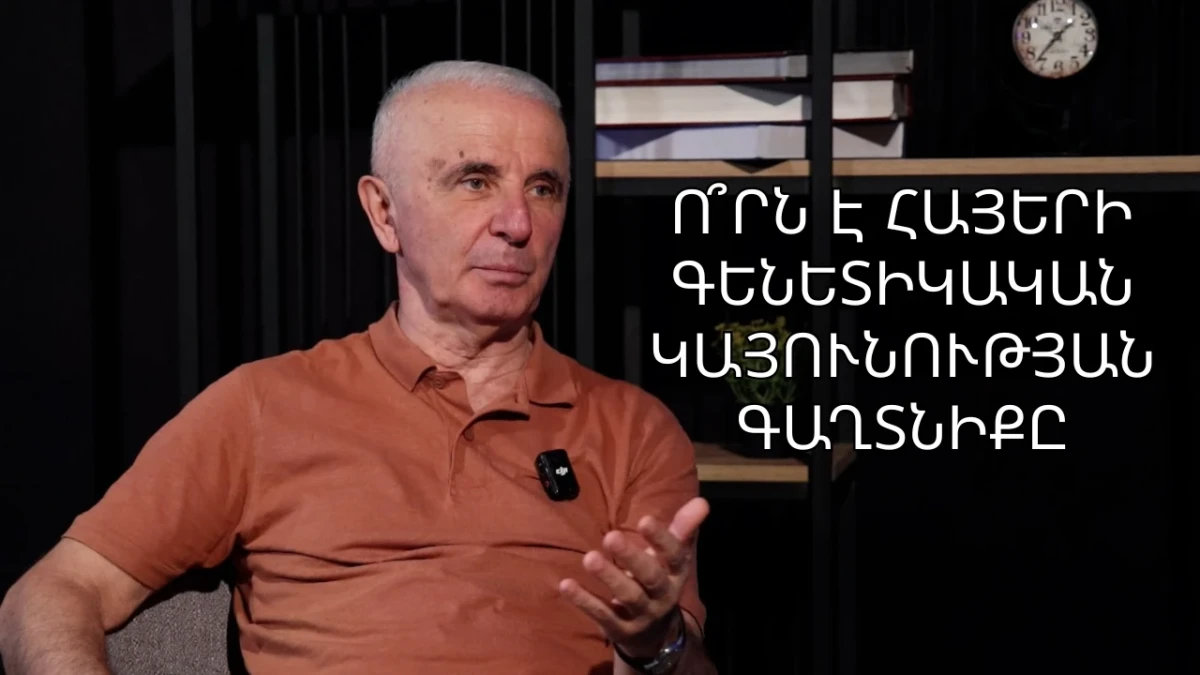
Over the past 8,000 years, the Armenian Highlands have passed through many historical eras. Cultures and civilizations succeeded one another here; kingdoms and empires arose and disappeared; borders, languages, and political systems changed. Yet genetic studies reveal a remarkable picture: despite all these historical upheavals, the genetic profile of the local population remained largely stable over the course of millennia.
How was this possible? What processes made it possible to preserve the genetic continuity of the population of the Armenian Highlands, and what can this feature tell us about its history? Levon Episkoposyan, head of the Laboratory of Evolutionary Genomics at the Institute of Molecular Biology, spoke about this and much more on the program “Did You Know?”.
The partner of this interview series on science and technology is Team Telecom Armenia.
The Armenian gene pool has been forming for at least 6–8 thousand years
Speaking about the genetic continuity of the population of the Armenian Highlands, Levon Episkoposyan emphasizes that this does not mean modern Armenians are the direct and unaltered descendants of every person who lived here 8,000 years ago. At the same time, studies do allow us to speak of significant genetic continuity.
According to him, around 6,000–8,000 years ago, people lived in the region whose genetic profile was in many respects close to that of modern Armenians. At the same time, the scientist clarifies an important detail: the figure of 8,000 years refers primarily to the maternal line — mitochondrial DNA.
“8,000 years of continuity means that the women who lived in this region over the last 8,000 years are our genetic, biological ancestors,” Episkoposyan notes.
At the same time, data from a larger-scale study conducted last year allow us to speak of at least 6,000 years of the formation of the Armenian gene pool in the full sense of the term. The analysis took into account mitochondrial DNA, the Y chromosome, and autosomal DNA — that is, the total genetic material of a person, including both maternal and paternal lines.
“We can speak of at least 6,000 years when it comes to the formation of the Armenian gene pool, both along the maternal and the paternal line,” the scientist says.
At the same time, Episkoposyan allows for the possibility that the maternal genetic roots of the region’s population may stretch even further into the past. According to him, researchers already have data that go beyond the 8,000-year mark, though it is still premature to disclose the results of those studies.
6 thousand years of genetic continuity and the formation of Armenian identity
According to Episkoposyan, especially important is the fact that the estimate of 6,000 years has a certain parallel with the history of the Armenian language. He notes that, according to the chronology he considers, the Armenian language branched off from the Indo-European language tree about 5,000 years ago.
The scientist links these two processes — genetic and linguistic distinctiveness — with the gradual formation of a separate population. “A people begins to form and develop from the moment it begins to differentiate itself,” Episkoposyan explains. According to him, genetic isolation means that marital ties are formed primarily within a certain territory. A similar process happens with language: under conditions of relative isolation, a distinct linguistic system gradually takes shape, which over time becomes a national language.
At the same time, this does not mean that some kind of “Armenian genes” appeared, the scientist emphasizes. Rather, it is about mutations that arise in a population and accumulate over time. If a population remains relatively isolated from others for a long period, the characteristic combination of such genetic changes becomes increasingly specific to it.
Episkoposyan compares this process to the formation of a dialect: changes that occur in one place and do not spread to other territories gradually create differences in language. In genetics, something similar happens, but combinations of genetic variants have a much lower probability of recurring by chance in another population. It is precisely the accumulation of many such features that, according to the scientist, ultimately forms a population’s characteristic genetic profile and makes it possible to distinguish it from the profiles of other peoples.
What happened to the Armenian gene pool 6 thousand years ago
Why, given such a long history of the Armenian population, did genetic continuity prove to be so resilient? Episkoposyan admits that there is still no exhaustive answer to this question, but ancient DNA is gradually helping reconstruct the picture.
According to him, samples obtained from Bronze Age burials are especially valuable. Starting roughly from this period, archaeologists have significantly more material at their disposal, making it possible to trace changes in the genetic composition of the population over millennia.
Studies show that a certain genetic influence from outside did occur. According to the scientist, a noticeable change is recorded roughly between 6,000 and 4,000 years ago, during the Late Bronze Age. The analysis shows that the group that arrived in the region had a Middle Eastern origin.
Episkoposyan links this to possible large-scale natural disasters that occurred in the Middle East during that period. On the suggestion of geologists, he considers the hypothesis of a powerful earthquake that may have been accompanied by a tsunami and caused the displacement of a significant mass of population.
At the same time, the scientist emphasizes that this version still needs more convincing confirmation. Additional ancient DNA samples are needed for definitive proof, which would make it possible to directly trace the origin of this group.
Why subsequent conquests hardly changed the gene pool
Much harder, according to Episkoposyan, is explaining another fact: why after that, over the course of roughly four thousand years, no large-scale changes in the Armenian gene pool practically occurred, despite numerous migrations and conquests.
This concerns the periods of the Iron Age and antiquity, and then later invasions and the presence of various peoples and states in the region. Arabs were present on the territory of Armenia, Persian influence continued, and about a thousand years ago Turkic-speaking tribes began to penetrate the area. However, as the scientist notes, these processes did not leave a corresponding large-scale trace in the modern Armenian gene pool.
Episkoposyan explains this primarily by the scale of genetic exchange. According to him, a noticeable trace appears in the gene pool when contacts between populations become mass in character. Isolated cases — whether marriages, violence, or other forms of contact between populations — are not in themselves capable of significantly changing the genetic profile of a large population group.
He also gives a historical example: after conquests, marriages between representatives of different elites were often used as a way to soften political confrontation. Such a practice existed in different states and societies, including in relations between the Russian nobility and representatives of the Tatar-Mongol elite. However, such marriages primarily affected a narrow social stratum and did not mean mass mixing of the population.
National identity is a key factor in preserving genetic continuity
In Episkoposyan’s view, similar logic also applies to Armenia. Even if individual cases of genetic mixing did occur, their scale was insufficient to significantly alter the overall gene pool.
Episkoposyan gives an example from stories told by his grandmother, which, according to him, he also discussed with ethnographers. She was born in Garman, where there was a large Azerbaijani population around, and she spoke about cases in which Armenian women became victims of violence.
“If a woman, a girl, was raped and became pregnant, she had two options. Either she had to terminate the pregnancy, or, if she had to give birth, she had to leave the village and give birth in the city.”
According to the scientist, this had direct significance for whether the father’s genetic material would enter subsequent generations of the Armenian community.
“Giving birth in the city meant that she had to become part of the Azerbaijani environment,” he noted.
As a result, Episkoposyan explains, the child, even if carrying certain genetic traits of the father, did not necessarily become part of the Armenian population.
“A child who was born and carried some Turkish genetic traces did not grow up in the Armenian community, did not receive an Armenian first name, did not receive an Armenian surname. He did not continue this line, he made no contribution to the Armenian gene pool,” he noted.
It is precisely this mechanism, according to the scientist, that helps explain why individual cases of genetic mixing in themselves did not lead to a significant change in the overall genetic profile of Armenians. Ultimately, the scientist believes, one of the key factors in preserving genetic continuity was national identity: belonging to the Armenian community determined in what environment a person continued to live, whether a child was raised within that community, and whether that child became part of subsequent generations of the Armenian population.
That is why, according to him, individual cases of the appearance of foreign genetic material did not necessarily become part of the reproducing gene pool of the entire population.
The research base cited by Episkoposyan today includes tens of thousands of Armenian genetic samples. In his own laboratory, about 7,000 samples have been studied, and together with data from commercial genealogical platforms and other studies, he says the total now comes to roughly 30,000–40,000 samples, including data on the Y chromosome, mitochondrial DNA, and the overall genetic profile.
At the same time, the scientist adds that it would be wrong to speak of a complete absence of external genetic influence. By his estimate, the share of foreign influence in the Armenian gene pool is about 0.5%.