make preferable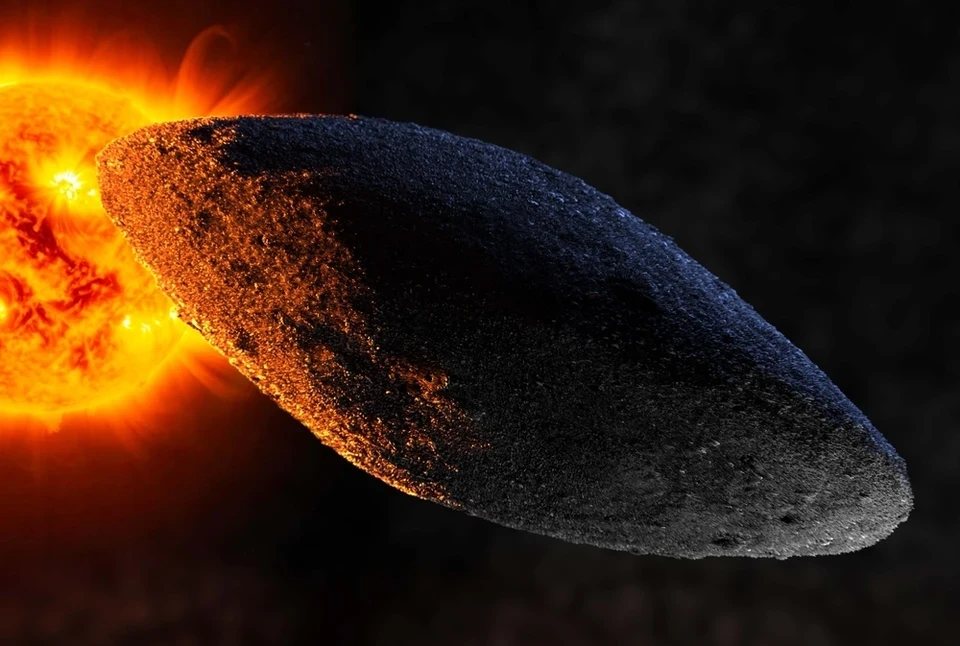
Interstellar comet 3I/ATLAS, the third known object to arrive in the Solar System from beyond its borders, likely formed in an extremely cold region of its home star system. This is suggested by the unusually high nitrogen content in its tail: according to astronomers’ estimates, the temperature at the comet’s birthplace was below −240 °C.
What was found in the comet’s tail
Astronomers were able to study the chemical composition of 3I/ATLAS using the William Herschel Telescope in the Canary Islands and its WEAVE spectrograph. The instrument makes it possible to carry out spectroscopy — analyzing light by wavelength and identifying the chemical elements present from their characteristic spectral lines.
Previous observations of 3I/ATLAS had mainly focused on the coma — the envelope of gas that forms around a comet when solar heat causes its ice to evaporate. But as it approaches the Sun, another important region for observation appears — the tail.
The solar wind is a stream of high-energy particles. When they collide with molecules of the comet’s material, they knock electrons out of them and turn the molecules into charged particles — ions. Determining the composition of these ions can provide information about the comet’s chemistry that cannot always be obtained from observations of its coma.
This turned out to be especially important for 3I/ATLAS. In 2019, astronomers had already detected ions in the tail of another interstellar object — comet 2I/Borisov — but at the time they were unable to reliably determine exactly which particles they were.
WEAVE, which has been operating since 2023, proved sensitive enough to carry out such an analysis for 3I/ATLAS. Observations made in late 2025 allowed researchers to identify ions of nitrogen, carbon dioxide, and carbon monoxide in the comet’s tail.
There turned out to be an unusually large amount of nitrogen
Of particular interest was the ratio of nitrogen to carbon monoxide. It can serve as a kind of clue about the temperature and conditions in which the comet formed.
The higher the proportion of nitrogen relative to carbon monoxide, the colder the object’s birthplace generally was. In 3I/ATLAS, this ratio is significantly higher than in most studied comets of the Solar System.
Based on these data, the team led by Lea Ferellec of Northumbria University estimated the temperature in the comet’s formation region to be below −240 °C.
This means that 3I/ATLAS most likely originated in the outer regions of its home star system — so far from its star that its light had almost no effect on the surrounding environment.
A window into an alien planetary system
The exact origin of 3I/ATLAS remains unknown for now. However, its chemical composition offers a rare opportunity to glimpse the conditions that existed in another star system.
Comets preserve the material from which planetary systems formed. Therefore, studying their composition makes it possible to reconstruct at least part of the conditions that existed in the distant past.
For 3I/ATLAS, this is especially valuable: unlike comets of the Solar System, it formed around another star, then left its system and, after an immense span of time, ended up near the Sun.
“This object gives us a rare opportunity to study material that formed in a completely different planetary system,” Ferellec said. In her words, each such object helps us better understand how planets form around other stars.
The team’s study was published on September 7 in the journal Monthly Notices of the Royal Astronomical Society.