make preferable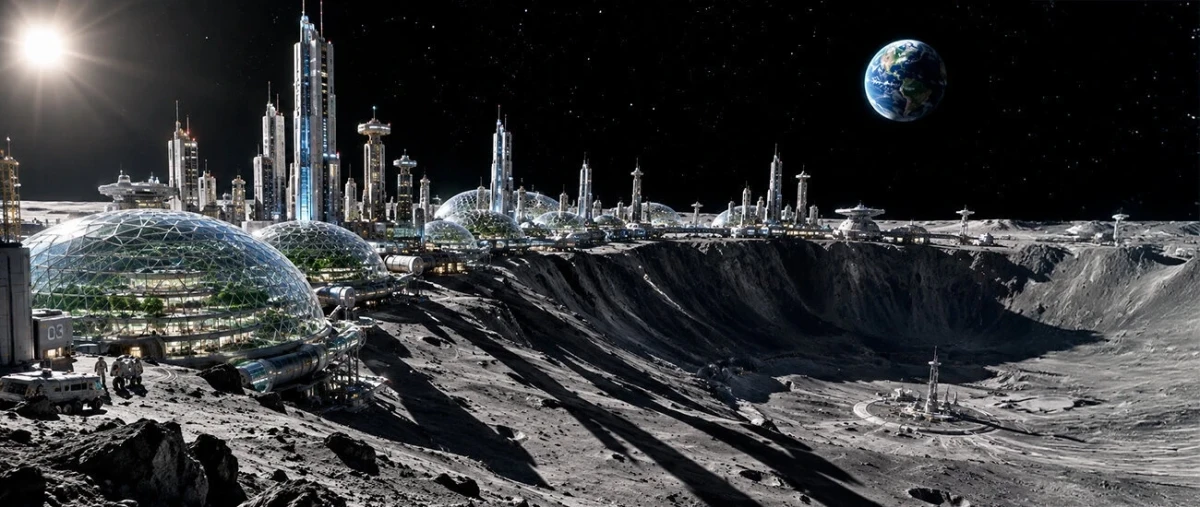
Water ice reserves on the Moon may prove insufficient for establishing large-scale permanent settlements. Astrophysicist Martin Elvis of the Harvard-Smithsonian Center for Astrophysics calculated how long the available water would last for a city with a population of one million. The result is clear: without new water sources or a radical reduction in consumption, a lunar megacity would not survive for long.
The study was published in the journal Frontiers. It addresses one of the main constraints on a future lunar colony: even if problems with energy and the production of necessary materials are solved, people will still need water — and not just for drinking.
Water on the Moon is needed for more than just drinking
Interest in permanent settlements on the Moon is largely tied to the discovery of water ice in polar craters. Their floors have remained out of direct sunlight for billions of years, so temperatures in these regions can drop to around 110 kelvin — about −163 °C.
Such areas are called cold traps. Under these conditions, ice can remain preserved with virtually no evaporation even in the lunar vacuum.
For future settlers, water will be a far more valuable resource than merely a source of drinking water. It can be processed to obtain oxygen for breathing and hydrogen for fuel. That is why the presence of accessible ice is considered one of the key conditions for the long-term development of the Moon.
There may be fewer problems with energy
At the same time, future lunar settlements may potentially be in a more favorable position when it comes to electricity.
On the rims of polar craters, there are areas that are illuminated by the Sun most of the time. They are called peaks of eternal light. In theory, tall structures with solar panels could be installed there, allowing energy to be generated almost continuously.
According to researchers, such a system could provide up to several gigawatts of power. The materials needed to manufacture solar panels could also be sourced directly on the Moon — silicon, in particular, is abundant there.
That amount of energy would make it possible to support not only the basic needs of a settlement, but also energy-intensive industries. In theory, the Moon could even host data centers for running artificial intelligence systems.
However, energy alone does not solve the main problem.
Water reserves may last only a few years
Elvis examined a scenario in which up to one billion tons of water are available on the Moon. Even such an enormous amount at first glance would not be enough for a city of one million people if the water is not recycled with high efficiency.
Current estimates of lunar reserves may also be significantly lower than earlier calculations. If those estimates are used as a guide, even a relatively small city would face water shortages in about ten years.
For long-term survival, the scale would have to be much smaller. A settlement of about 1,000 people or a small city with a population of around 10,000 could theoretically expect to exist for several centuries.
Thus, the problem lies not so much in the absolute quantity of ice as in how much water can actually be extracted and how many times the same resource can be reused.
Without new water sources, a lunar city will not survive
The scientist considers several ways to solve the problem. One of them is to significantly improve the efficiency of water recycling — by at least a factor of five. In addition, consumption could be reduced with the help of vertical farms and other systems that allow food to be grown in closed environments with water reuse.
Another option is to transport water from near-Earth asteroids. However, such logistics would require enormous resources and постоянных космических перевозок.
Elvis considers a third path the most promising — finding more water on the Moon itself than can currently be detected.
Today, spacecraft are studying only the upper layers of the lunar regolith. At the same time, this loose soil may extend tens of meters deep, while the layers below remain much less well studied.
Therefore, existing estimates may reflect only part of the actual reserves. If additional ice deposits are indeed found in deeper layers, the situation for future settlements will change substantially.
That is why the first practical step toward creating a large permanent base on the Moon may be not building a city, but searching for new water sources. Without them, even vast energy reserves and advanced industry will not make it possible to turn a lunar settlement into a truly autonomous city.