make preferable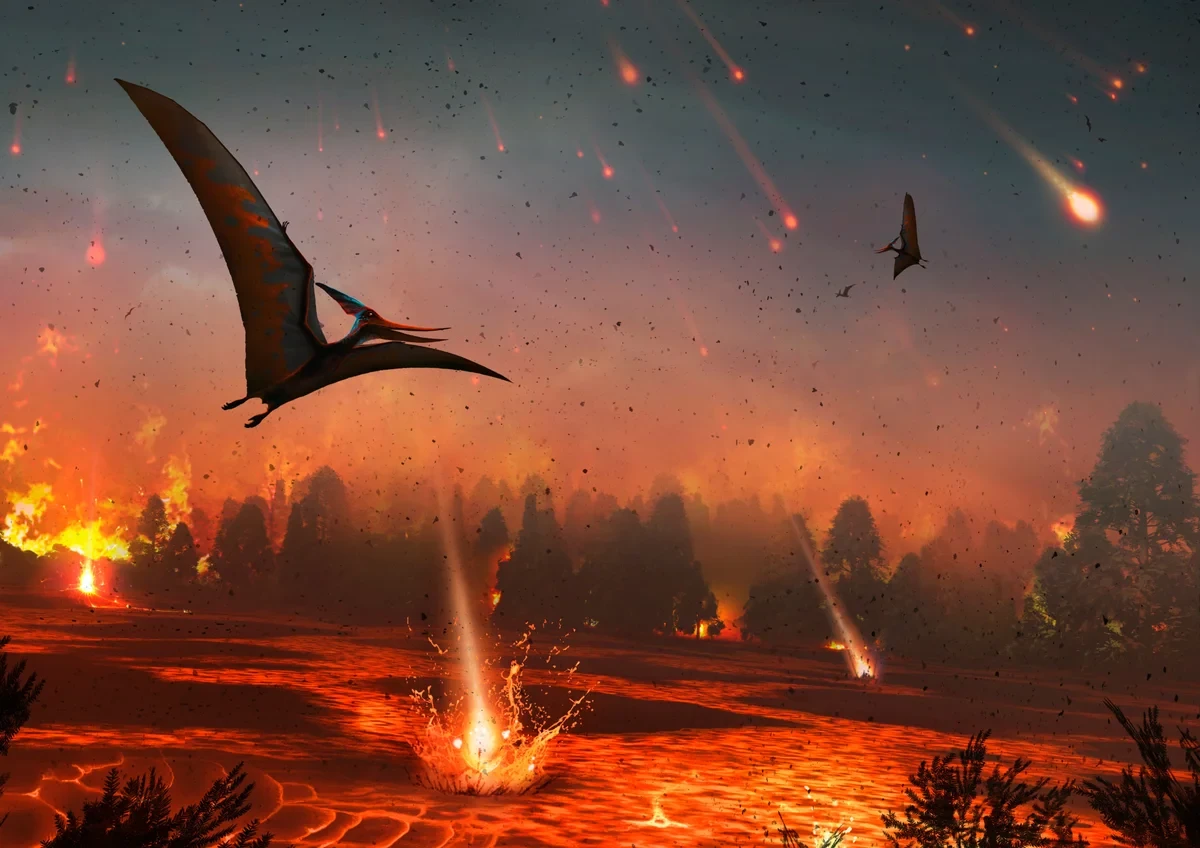
A feather preserved in a coprolite about 66 million years old helped scientists explain why some ancient birds survived the mass extinction at the boundary between the Cretaceous and Paleogene periods, while others disappeared. The study suggests that a key advantage may have been more advanced plumage, capable of retaining heat more effectively during the cooling that followed the asteroid impact.
The work was published in the journal Current Biology.
Feathers in a “time capsule”
The find was studied by scientists from the Field Museum in Chicago together with colleagues from other research institutions. Inside one coprolite — fossilized droppings of an ancient animal — they discovered several feathers, as well as tiny fish scales and bones from the leg of a bird from the hesperornithiform group.
The exceptional value of the find came precisely from the preservation of the feathers. Soft tissues usually decay and very rarely survive to the present day in fossil form. In this case, the coprolite acted like a kind of “time capsule,” preserving details that might have disappeared in ordinary sediments.
Scientists used computed tomography to obtain three-dimensional images of the feathers and examine their structure in extremely high detail.
This information made it possible to compare the structure of ancient plumage with the feathers of later birds and to suggest what role its features may have played in survival after the catastrophe.
An “impact winter” followed the asteroid
About 66 million years ago, the asteroid impact marked the beginning of global changes that led to the mass extinction of dinosaurs and most bird groups that existed at the time.
The impact itself was only the beginning of a chain of consequences. An enormous amount of material was thrown into the atmosphere, sharply reducing the amount of sunlight and causing prolonged cooling — the so-called “impact winter.”
For animals capable of maintaining a constant body temperature, this meant a serious challenge. With a lack of sunlight and falling temperatures, the ability to retain already generated heat became especially important.
It is here, the study authors suggest, that the ancestors of modern birds may have gained an advantage.
More advanced plumage may have been an advantage
In birds belonging to the ancestors of modern true birds, plumage may have provided more effective thermal insulation. This allowed them to better maintain body temperature under conditions of sharp cooling and limited resources.
Other groups of ancient birds, including hesperornithiforms and enantiornithines, had more primitive feathers. According to the researchers, their insulating properties may have been insufficient to survive the extreme period after the asteroid impact.
Thus, feathers may have been a survival factor not only because they helped birds fly. Their ability to retain heat may have been one of the advantages that allowed the ancestors of modern birds to survive a global climate catastrophe.
Why the coprolite itself matters
Fossilized droppings have long been used by paleontologists as a source of information about ancient animals. They can preserve food remains — bones, scales, and other fragments — that help reconstruct the diet and lifestyle of extinct species.
But in this case, the coprolite proved valuable not only for that reason, but also because of the preserved feathers. Studying them makes it possible to see features of soft tissues that are practically absent from the ordinary fossil record.
The find also adds another detail to the picture of the mass extinction 66 million years ago. The asteroid impact itself caused the catastrophe, but growing evidence indicates that the prolonged cooling that followed played an important role in the fate of the ecosystems that survived the initial blow.
If the researchers’ hypothesis is correct, one of the advantages of the birds-to-be was something that today seems like a completely ordinary trait: feathers helped them retain heat when the world around them, after the asteroid impact, suddenly became a much colder place.