make preferable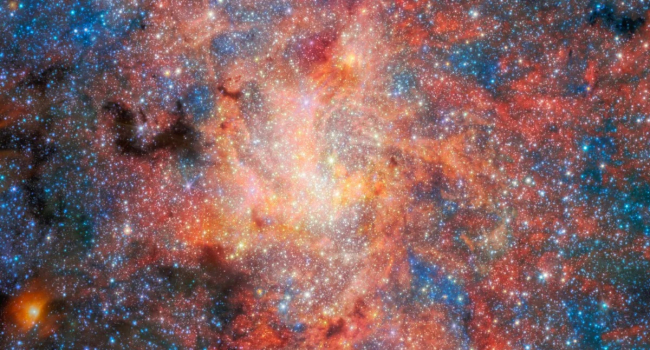
The James Webb Space Telescope has detected water and cosmic dust around an aging star just 0.55 light‑years from Sagittarius A*—the supermassive black hole at the centre of our galaxy. The discovery shows that even in such extreme conditions, molecules and dust can persist.
What the scientists found
Using the MIRI instrument, researchers studied the star IRS 3—one of the brightest mid‑infrared sources in the galactic centre. It is an asymptotic giant branch (AGB) star: in its late evolutionary stage, it is actively shedding gas and dust through powerful stellar winds, returning material to the surrounding environment.
The environment around Sagittarius A* (the black hole has a mass of about 4 million Suns) is extremely harsh, with a high density of stars and intense radiation. Previously, it was thought that under such conditions, molecules and fresh dust would be rapidly destroyed.
However, Webb's observations showed the opposite. By combining the star's spectrum with radiation‑transfer modelling, the scientists reconstructed the structure of its envelope. A layered shell of silicate dust was found around IRS 3, extending about 10,000 astronomical units. The temperature within it drops from roughly 927 °C near the star to minus 173 °C in the outer layers. In addition, clear signs of water were detected for this star for the first time.
Why this matters
"Galactic centres are among the most extreme environments, so it is important to understand whether stars can continue to enrich their surroundings there as well. With Webb, we are directly seeing how stars behave in such conditions and confirming that dust production remains remarkably resilient," noted lead author Florian Peißker from the University of Cologne.
"The detection of water is particularly interesting because it shows that molecular material can survive in an environment dominated by intense radiation," added co‑author Macarena García Marín, an astronomer at the European Space Agency.
Water and dust are key components in the chemistry accompanying star and planet formation. Material shed by aging stars such as IRS 3 could potentially participate in the birth of future generations of stars and planetary systems, even in the vicinity of a supermassive black hole.
The study was published on 11 August in the journal Astronomy & Astrophysics.
In brief
The James Webb Space Telescope has detected water and silicate dust around the star IRS 3, just 0.55 light‑years from the supermassive black hole at the centre of the Milky Way. This shows that molecules and dust can survive even in the extremely harsh conditions of the galactic centre. The discovery helps to understand how aging stars continue to enrich the material in the vicinity of supermassive black holes. The work was published in the journal Astronomy & Astrophysics.