make preferable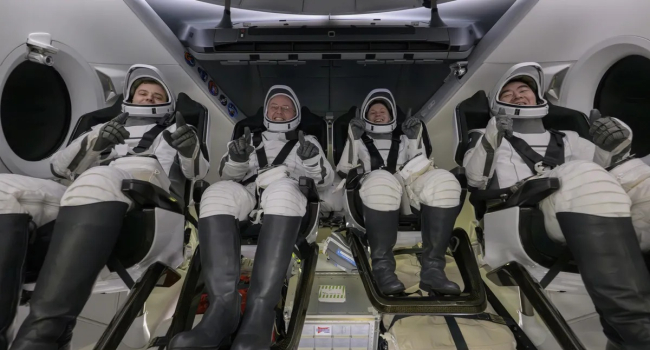
On January 15, 2026, at 03:41 Eastern Time in the United States, which corresponds to 10:41 GMT, the SpaceX Crew Dragon spacecraft carrying the Crew 11 mission safely splashed down in the Pacific Ocean off the coast of San Diego. This marked the first medical evacuation in the history of the International Space Station, as all four astronauts returned to Earth almost a month earlier than planned.
Brief mission history
Crew 11 consisted of NASA astronauts Mike Fincke and Zena Cardman, Japanese astronaut Kimiya Yui, and Russian cosmonaut Oleg Platonov. They launched to the ISS on August 1, 2025, with an initial plan to spend about six months in orbit. However, on January 7 NASA announced the cancellation of a planned spacewalk by Fincke and Cardman due to a medical issue affecting one of the crew members. The following day, the agency confirmed that the mission would be terminated early.
NASA Administrator Jared Isaacman explained at a press conference on January 8 that this was not considered an emergency descent, even though such scenarios are always planned for and regularly practiced. He added that the ISS does not have the necessary equipment for full diagnosis and treatment, and that the ability to properly diagnose and manage the condition in question was not available aboard the station.
NASA did not disclose the name of the affected astronaut or the details of the diagnosis, citing medical confidentiality. Chief Medical Officer James Polk clarified that the situation was not related to any technical malfunction or injury sustained during operations. He stated that it was primarily a medical issue that became more complicated under the conditions of microgravity and limited diagnostic equipment.
First medical evacuation in 25 years
The ISS has been continuously inhabited since November 2000. In a quarter of a century, this is the first time a mission has been cut short for medical reasons. Polk noted that statistical models had predicted that such incidents could occur approximately once every three years.
Crew 11 spent 167 days in space, including 165 days aboard the station. For Cardman and Platonov this was their first spaceflight, for Yui it was his second, and for Fincke his fourth. Fincke’s total time in space has now reached 549 days, while Yui’s stands at 309 days.
After splashdown, Commander Zena Cardman expressed that it was wonderful to be home and conveyed deep gratitude to all the teams who made the journey to space and back possible.
Skeleton crew on the station
After the departure of Crew 11, only three people remained aboard the ISS: NASA astronaut Christopher Williams and Russian cosmonauts Sergey Kud Sverchkov and Sergey Mikaev, who had arrived on a Soyuz spacecraft on November 27. Williams temporarily became the only representative of the United States on the American segment of the station.
NASA Deputy Administrator Amit Kshatriya assured that the situation was fully under control. He said that Williams was trained to handle all necessary tasks on the station and emphasized that most operations are primarily managed from the ground, where thousands of specialists support the crew. He also noted that the Russian cosmonauts could assist if required.
Operating the ISS with a three person crew is not unprecedented. Until 2009, the station functioned routinely with crews of that size.
Crew 12, which is scheduled to replace Crew 11, is currently planned for launch in mid February, although NASA is considering the possibility of moving the launch to an earlier date. The exact duration of the skeleton crew period is still unknown, but it is expected to last about a month.
In brief
Crew 11 returned to Earth on January 15, 2026, marking the first medical evacuation in the history of the ISS. The reason was a medical condition affecting one of the astronauts that required proper diagnosis on Earth. The mission lasted 167 days instead of the originally planned six months. After their departure, three people remained on the station, including one American astronaut. NASA stressed that the situation is stable, the crew can cope with all tasks, and operations are continuously supported from the ground. This event is unprecedented but was considered statistically inevitable over the 25 year history of the station.