make preferable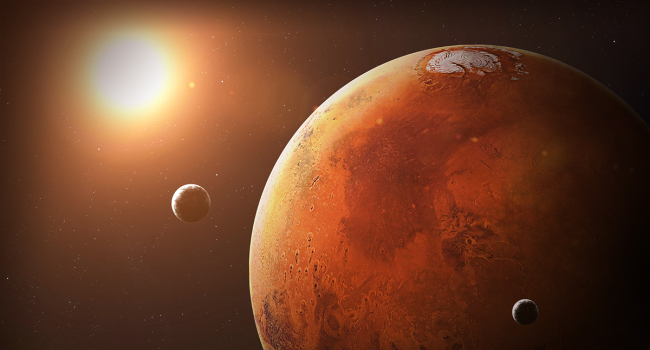
Mars, which is ten times lighter than Earth and about half its diameter, has a much stronger influence on our planet’s climate than previously thought. An international team of scientists led by Stephen Kane from the University of California, Riverside, conducted computer simulations and showed that the gravity of the Red Planet directly participates in shaping long-term climate cycles, including ice ages. The study was published in the journal Publications of the Astronomical Society of the Pacific (PASP).
Milankovitch cycles and the role of Mars
Earth’s climate over millions of years is determined by Milankovitch cycles, which are changes in orbital parameters and axial tilt that affect how sunlight is distributed across the planet’s surface. These variations trigger and end ice ages.
One of the main cycles lasts about 430,000 years and is connected to changes in the shape of Earth’s orbit, from nearly circular to more elongated. It is formed mainly by the gravitational influence of Venus and Jupiter and remains present in models even without Mars.
However, two other important cycles, with periods of about 100,000 years and 2.3 million years, completely disappear from simulations if Mars is excluded. Stephen Kane explained that when Mars is removed from the calculations, these cycles vanish entirely, and when the mass of Mars is increased, the cycles become shorter because its gravitational influence grows stronger.
An even more unexpected effect is that Mars stabilizes Earth’s axial tilt, which is currently about 23.5 degrees. In the models, increasing the mass of Mars slows down the rate of change of the axial tilt, making the planet less prone to abrupt climatic fluctuations.
Why this matters
Earth has experienced at least five major ice ages over its 4.5-billion-year history. The most recent one began about 2.6 million years ago and continues to this day. The stability of the axial tilt and the regular rhythm of climate cycles have allowed life to develop under relatively predictable conditions.
The discovery shows that even comparatively small planets in other star systems can subtly shape the climatic stability of potentially habitable worlds. This is an important factor in the search for Earth-like exoplanets.
In brief
Despite its small mass, Mars plays a key role in forming two of Earth’s main climate cycles, those lasting about 100,000 years and 2.3 million years, and also stabilizes Earth’s axial tilt. Without Mars, these cycles disappear from climate models and the axial tilt becomes unstable. The research by Stephen Kane and his colleagues demonstrates that the gravity of Mars is an essential factor in Earth’s long-term climatic stability. This discovery changes our understanding of how neighboring planets influence each other and is important for the search for habitable worlds in other planetary systems.