make preferable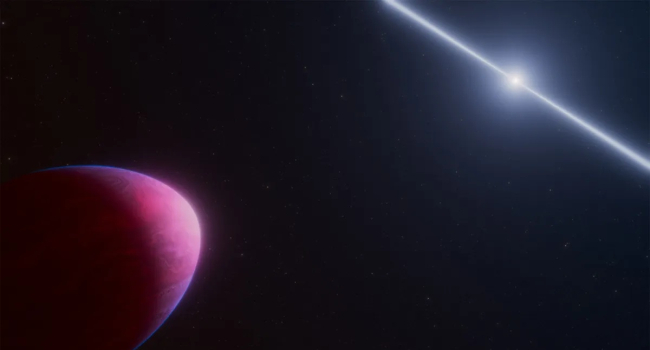
The James Webb Space Telescope has discovered one of the strangest exoplanets ever observed — PSR J2322-2650b. The planet has a lemon or rugby-ball shape, an atmosphere made almost entirely of helium and molecular carbon, and likely experiences diamond rain. Scientists admit they currently cannot explain how such a planet could have formed.
A Planet Orbiting a Black Widow Pulsar
PSR J2322-2650b orbits a millisecond pulsar, a rapidly spinning neutron star only about 20 kilometers across but with a mass one to two times that of the Sun. The planet completes an orbit in just eight hours at a distance of about 1.6 million kilometers. The pulsar emits intense gamma radiation but very little infrared light, allowing JWST to study the planet in detail without interference from its host star.
The planet is tidally locked. One side always faces the pulsar, reaching temperatures up to 2040 degrees Celsius, while the opposite side faces space at around 650 degrees Celsius. The pulsar’s gravity has stretched the planet into an elongated ellipsoid, giving it its distinctive lemon-like shape.
An Atmosphere Like No Other
Analysis shows that the atmosphere is dominated by helium and molecular carbon in the form of C2 and C3. There is no water, methane, or carbon dioxide, which are commonly found in other exoplanet atmospheres. Out of roughly 150 studied planetary atmospheres, this one is unique.
This is a new type of planetary atmosphere that no one has seen before, said lead researcher Michael Zhang of the University of Chicago. Instead of expected molecules like water, methane, and carbon dioxide, we found molecular carbon.
On the intensely heated dayside, carbon condenses into soot. As material moves to the cooler nightside, it can crystallize into diamonds, which then fall inward as diamond rain.
Where Did Such a Planet Come From
Did this form like a normal planet? No, the composition is completely different. Was it created by stripping the outer layers of a companion star, as in typical black widow systems? Probably not, because nuclear physics does not produce pure carbon, Zhang explained.
The only working hypothesis is that carbon crystallized deep inside a former stellar companion and rose to the surface, mixing with helium. However, what prevented oxygen and nitrogen from appearing in the atmosphere remains a mystery.
It is nice not to know everything. I am really looking forward to learning more about this strange atmosphere. It is great to have a mystery to solve, added Roger Romani of Stanford University.
In Brief
JWST has discovered the exoplanet PSR J2322-2650b orbiting a pulsar. It has a lemon-like shape, an atmosphere composed of helium and carbon, and likely experiences diamond rain. Its composition does not fit any known formation model, making it an entirely new type of planet and an exciting mystery for astronomers to unravel.