make preferable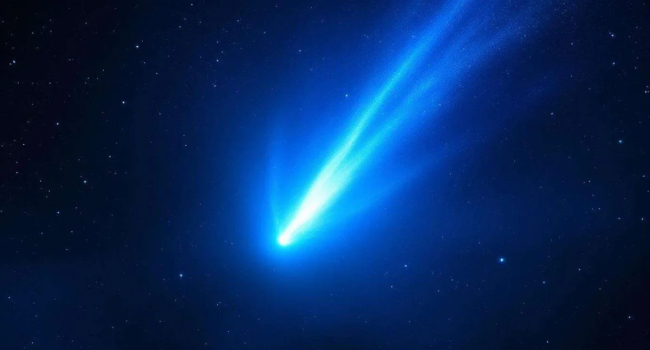
The interstellar comet 3I/ATLAS, the third confirmed object to arrive from beyond the Solar System, continues to surprise astronomers. Discovered on 1 July 2025 by the Chilean ATLAS system, it has already passed perihelion on 27 October and is now moving away, but before leaving it will make an unexpected “visit” to Jupiter. The Laboratory of Solar Astronomy of the Space Research Institute of the Russian Academy of Sciences reported that on 16 March 2026 the comet will pass only 53.4 million kilometers from the gas giant. This will be its last close encounter with the planets of our system.
Trajectory of the comet: from Earth to Jupiter and farther into space
Trajectory calculations based on data from 230 observatories, including NASA’s JPL Horizons, show that 3I/ATLAS is moving along a hyperbolic orbit at about 60 km per second. On 19 December 2025 it will pass Earth at a distance of 269 million kilometers, or 1.8 astronomical units, which is five times the distance from Earth to the Sun. Its approach to Jupiter will be much closer, 0.357 astronomical units or 53.4 million kilometers, at approximately 15:00 Moscow time.
This encounter will be a “farewell moment.” The gravity of Jupiter will slightly adjust the comet’s path but will not capture it. After March 2026, 3I/ATLAS will leave the inner part of the Solar System, cross Neptune’s orbit only in 2028, and head toward the constellation Gemini. Its trajectory is unusual because, according to probability theory, intersections with the outer planets Saturn, Uranus, and Neptune were considered extremely unlikely. The comet passed them at distances greater than a billion kilometers.
Non-gravitational acceleration caused by cometary activity, such as dust and gas release, has already influenced its trajectory. The coma of the object, with a diameter of about 24 kilometers, is ejecting up to 66 kilograms of dust per second, making it one of the most active among interstellar visitors.
Observation opportunities: the role of the Juno and Juice missions
The approach to Jupiter offers a valuable opportunity for spacecraft. NASA’s Juno probe, orbiting the planet, may capture the comet in March 2026. Its spectrometers and cameras are ideal for composition analysis. However, due to low fuel reserves and issues with its engine, reorientation of Juno is unlikely. The mission was originally planned to conclude in 2025–2026, but this event could extend it.
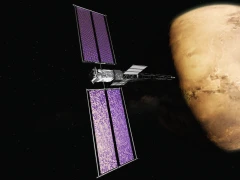
The European spacecraft Juice, the Jupiter Icy Moons Explorer, observed 3I/ATLAS in October and November 2025, but the data, due to use of its antenna as a thermal shield, will only arrive in February 2026. The optimal window for Juice is from 9 to 22 March, when its distance to the comet will be minimal. Earlier, missions near Mars, such as MRO and Tianwen-1, had already provided data that improved trajectory accuracy tenfold.
Scientific value: from the comet’s age to speculation
3I/ATLAS is an ancient visitor. Computer models estimate its age at 7.5 billion years, about three billion older than the Sun. This makes it a valuable sample for studying the formation of stellar systems. The passage near Jupiter will help measure the effect of gravity on an interstellar object and test hypotheses about its origin, possibly from the Scutum–Centaurus Arm of the Milky Way.
The event has also fueled speculation. Professor Avi Loeb of Harvard has suggested an artificial origin due to the comet’s precise passage through Jupiter’s Hill sphere, the region of gravitational influence with a radius of about 53.5 million kilometers. NASA and the Space Research Institute of the Russian Academy of Sciences insist that it is a natural comet and that its non-gravitational acceleration is simply the result of outgassing.
Summary
On 16 March 2026 comet 3I/ATLAS will pass 53.4 million kilometers from Jupiter. This will be its last encounter with the planets of the Solar System before heading into interstellar space, crossing Neptune’s orbit in 2028. The uniqueness of its trajectory and the observation opportunities for Juno and Juice make this a key scientific event. An object ancient as the Universe itself will provide new data on interstellar visitors and may dispel speculation about a “spaceship.”